 MineArchive
Coal Dust
| Also known as | Dust Explosion (Gresley's term for an explosion of coal dust mixed with a small percentage of firedamp.), Mine Dust (Scottish) |
|---|---|
| Category | Ground Conditions & Hazards |
Finely powdered coal lying on the floor, timbers and roadways of a pit and suspended in its air: explosive when raised into a cloud by a blast or a flame, and the cause of the lung disease that took far more lives than the explosions.
Historical usage
Gresley's glossary of 1883 already states the matter plainly: coal dust, very finely powdered dust suspended in the air-currents of mines, is capable of extending and aggravating an explosion of firedamp, and when mixed with even less than one per cent of that gas gives an explosive mixture under certain conditions; a dust explosion he defines as an explosion of coal dust mixed with a small percentage of firedamp. By then it had been argued over for forty years. Michael Faraday and Charles Lyell, investigating the Haswell explosion of 1844 for the government, concluded that coal dust had carried the blast, and their conclusion was set aside. Through the rest of the century the inspectors and the colliery engineers fought over whether dust alone could explode, while the great explosions of the dry, dusty steam-coal pits went on, among them the Senghenydd disaster of 1913, which killed more than four hundred men.
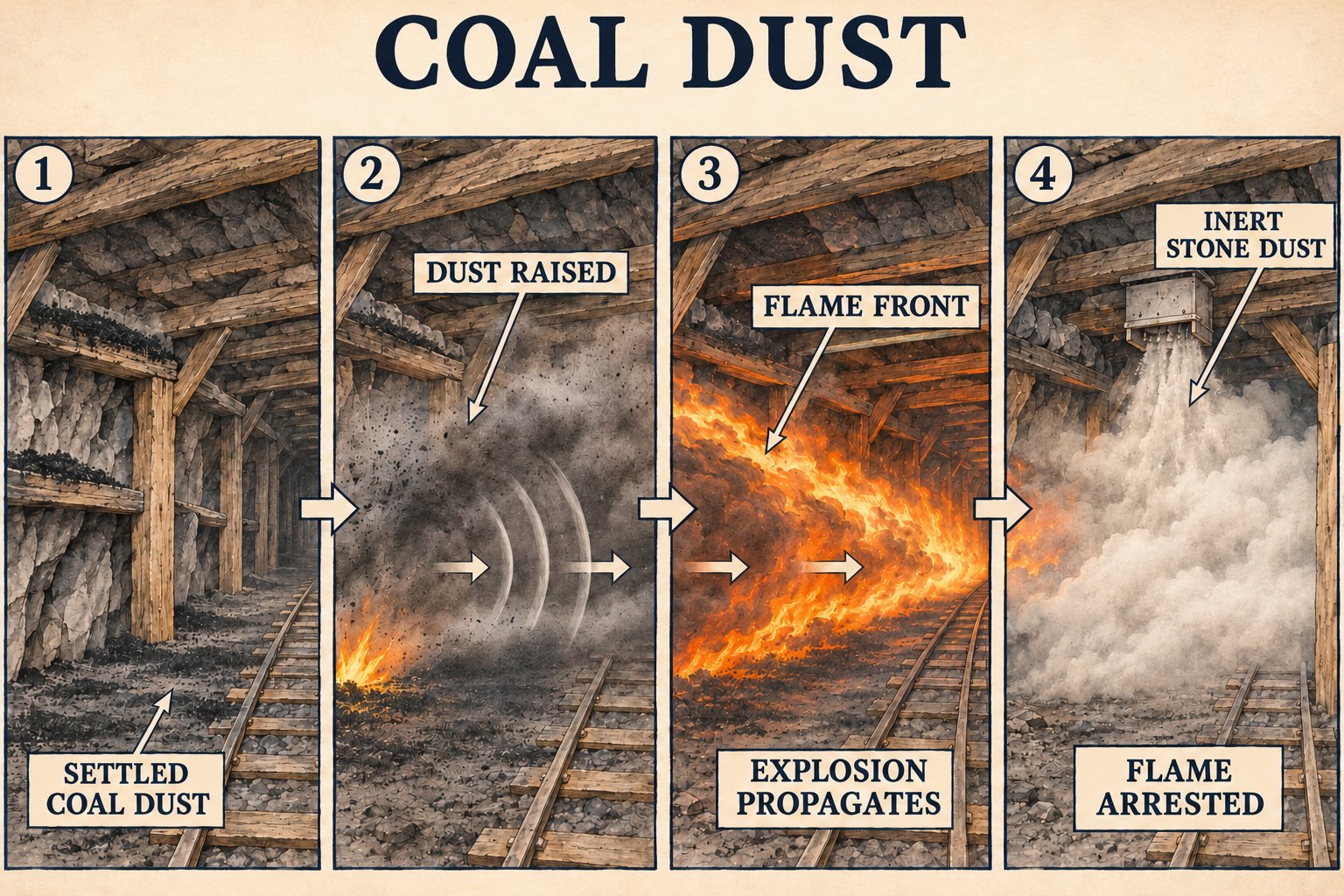
The answer was stone dusting: diluting the coal dust on the roadways with inert limestone dust, spread by hand and later piled on stone dust barriers in the roof that an explosion would bring down in a cloud to stop its own propagation. The stone duster was a job in its own right, and the dust suppression officer a later one. The other harm was slower. Dust of less than five microns passes into the lungs, and coal workers' pneumoconiosis, the black lung, affected a large part of every generation of miners who worked in it.
How it worked
Lump coal burns slowly; dust has far more surface for its weight and, once raised into a cloud, burns fast enough to explode. A firedamp ignition at the face, or a blown-out shot, raises the dust from the floor and timbers with its shock wave, the flame behind the wave ignites it, and the explosion feeds itself along every dusty roadway in the pit, far beyond where any gas was. That is why a small ignition could travel miles, and why the deaths in the great explosions were so often in roadways nowhere near the first flame. Stone dust stops it because an inert cloud absorbs the heat and starves the flame; watering the roadways and efficient ventilation do the same work less reliably.
Why it was used
Coal dust is nowhere used; it is a condition of the pit, made by every pick, shot, cutter and conveyor transfer point, and worst in the dry pits working hard, dry steam coal. The term matters because recognising it changed the law: the Coal Mines Act of 1911 and the regulations under it required dust to be dealt with, stone dusting became general, and the explosions of the kind that had killed hundreds at a time largely ended in Britain after the 1930s.
Risks & limitations
Two hazards, one acute and one chronic. The explosion hazard is described above and needed firedamp or a flame to start it, so it travels with every other source of ignition in a pit. The inhalation hazard needed nothing but years: pneumoconiosis and chronic obstructive disease were the price of the mechanised face in particular, because cutters and conveyors make far more fine dust than the hand pick did. Dust suppression, sprays at machines and transfer points, and the dust sampling and examination of the later pits were the answer, and a partial one.
Regional variation
A general term; Barrowman's Scottish glossary refers the reader to mine dust. The practice words vary: stone dust, stone dusting, the stone duster who spread it, the bats of stone dust or water hung in the roof as a barrier, and the dust suppression officer of the nationalised pits.
Related terminology
Afterdamp, Coal Workers' Pneumoconiosis, Firedamp, Safety Lamp, Shot-firing, Stone Dusting
Mines associated with this term
5 examples chosen from 26 linked records — the term page is not an index.
- Park Slip Colliery — Bridgend (well documented example)
Named in this record’s history: “…26 August 1892 an explosion of firedamp, its violence multiplied by coal dust, tore through the workings, killing 112 of the men and boys…” - Pretoria Pit (Hulton Colliery Bank Pit) — Greater Manchester (well documented example)
Named twice in this record, first in the summary: “…yards. On the morning of 21 December 1910 an explosion of gas and coal dust killed 344 men and boys — the worst mining accident in Lancashire’s…” - Six Bells Colliery — Blaenau Gwent (well documented example)
Named 3 times in this record, first in the summary: “…when 45 of the 48 men in one district were killed by a firedamp and coal dust explosion — the worst British colliery disaster since the war.” - Albion Colliery — Rhondda Cynon Taf (well documented example)
Named in this record’s summary: “…worked until 1966. It is overwhelmingly notable for the firedamp and coal-dust explosion of 23 June 1894, which killed 290 men and boys — the…” - Allerton Bywater Colliery — West Yorkshire (well documented example)
Named in this record’s geology: “…Firedamp accumulated in those workings in explosive proportions, and coal dust in the district worsened what followed.”
Disasters associated with this term
5 examples chosen from 75 linked records, most direct relationship first.
- Albion Colliery explosion, 1894 (contextual relationship)
Named twice in this record, first in the summary: “A firedamp and coal-dust explosion tore through Albion Colliery on 23 June 1894, killing 290…” - Allerton Bywater Colliery explosion, 1930 (contextual relationship)
Named twice in this record, first in the summary: “…had gathered in explosive proportions. The explosion, worsened by coal dust, killed five men and a pit pony. The inquest found no negligence,…” - Altofts Colliery explosion, 1886 (contextual relationship)
Named 4 times in this record, first in the summary: “…little stone but threw a great deal of flame into a roadway where coal dust lay everywhere. Recovery took ten weeks of careful work, the inquest…” - Apedale Colliery Sladderhill No. 3 Pit explosion, 1891 (contextual relationship)
Named 3 times in this record, first in the summary: “…gas in the Bullhurst seam of the Sladderhill No. 3 Pit, Apedale, and coal dust carried the explosion through the district. Eleven died, most of…” - Benwell Colliery explosion, 1907 (contextual relationship)
Named twice in this record, first in the cause: “Firedamp and coal dust ignited by a safety lamp whose gauze had slipped out, turning it…”
Sources
- (primary) A Glossary of Terms Used in Coal Mining, by William S. Gresley, 1883 — Internet Archive
- (primary) Glossary of Scotch Mining Terms — James Barrowman (1886), via Scottish Mining Website
- (secondary) Coal dust — Wikipedia
- (secondary) Glossary of mining terms (S) — North Staffordshire Miners Group
- (secondary) Pit Terminology — Healey Hero
Record created: 6 October 2026 · Last researched: 6 November 2026