 MineArchive
Allerton Bywater Colliery explosion, 1930
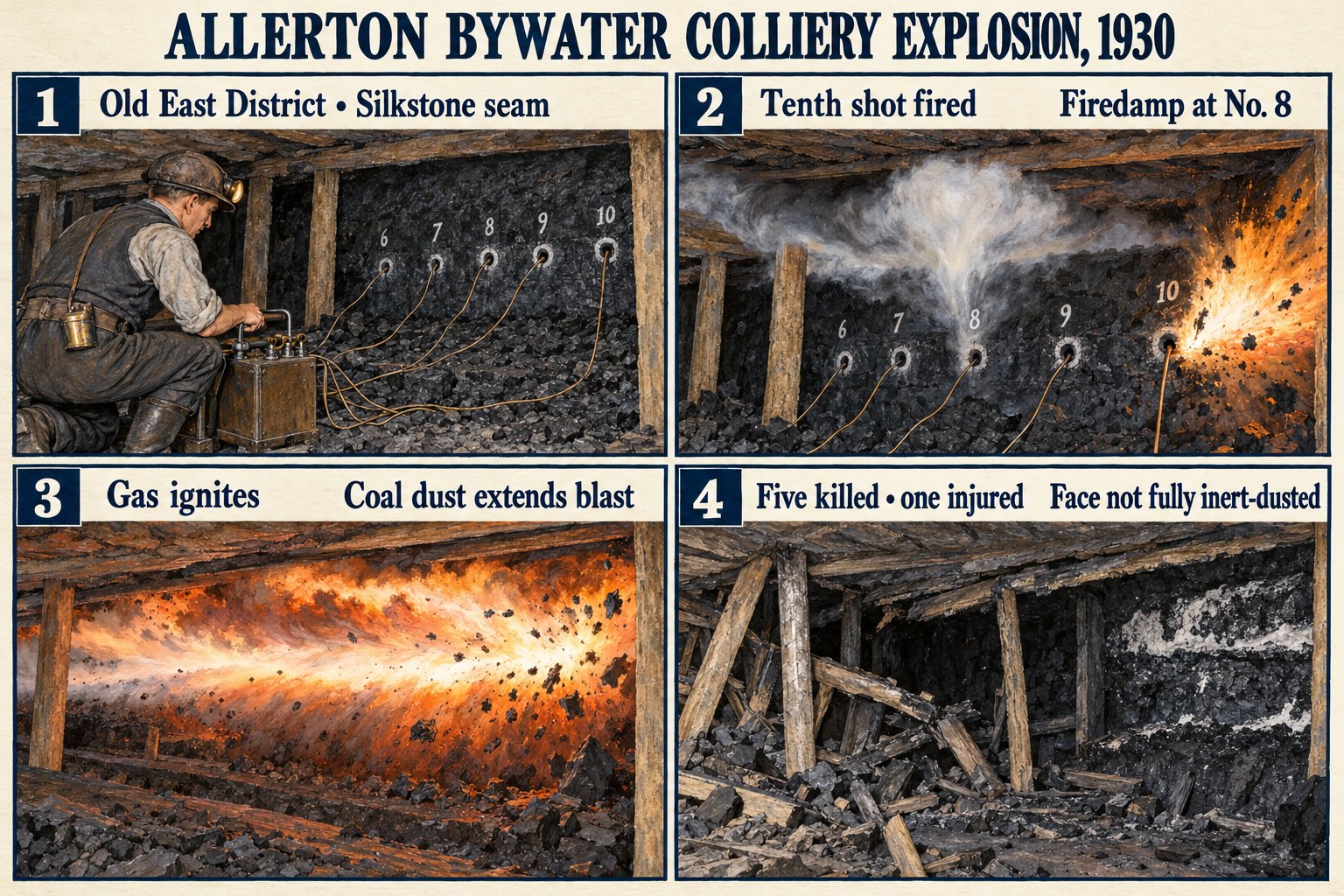
At about half past nine on the morning of Monday 10 March 1930, a deputy at Allerton Bywater Colliery fired his tenth shot of the shift into a place where firedamp had gathered in explosive proportions. The explosion, worsened by coal dust, killed five men and a pit pony. The inquest found no negligence, but noted that the face had not been thoroughly treated with inert dust and that the shot-firing dynamo in use should not have been.
| Date | 10 March 1930 |
|---|---|
| Mine | Allerton Bywater Colliery |
| Region | West Yorkshire |
| Primary type | Explosion |
| Associated types | Gas / Asphyxiation |
| Fatalities | 5 (George Paley and Arthur Richards were killed instantly, and John Allan, the pony driver, was killed with his pony. Albany Taylor died during the night and William Townend the following day, both of burns. Harold Collinson was injured.) |
| Injuries | 3 |
| Context | During active mining (A Monday day shift in the Old East District, with about 150 men in that district and a thousand in the pit.) |
Cause
Firedamp ignited by shot-firing, the flame extended by coal dust.
Contributing factors
Dust samples taken the day after contained between 45.2 and 71.2 per cent combustible matter, showing the face had not received thorough treatment with inert dust; and the three-shot dynamo used for firing did not comply with the Explosives in Coal Mines Order and should not have been in use.
What happened
The Old East District lay in the Silkstone seam, 385 yards down. The seam was four feet nine inches thick, and colliers drilled shot holes from the roof at eighteen-inch intervals for a deputy to charge and fire. George Paley, the day-shift deputy, had begun the shift with five pounds of explosive in his canister and used six ounces a shot. He had fired eight before he reached the working place known as number 8, and fired his ninth at one side of No. 8’s gate without incident. Five minutes later he fired his tenth, six yards to the right of the centre of the gate. A large accumulation of firedamp had gathered there in explosive proportions. Paley was killed instantly, and so was Arthur Richards. Two men in the No. 8 stall, Albany Taylor and William Townend, were badly burnt. Herbert Taylor and a colleague in 101 gate had left the face to take a meal a minute earlier, which probably saved them; he heard an enormous explosion and was plunged into darkness, the air filling with choking fumes, smoke and dust. Harold Collinson, aged 19, had been standing in No. 7 stall waiting for John Allan and his pony, who were overdue. He felt a tremendous gust of wind and a report and was peppered in the back by flying stones. Injured as he was, he helped Albany Taylor and William Townend out of the pit. On the way the three passed Harold’s father, Harry Collinson, who had set off to find out why Allan was late; forty yards further from the explosion than his son, he had still been knocked off his feet. Seeing his son’s condition but smelling burning, he went on towards the seat of the explosion, because investigating it was his job as pit corporal. He found the broken bodies of John Allan — whom he had trained since Allan started in the mine as a boy — and Allan’s pony, thrown against the road side by the force of the blast. Afterdamp stopped him going further and he had to leave the mine. Albany Taylor walked out despite his burns; William Townend was carried on a stretcher. Both were taken to the Castleford, Normanton and District Hospital. Taylor died during the night and Townend the following day.
Rescue & recovery
The injured were brought out by the men around them rather than by a rescue team: Harold Collinson, himself hurt, helped Albany Taylor and William Townend to the surface, and Harry Collinson went inbye alone to look for John Allan before afterdamp forced him back.
Investigation & inquiry
The jury at the inquest returned the verdict that the explosion had resulted from methane ignited by the firing of a shot, and that no case of negligence attached to anyone connected. It nonetheless observed two things: that the face had not received thorough treatment with inert dust — samples taken the following day contained between 45.2 and 71.2 per cent combustible matter — and that the three-shot dynamo used for firing did not comply with the Explosives in Coal Mines Order and should not have been used. E. H. Frazer, H.M. Divisional Inspector of Mines, reported on the causes and circumstances.
Recorded claims
Individual factual claims, each attached to the source(s) that support it below. Where sources disagree, both are kept.
- The explosion occurred at 9:30 am on Monday 10 March 1930 in the Old East District of the mine, in the Silkstone Seam, 385 yards below the surface. Around 150 miners were working in the district, out of 1,000 who were in the pit at the time. 1
- The day shift deputy, George Paley, had fired eight shots before reaching the working place known as number 8, and fired his ninth at one side of No. 8’s gate without incident. The explosion occurred when he fired his tenth shot six yards to the right of the centre of the gate, five minutes later, into a large accumulation of firedamp in explosive proportions. The resulting explosion was slightly exacerbated by coal dust. 1
- George Paley was killed instantly, as was Arthur Richards. John Allan and his pony were killed by the force of the explosion. Albany Taylor and William Townend, badly burnt, were taken to the Castleford, Normanton and District Hospital, where Taylor died during the night and Townend the following day. 1
- Albany Taylor and William Townend were helped out of the pit by Harold Collinson, aged 19, who had himself been injured and peppered in the back by flying stones. 1
- Harry Collinson, forty yards further from the explosion than his son and still knocked off his feet, continued towards the scene because it was his job as pit corporal to investigate. He found the bodies of John Allan, whom he had trained since Allan started in the mine as a boy, and Allan’s pony, and could go no further because of afterdamp. 1
- The jury returned the verdict that the explosion resulted from methane ignited by the firing of a shot and that no case of negligence attached to anyone connected. It observed that the face had not received thorough treatment with inert dust, dust samples taken the following day containing between 45.2% and 71.2% combustible matter, and that the three-shot dynamo used for firing did not comply with the Explosives in Coal Mines Order and should not have been used. 1
- At least 99 miners died in the village collieries between 1856 and 1991, including fourteen boys under the age of 18; this was the worst single accident among them. 2
Related terminology
Mining terms this disaster is structurally linked to, with the nature of the relationship.
- Afterdamp (contextual relationship)
Named twice in this record, first in the narrative: “…pony, thrown against the road side by the force of the blast. Afterdamp stopped him going further and he had to leave the mine. Albany…” - Deputy (contextual relationship)
Named 3 times in this record, first in the summary: “At about half past nine on the morning of Monday 10 March 1930, a deputy at Allerton Bywater Colliery fired his tenth shot of the shift into…” - Pit Pony (contextual relationship)
Named in this record’s summary: “…The explosion, worsened by coal dust, killed five men and a pit pony. The inquest found no negligence, but noted that the face had not…” - Shot-firing (contextual relationship)
Named twice in this record, first in the summary: “…face had not been thoroughly treated with inert dust and that the shot-firing dynamo in use should not have been.” - Stall (contextual relationship)
Named twice in this record, first in the narrative: “…killed instantly, and so was Arthur Richards. Two men in the No. 8 stall, Albany Taylor and William Townend, were badly burnt. Herbert Taylor…”
Photographs & further reading
This page doesn't try to reproduce everything — these are the best original sources found for this disaster.
The fullest available account, drawn from the Yorkshire Evening Post of 10 and 11 March 1930 and E. H. Frazer’s official report: the shot-firing sequence, each man’s position, the escape of the injured, and the inquest findings on dust and the firing dynamo.
View sourceSources
- (primary) WATH MAIN COLLIERY (EXPLOSION) — Hansard, 25 February 1930 — UK Parliament (Historic Hansard)
- (secondary) Allerton Bywater — Wikipedia
Record created: 7 September 2026 · Last researched: 7 September 2026