 MineArchive
Stall
| Also known as | Stall Work (working coal in stalls, as Gresley has it) |
|---|---|
| Category | Mine Workings & Access |
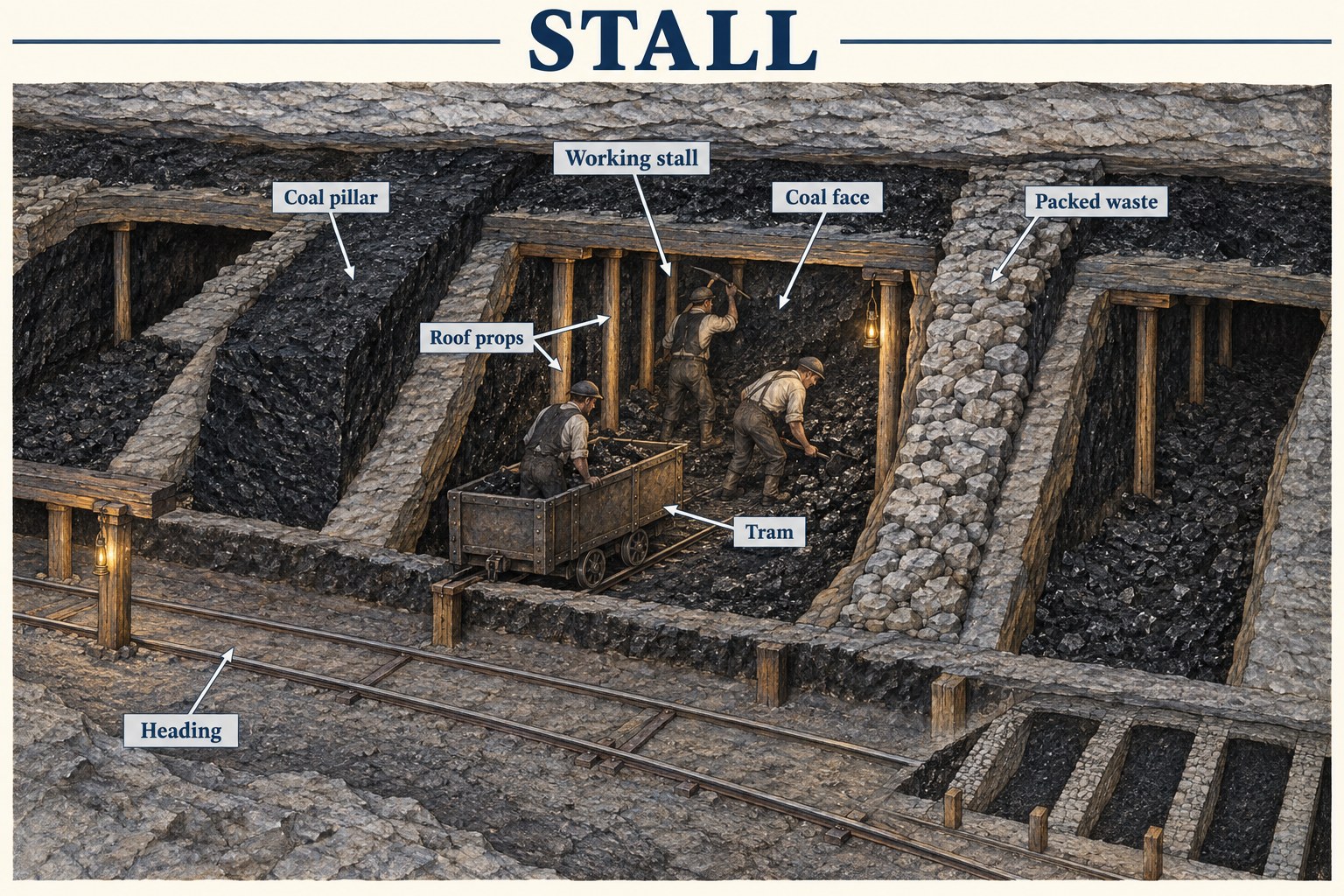
The working place at the coal face — a room or chamber driven into the seam in which a collier and his mates cut the coal, with coal or packed waste left between one stall and the next to carry the roof.
Historical usage
Stall is the word for the working place across South Wales, the Midlands, Yorkshire and, as an older usage, Scotland; it is not the North East word. Gresley's 1883 glossary records it both as a place — the definition of bank, in his fourth sense, is 'the whole or sometimes only one side or one end of a stall or working place underground' — and as the name of a whole system of working, pillar and stall, which he marks as South Welsh. Stall work was simply working coal in stalls, and a stallman was the man who held one, in some districts under a butty. In South Wales the length of face a collier was answerable for was his stent: a hundred-and-fifty-yard face might be divided into fifteen or eighteen of them.
How it worked
Stalls were driven off a heading, a few yards wide, each separated from the next by a pillar of coal or, later, by packs built of stone from the ripping. The collier holed under the coal, brought it down, timbered his own roof as the face advanced, and filled his own trams: the stall was a unit of work, of payment and of responsibility all at once. As the face moved forward the ground behind it was allowed to settle, or was packed, and when the district was worked out the stalls were left standing empty.
Why it was used
Stall working suited seams and markets where coal was cut by hand and paid for by the ton. It needed no expensive plant, it let a colliery open several faces at once with small gangs, and it made every collier the manager of his own place — which is also why the practice of a colliery could vary from stall to stall in the same district.
Risks & limitations
Two dangers ran through stall working. The first was the roof: a man timbered his own place, and the inspectors' reports are full of falls at the face where a prop had not been set or a sprag had been crushed out. The second was what stood in the stalls nobody was working any more. Gas gathered undisturbed in old stalls and waited for a light: it is the recorded cause of the Eaglesbush explosion of 1848, where the gas standing in the abandoned stalls fired first and the gas in all the others followed.
Regional variation
In Northumberland and Durham the working place is a board or bord, and the system bord and pillar; Greenwell's 1849 glossary of the northern coal trade has no entry for stall at all. In Scotland the word was used but the system is stoop and room — Barrowman's 1886 Glossary of Scotch Mining Terms disposes of it in three words: 'STALL, See Stoop and Room.' Gresley records post and stall as the Yorkshire form and pillar and stall as the South Welsh.
Related terminology
Goaf, Longwall, Room and Pillar
Mines associated with this term
5 examples chosen from 39 linked records — the term page is not an index.
- Gethin Colliery — Merthyr Tydfil (well documented example)
Named in this record’s workings: “…were in general use, with safety lamps issued only to men working in stalls where gas had already been found.” - Lletty Shenkin Colliery — Rhondda Cynon Taf (well documented example)
Named in this record’s workings: “…came; a shaft of 134 yards is recorded in 1891. Coal was worked in stalls off cross-headings and hauled by horses — eleven were underground on…” - Amington Colliery — Staffordshire (well documented example)
Named 3 times in this record, first in the summary: “…and 1930s with no underground machinery at all, working bord and stall until the Second World War. In 1951 it merged with Alvecote and…” - Babbington Colliery — Nottinghamshire (well documented example)
Named in this record’s history: “…September 1901 two men were killed by successive falls of roof in a stall (see Disasters, below).” - Charles Pit, Llansamlet — Swansea (well documented example)
Named in this record’s workings: “…with a 600-yard heading towards Tregof Farm; heading and stall working.”
Disasters associated with this term
5 examples chosen from 79 linked records, most direct relationship first.
- Garngoch Colliery explosion, 1880 (contributing factor)
Gas gathered in an idle stall. - Abercrave Colliery roof fall, 1917 (contextual relationship)
Named in this record’s narrative: “…1917, during the night shift at Abercrave Colliery, three men whose stalls had just been cleared by a haulier were waiting on a parting in the…” - Allerton Bywater Colliery explosion, 1930 (contextual relationship)
Named twice in this record, first in the narrative: “…killed instantly, and so was Arthur Richards. Two men in the No. 8 stall, Albany Taylor and William Townend, were badly burnt. Herbert Taylor…” - Babbington Colliery roof fall, 1901 (contextual relationship)
Named twice in this record, first in the summary: “Two men died in successive falls of roof in a stall at Babbington Colliery, Cinderhill, Nottingham, on 11 September…” - Bentley Colliery explosion, 1931 (contextual relationship)
Named 3 times in this record, first in the cause: “…caused by a gob fire smouldering either in the waste ground between stalls 141 and 140 or in an old gate road, near stall 140.”
Sources
- (primary) Glossary of Scotch Mining Terms — James Barrowman (1886), via Scottish Mining Website
- (primary) W. S. Gresley, A Glossary of Terms used in Coal Mining (1883) — W. S. Gresley; digitised by the Internet Archive
- (secondary) Glossary of South Wales colliery terms — Welsh Coal Mines
Record created: 4 September 2026 · Last researched: 4 September 2026