 MineArchive
Amington Colliery
| Location | Amington, Tamworth, Staffordshire — 52.6310, -1.6461 (exact) |
|---|---|
| Commodities | Coal, Fireclay |
| Type | Coal |
| Worked | 1862–1951 |
| Maximum depth | Unknown. The shafts were deepened by a further 109 feet to reach the Bench seam after 1921. |
| Operators | Gibbs and Canning (1862–?), National Coal Board (1947–?), Glascote Colliery Co. Ltd |
Overview
Amington Colliery was sunk in 1862 by Gibbs and Canning of Glascote, two miles north-east of Tamworth, and worked the Seven Feet seam of the Warwickshire Coalfield until the coal beneath it ran out. Starved of investment for most of its life, it was deepened another 109 feet to the Bench seam only after the 1921 lock-out, when its own miners accepted a fourteen per cent wage cut and a longer week to keep the pit open. It stayed profitable through the 1920s and 1930s with no underground machinery at all, working bord and stall until the Second World War. In 1951 it merged with Alvecote and Pooley Hall collieries to form North Warwick Colliery, after which its shafts pumped water and carried men rather than coal.
History
Gibbs and Canning of Glascote sank Amington Colliery in 1862, down to the Seven Feet seam. By 1892 the coal immediately north of the shafts was exhausted and a new district known as 'the west' was opened. The colliery was worked by the Glascote Colliery Co. under H. O. Firmstone and later by the Glascote Colliery Co. Ltd, employing around 280 to 290 people from the 1890s to the First World War and raising household, manufacturing and steam coal, with fireclay as well by 1915. By the early twentieth century Amington was starved of capital, and it took the Ministry of Fuel and Power's wartime control to draw up a plan to sink the shafts to the Bench seam at an estimated £52,000. Before the work could be done the government ended state control on 31 March 1921, and the day after the announcement the Colliery Owners Federation proposed the sharpest wage cut in the industry's history; miners who would not accept the terms were locked out, and the 1921 strike followed. The Amington men judged that the pit and their jobs would only survive if they accepted, taking a fourteen per cent wage reduction and a longer working week. The dispute ended in July 1921, the government subsidy that closed it covered the planned investment, and Amington got its 109-foot deepening to the Bench seam, new steel headgears in place of the old wooden ones, and new surface screens. Even so it was never a modern colliery. It stayed profitable through the 1920s and 1930s, though whether that came from the modernisation or simply from paying its men less than the rest of the Warwickshire coalfield is not clear. No underground machinery was introduced, and the bord and stall method of working continued until the Second World War, when longwall was brought in.
Geology
Amington worked the Warwickshire Coalfield's productive Coal Measures, principally the thick Seven Feet seam; when that was worked out under the colliery, the Bench and Double seams beneath it were reached by deepening the shafts a further 109 feet. Fireclay was raised alongside the coal by 1915.
Geological setting: Sedimentary Beds and Seams (well documented example)
Workings
Two shafts, No. 1 and No. 2 Pits, originally with wooden headgears replaced by steel after 1921. Bord and stall working continued with no underground machinery until longwall was introduced during the Second World War. Employment ran from 291 in 1894 to 465 in 1940 and 538 in 1947, when output was 150,000 tons.
Closure
Amington merged with Alvecote and Pooley Hall collieries in 1951 to form North Warwick Colliery. Its shafts were no longer used for winding coal after the merger, serving instead to pump water and to carry men to the other parts of the combined mine; pithead baths were built at Amington in 1953. North Warwick closed twelve years later and the Amington shafts were officially recorded as abandoned in 1965.
What remains
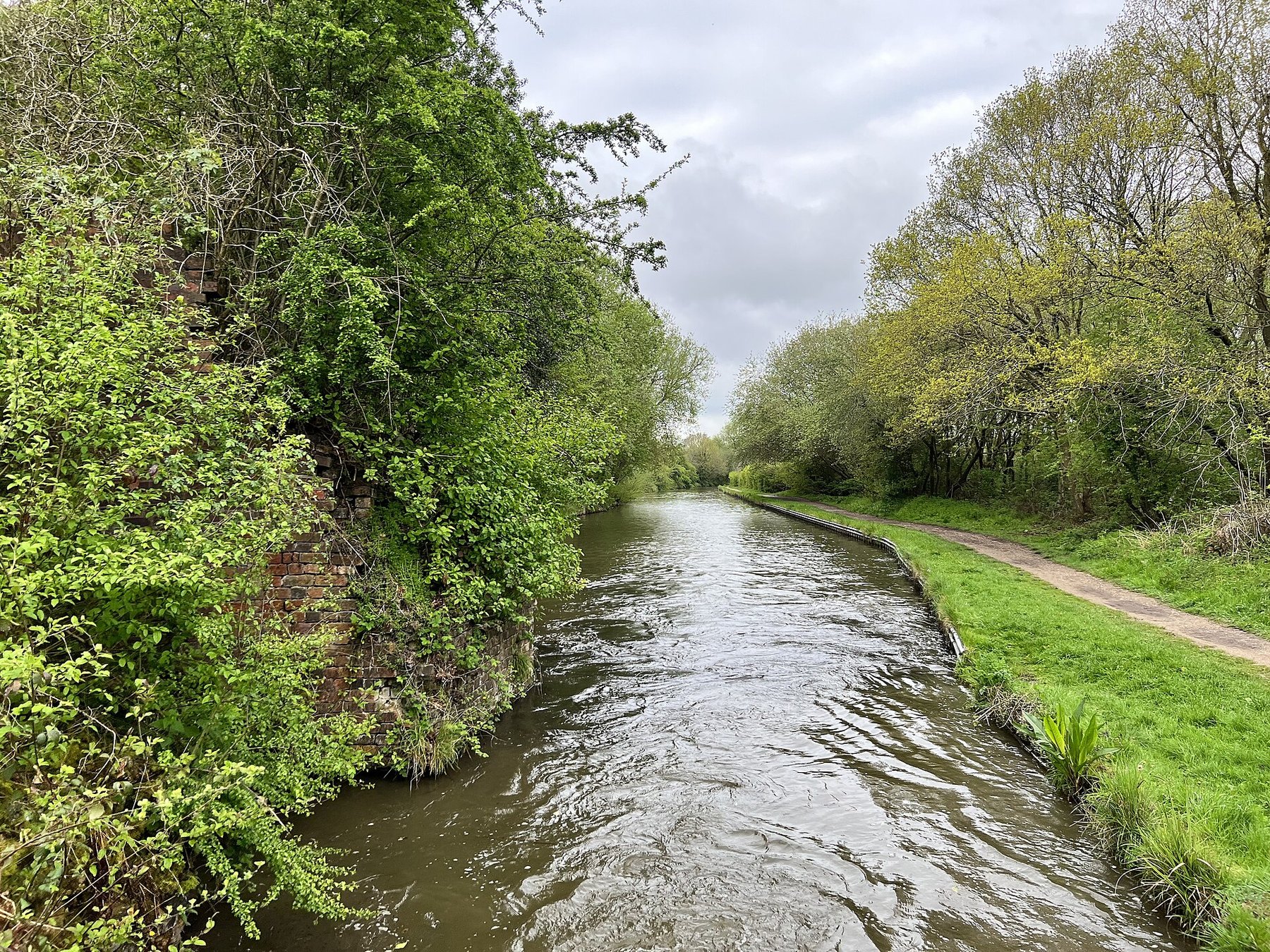
The colliery is gone. The most visible survival is the remains of the bridge that carried the Amington and Glascote Colliery Railway over the Coventry Canal, photographed in 2023.
The abutments of the bridge that carried the colliery railway over the Coventry Canal.
Related mines
- Alvecote Colliery — The two Tamworth pits merged with Pooley Hall in 1951 to form North Warwick Colliery, and both had their shafts recorded as abandoned in 1965 when North Warwick closed.
- Glascote Colliery — Tamworth collieries of the Glascote Colliery Company, joined by the Amington and Glascote Colliery Railway.
- Pooley Hall Colliery — Amington merged with Pooley Hall and Alvecote in 1951 to form North Warwick Colliery, after which Amington's shafts pumped water and carried men to the other parts of the combined mine.
Nearby mines
- Alvecote Colliery — 0.7 miles (1.1 km) NE, Warwickshire
- Glascote Colliery — 0.7 miles (1.2 km) SW
- Pooley Hall Colliery — 1.0 miles (1.6 km) E, Warwickshire
- Birchmoor Colliery — 1.6 miles (2.5 km) SE, Warwickshire
- Dexter Colliery — 4.1 miles (6.6 km) S, Warwickshire
Straight-line distance, within 9 miles (15 km). Show on the map.
What's uncertain
Points where sources disagree or the record could not be settled; both accounts are kept. All open questions in the archive.
- The BGS mine-plans catalogue holds a Mining Remediation Authority abandonment plan titled 'Amington' (catalogue 2058, Ryder (Bel Smithy) And Ironstone, dated 1886); the catalogue gives no location and the plan's details do not clearly tie it to this working, so it may belong to another of the same name. (uncertain) 3
Recorded claims
Individual factual claims, each attached to the source(s) that support it below. Where sources disagree, both are kept.
- Amington Colliery was sunk in 1862 by Gibbs and Canning of Glascote, down to the Seven Feet seam. 1
- The government drew up plans during the First World War to deepen the shafts to the Bench seam at an estimated cost of £52,000, but ended state control on 31 March 1921 before the work was done. 1
- Amington's miners accepted a fourteen per cent wage reduction and a longer working week in 1921 in the hope of keeping the colliery open; the shafts were then sunk a further 109 feet to the Bench seam. 1
- Bord and stall working continued with no underground machinery until longwall was introduced during the Second World War. 1
- Employment ran from 291 in 1894 to 538 in 1947, when output was 150,000 tons; the owners were the Glascote Colliery Co. and then the Glascote Colliery Co. Ltd until nationalisation. 2
- Amington merged with Alvecote and Pooley Hall in 1951 to form North Warwick Colliery; its shafts were then used for pumping and manriding, and were recorded as abandoned in 1965. 1
- The BGS mine-plans catalogue holds a Mining Remediation Authority abandonment plan titled 'Amington' (catalogue 2058, Ryder (Bel Smithy) And Ironstone, dated 1886); the catalogue gives no location and the plan's details do not clearly tie it to this working, so it may belong to another of the same name. (uncertain) 3
Photographs & further reading
Warwickshire County Council’s account of the sinking, the 1921 lock-out and the wage cut the Amington men accepted, the deepening to the Bench seam and the North Warwick merger.
View sourceOwners, output, employment and seams for each Lists of Mines year, with the names and circumstances of twelve people killed at the colliery.
View sourceSources
- (secondary) Amington Colliery — Our Warwickshire (Warwickshire County Council), by Laura Orriss
- (primary) Durham Mining Museum: Amington Colliery — Durham Mining Museum, from the Mines Inspectors Reports and the Lists of Mines
- (primary) BGS / Mining Remediation Authority mine plans: AMINGTON — British Geological Survey / Mining Remediation Authority
- (observational) Remains of the bridge for the Amington and Glascote Colliery Railway (photographed 2023) — Geograph Britain and Ireland, Andrew Abbott
Record created: 9 September 2026 · Last researched: 9 September 2026