 MineArchive
Pooley Hall Colliery
| Also known as | North Warwick Colliery |
|---|---|
| Location | Polesworth, near Tamworth, Warwickshire — 52.6295, -1.6232 (approximate) |
| Commodity | Coal |
| Type | Coal |
| Worked | 1850–1965 |
| Maximum depth | Unknown. |
| Operators | Pooley Hall Colliery Company Limited (1880–1947), D’Arcy Chaytor (1920–1947), National Coal Board (1947–1965) |
Overview
Sunk on the Pooley Hall estate beside the Coventry Canal in 1847, completed in 1849 and raising coal from 1850. A syndicate formed the Pooley Hall Colliery Company in 1897 and the concern grew to include a brickworks; the 1880 list of collieries at work already returns it under the Pooley Hall Colliery Co. Limited. It was taken over by the Ministry of Fuel and Power during the First World War, which installed a new winding engine and headgear in 1915, and afterwards sold to Colonel D’Arcy Chaytor, a mining engineer from New Zealand. Its men stayed at work through the 1921 strike, and the day the strikers from Baddesley and Birch Coppice marched on Polesworth to change their minds ended in a police baton charge. Pooley Hall opened the first pithead baths in the Warwickshire coalfield in 1928, merged with Alvecote and Amington in 1951 to form North Warwick Colliery, and closed with it in 1965.
History
A coal mine was sunk on the Pooley Hall estate in 1847, not far from the house, completed in 1849 and producing coal from 1850. The Coventry Canal ran past the site and took the output. By 1880 the pit was in the hands of the Pooley Hall Colliery Co. Limited, and a syndicate formally constituted the Pooley Hall Colliery Company in 1897; a brickworks grew up with it.
During the First World War the colliery was taken over by the Ministry of Fuel and Power, which invested in it and installed a new winding engine and headgear in 1915. It was returned to its previous owners after the war and sold on to Colonel D’Arcy Chaytor, an accomplished mining engineer from New Zealand.
The Pooley Hall men did not support the 1921 miners’ strike and stayed at work while the rest of the Warwickshire coalfield stopped over the reduction in wages. On 21 June 1921 the striking miners of Baddesley and Birch Coppice assembled at Baddesley Ensor and marched on Polesworth to persuade them to join. Two hundred policemen had been drafted into the village without the marchers’ knowledge; a baton charge left several people unconscious. The rest of the coalfield eventually went back to work on a further reduction in wages and a longer week — conditions the Pooley Hall miners had already accepted.
In 1924 the Duke of York, later George VI, came to Tamworth to open an extension to the General Hospital, and Chaytor lobbied his advisers into adding a visit to the colliery as a reward for the men. The smartest of them were picked for a guard of honour and told to wear their Sunday suits and a flat cap, those who owned no cap being sent to buy one. The pit bottom was whitewashed for the occasion, and Pooley Hall became the first colliery in Britain to have an underground toilet: a bucket lavatory with a rosewood seat, which the men were instructed not to use until after the visit. Within a week it had to be removed, the stench in that part of the pit having become unbearable.
The Pooley Hall men did join the General Strike of 1926, and suffered less than most: Chaytor’s brother owned the Tamworth Electricity Company and took many of the strikers on temporarily to dig ditches for cables, bringing electricity to the outlying villages. In 1928 the colliery opened the first pithead baths in the Warwickshire coalfield, financed by the Miners’ Welfare Fund and designed for two thousand men, with showers, drying lockers and separate facilities for managers. Conveyor belts replaced the shaker pan face conveyors in 1932. In 1942 Alvecote Colliery at Tamworth became an adit pit used by Pooley Hall for manriding and winding coal, and in 1951 the two merged with Amington Colliery to form North Warwick Colliery.
Geology
The Warwickshire coalfield at its northern end, where the seams run beneath the Anker valley towards Tamworth. The colliery’s working life left its mark on the ground above it: several pools in what is now Pooley Country Park are subsidence hollows from the workings beneath.
Geological setting: Sedimentary Beds and Seams (well documented example)
Workings
Shaft mining beside the Coventry Canal, which carried the coal away from the start. The Ministry of Fuel and Power installed a new winding engine and headgear in 1915. Face conveying was modernised in 1932, shaker pans giving way to belts. From 1942 Alvecote Colliery served as an adit pit, used by Pooley Hall for manriding and for winding coal, and the two were formally merged with Amington in 1951 as North Warwick Colliery.
Closure
Pooley Hall did not close on its own account. It merged with Alvecote and Amington collieries in 1951 to form North Warwick Colliery, and it was North Warwick that closed in 1965, ending all deep mining in Polesworth.
What remains
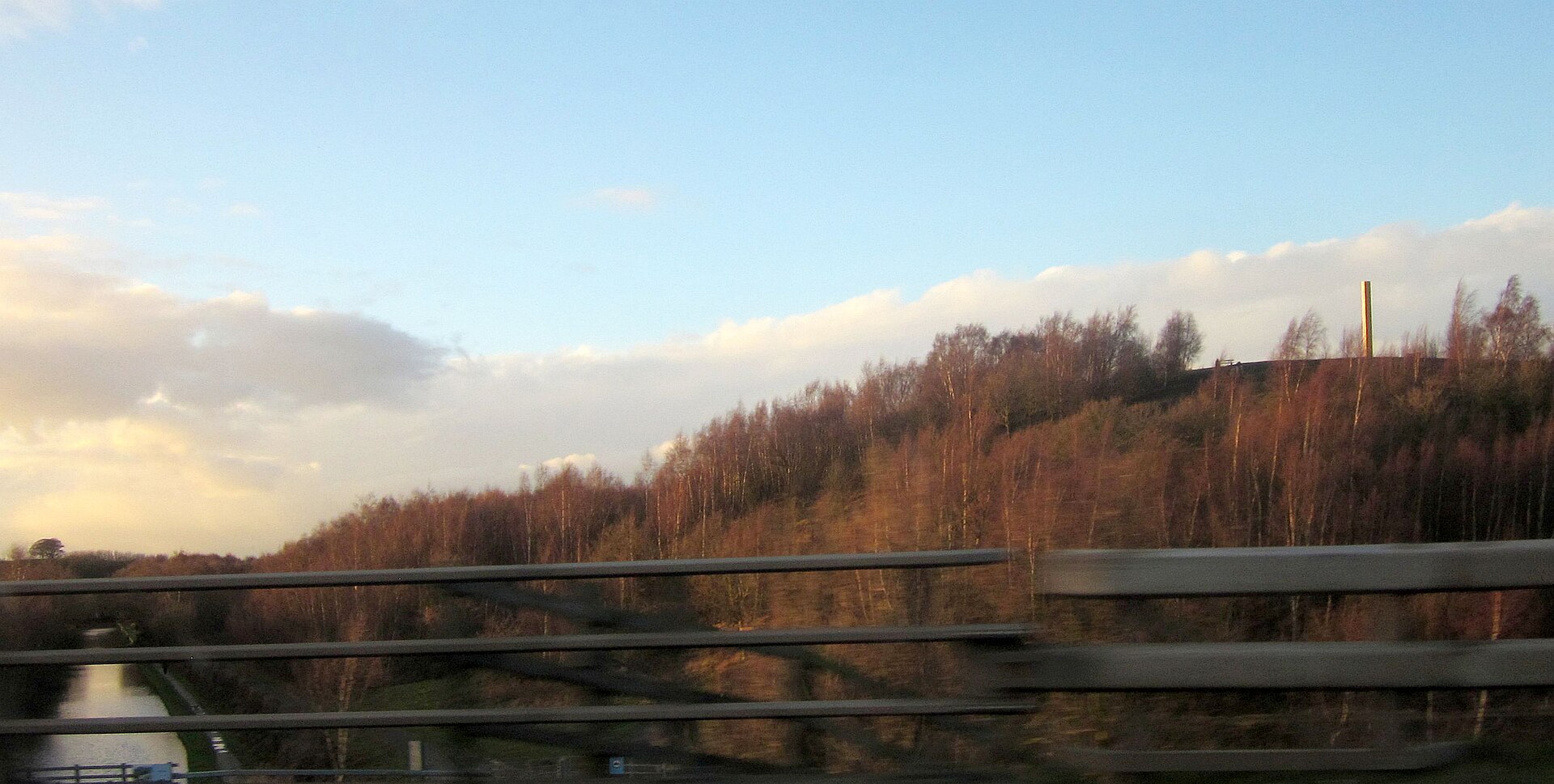
The colliery site is now Pooley Country Park, some 62.5 hectares of reclaimed ground with a visitor centre, photographed in December 2013. The Miners Walk through it follows a footpath used by miners as long ago as 1846, several of the pools are subsidence hollows from the workings, and the Coventry Canal that carried the coal still runs along the edge.
Pooley Country Park, with its heritage centre, the Miners Walk, the subsidence pools and the Coventry Canal. Pooley Hall itself, the house on whose estate the pit was sunk, still stands.
Redevelopment
Pooley Country Park and Heritage Centre, a 62.5-hectare reclaimed site.
Related mines
- Alvecote Colliery — Alvecote was made part of Pooley Hall Colliery in 1942 when its own surface plant closed, and the two merged with Amington in 1951 to form North Warwick Colliery.
- Amington Colliery — Amington merged with Pooley Hall and Alvecote in 1951 to form North Warwick Colliery, after which Amington's shafts pumped water and carried men to the other parts of the combined mine.
Nearby mines
- Alvecote Colliery — 0.6 miles (1.0 km) NW
- Amington Colliery — 0.9 miles (1.5 km) W, Staffordshire
- Birchmoor Colliery — 1.3 miles (2.1 km) S
- Glascote Colliery — 1.7 miles (2.7 km) W, Staffordshire
- Dexter Colliery — 4.2 miles (6.7 km) S
Straight-line distance, within 9 miles (15 km). Show on the map.
Recorded claims
Individual factual claims, each attached to the source(s) that support it below. Where sources disagree, both are kept.
- The official list of collieries at work in 1880 returns the pit as "Pooley Hall, Tamworth, Pooley Hall Colliery Co. Limited". 1
- A coal mine was sunk on the Pooley Hall estate in 1847, completed in 1849, and coal began to be extracted in 1850; a syndicate formed the Pooley Hall Colliery Company in 1897 and the colliery grew to include a brickworks. 2
- The colliery was taken over by the Ministry of Fuel and Power during the First World War, which invested in it and installed a new winding engine and headgear in 1915, and was afterwards returned to its owners and sold to Colonel D’Arcy Chaytor, a mining engineer from New Zealand. 2
- The Pooley Hall miners did not support the 1921 strike; on 21 June 1921 the striking miners of Baddesley and Birch Coppice marched from Baddesley Ensor on Polesworth to persuade them to join, and a baton charge by 200 policemen drafted into the village left several people unconscious. 2
- For the Duke of York’s visit in 1924 the pit bottom was whitewashed and Pooley Hall became the first colliery in Britain to have an underground toilet — a bucket lavatory with a rosewood seat — which had to be removed within a week as the stench in that part of the pit had become unbearable. 2,3
- The first pithead baths in the Warwickshire coalfield were opened at Pooley Hall in 1928, financed by the Miners’ Welfare Fund and designed for 2,000 men with showers and drying lockers, plus separate facilities for managers. 2,3
- In 1951 Pooley Hall and Alvecote collieries merged with Amington Colliery to form North Warwick Colliery, which closed in 1965, ending all deep mining in Polesworth. 2,3
- The colliery site is now Pooley Country Park, some 62.5 hectares with a visitors’ centre, the Miners Walk — a footpath used by miners as long ago as 1846 — several pools caused by mining subsidence, and the Coventry Canal that carried the coal. 3
- Mining Remediation Authority abandonment plans for the combined 'North Warwick / Alvecote / Amington / Pooley Hall' workings run from 1958 to 1965 (WMW335, Bench seam, 1965), matching the colliery's closure; earlier plans titled 'Pooley Hall' are dated 1892 and 1899. 4
Photographs & further reading
Warwickshire County Council’s account, drawing on Fretwell’s chapter in The Warwickshire Coalfield: the 1847 sinking, the 1921 baton charge at Polesworth, the Duke of York’s visit and its rosewood-seated consequence, and the 1928 pithead baths.
View sourceSources
- (secondary) List of coal mines UK 1880 — Coalmining History Resource Centre
- (secondary) Pooley Hall Colliery — Our Warwickshire, Warwickshire County Council
- (secondary) Pooley Hall Colliery — Show Mines of Great Britain — showcaves.com
- (primary) BGS / Mining Remediation Authority mine plans: NORTH WARWICK/ ALVECOTE/ AMINGTON/ POOLEY HALL — British Geological Survey / Mining Remediation Authority
- (observational) Pooley Country Park (photographed 22 December 2013) — Derek Harper, Geograph Britain and Ireland
Record created: 6 September 2026 · Last researched: 6 September 2026