 MineArchive
Goaf
| Also known as | Gob (the everyday word underground, and the usual form in the Midlands and North), Goff |
|---|---|
| Category | Mine Workings & Access |
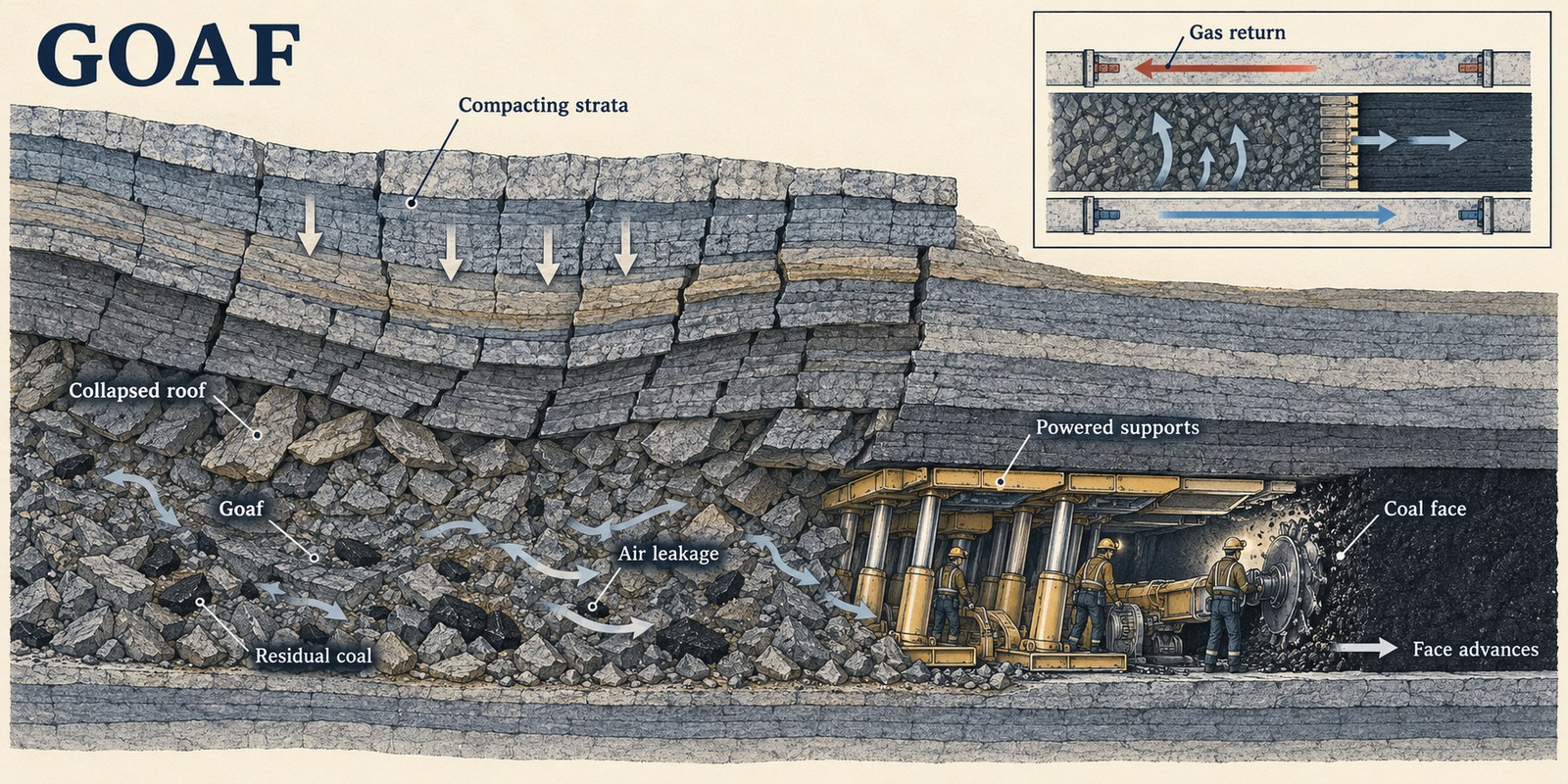
A worked-out area of a coal mine, left behind once coal has been extracted and usually partly filled with waste rock ('gob') as the roof above it settles or is deliberately packed.
Historical usage
Goaf (and its synonym gob) is coal-mining terminology going back to the earliest days of British deep coal mining, describing the inevitable void left behind wherever a coal seam had been worked out — a permanent, unavoidable feature of any coal mine's underground geography.
How it worked
As coal was extracted along a working face, the space left behind was allowed to collapse in a controlled way, or was packed with waste rock, forming the goaf; overlying strata settle and compact over it in stages, sometimes hanging unsupported for a time before collapsing.
Why it was used
Managing the goaf, rather than leaving it entirely open, let a mine control roof collapse in a predictable way and reduced the risk of sudden, uncontrolled falls reaching still-active workings.
Risks & limitations
A goaf is a genuine, ongoing hazard rather than simply dead ground: loose broken rock allows fast air leakage, and old goaf areas are prone to spontaneous combustion, since residual coal left behind can self-heat in a long-enclosed, humid space — a fire hazard that can persist underground long after the coal around it was worked out. On a modern longwall the goaf is managed as much as it is left. Ventilation is arranged to keep gas coming off it away from the face, either by a bleeder or back return road or by running the air across the face in the same direction as the face chain. Where the coal left in the goaf might heat and fire on its own, gases are allowed to build up behind seals so as to exclude oxygen; where the goaf might instead hold an explosive mixture of methane and oxygen, nitrogen is injected to push that mixture deep into it or to inert the space outright.
Regional variation
Three spellings are in use for the same thing — goaf, goff and gob — and they are not regional alternatives so much as competing conventions: goaf is the usual British form, gob the usual American one, and goff an older British variant. British coal sources will use goaf and gob interchangeably in the same paragraph, gob more often for the packed waste itself and goaf for the space.
Related terminology
Gate Road, Powered Roof Supports, Spontaneous Combustion, Stall
Mines associated with this term
5 examples chosen from 21 linked records — the term page is not an index.
- Minnie Pit — Staffordshire (notable incident)
The 1918 explosion originated in or near the goaf at the top of No. 4 district in the Bullhurst. - Bedford Colliery — Greater Manchester (well documented example)
Named in this record’s workings: “…drawn as the face retreated so the roof settled into the goaf behind. The colliery had its own half-mile mineral railway to Guest…” - Trimdon Grange Colliery — County Durham (well documented example)
Named in this record’s workings: “…with the Pit Narrow Board district on the northern edge of a large goaf. Coke ovens operated on the site until 1962.” - Beynon Colliery — Blaenau Gwent (well documented example)
Named in this record’s closure notes: “A fire was found in a gob at an old face in the Lower Black Vein at about 10.30 pm at the…” - Blenkinsopp Colliery — Northumberland (well documented example)
Named in this record’s history: “…and a seam unusual for its limestone roof, which would hang over the goaf and then drop in blocks larger than cars. A whin dyke stood between…”
Disasters associated with this term
5 examples chosen from 43 linked records, most direct relationship first.
- Minnie Pit Explosion, 1918 (direct cause)
The explosion originated in or near the goaf, where bull-dog stone had fallen. - Hyde Colliery Explosion, 1889 (contributing factor)
The gas is thought to have come out of the goaf beside No. 8 level, probably pushed out by a sudden weight coming on to the waste. - Newdigate Colliery explosion, 1931 (contributing factor)
The gas came from the waste. - Springwell Colliery explosion, 1869 (contributing factor)
Gas rose from the goaf below. - Leycett Colliery explosion, 1883 (hazard involved)
The fire was in the gob.
Sources
- (secondary) Definition of goaf — Mindat
- (secondary) Dynamic distribution and prevention of spontaneous combustion of coal in gob-side entry retaining goaf — PMC
- (secondary) Longwall mining — Wikipedia
Record created: 22 August 2026 · Last researched: 9 September 2026