 MineArchive
Bedford Colliery
| Also known as | Wood End Pit |
|---|---|
| Location | Bedford, Leigh, Greater Manchester — 53.5040, -2.4970 (exact) |
| Commodity | Coal |
| Type | Coal |
| Worked | 1876–1967 |
| Maximum depth | 891 yards (about 815 m), No. 1 shaft to the Arley mine after its 1886 deepening. |
| Operators | John Speakman & Sons (1874–1929), Manchester Collieries Ltd (1929–1947), National Coal Board (1947–1967) |
Overview
A Manchester Coalfield colliery at Bedford in Leigh, sunk by John Speakman from 1874 and worked by his family until 1929. Known also as Wood End Pit and known in its own day as a fiery pit, it was the scene of a firedamp explosion on Friday 13 August 1886 that killed 38 men and boys and left 48 children fatherless. It went on working for another eighty years, closing in 1967.
History
Bedford was rural until the Bridgewater Canal arrived and a large basin was built at Butts in 1795, though coal had long been got from small pits in the north-east of the township. Wood End Farm was among that older ground, with pits including Milner's working there in 1853.
John Speakman — whose father owned the Priestners, Bankfield and Broadoak collieries in Westleigh — began sinking two shafts on Wood End Farm land, south of the London and North Western Railway's Tyldesley Loopline, in about 1874, and coal was being raised by 1876. The shafts were 197 yards deep to the Crombouke mine. In 1883 No. 2 shaft was deepened to 420 yards for the Seven Foot mine and to 627 yards for the Trencherbone; three years later No. 1 was deepened to the Arley mine at 891 yards. A private mineral railway about half a mile long ran to a landsale yard at Guest Street, serving a brickyard and a smokeless fuel plant, with Speakman's Sidings provided on the main line after 1882.
The explosion of 13 August 1886 killed 38 (see Disasters, below). By 1896 the colliery employed 366 men underground and 108 on the surface, getting household and manufacturing coal from the Crombouke, Six Foot and Seven Foot mines. Speakmans sank a No. 3 pit between 1913 and 1916.
The colliery stayed in the Speakman family until it was amalgamated into Manchester Collieries in 1929, which linked its railway into the Astley and Tyldesley system between Nook and Gin Pit collieries and put in new headgear and screens. It passed to the National Coal Board in 1947 and closed in 1967, still employing 518 underground and 131 surface workers.
Geology
The colliery worked the Middle Coal Measures of the Manchester Coalfield, taking coal from the seams between the Worsley Four Foot and the Arley — locally these seams are called mines and the pit itself the colliery. The seams here dip generally south and west and are cut by small faults. The Upper Coal Measures are not worked in this part of the coalfield. The Crombouke mine, in which the 1886 explosion occurred, lay nearest the surface of those worked.
Geological setting: Sedimentary Beds and Seams (well documented example)
Workings
Two shafts sunk from about 1874 and a third added between 1913 and 1916. Both original shafts reached the Crombouke at 197 yards; No. 2 was later deepened to 420 yards for the Seven Foot and 627 for the Trencherbone, and No. 1 to 891 yards for the Arley. In 1886 the coal at the seat of the explosion was being worked on the retreating principle: headings driven into the coal, a face opened between them, and the props progressively drawn as the face retreated so the roof settled into the goaf behind. The colliery had its own half-mile mineral railway to Guest Street and, after 1929, a connection into the Astley and Tyldesley collieries system.
Closure
Closed by the National Coal Board in 1967, still employing 518 people underground and 131 on the surface.
What remains
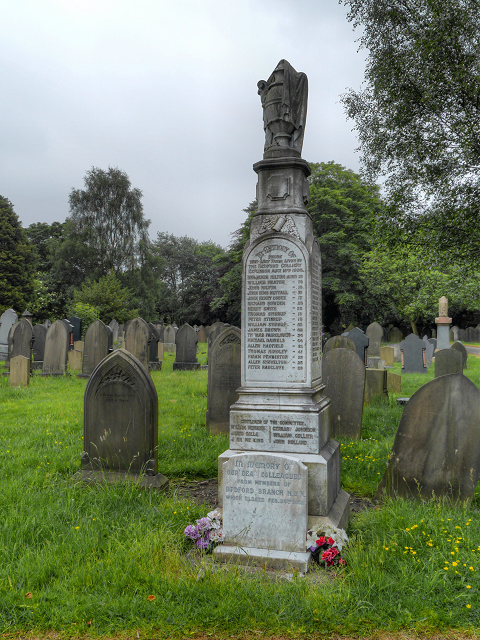
No colliery structures survive. The disaster is commemorated by a monument in Leigh Cemetery to those killed in 1886.
None located. The 1886 memorial in Leigh Cemetery is the principal surviving marker.
Related mines
- Chanters Colliery — Under Manchester Collieries Chanters' take was extended into Bedford's area, and a power feeder ran down Bedford No.3 shaft and through underground roadways to Chanters.
- Priestners Colliery — Both Speakman family collieries in Leigh before 1877.
Nearby mines
- Howe Bridge Colliery — 1.0 miles (1.7 km) NW
- Lovers Lane Colliery — 1.0 miles (1.7 km) NW
- Gin Pit Colliery — 1.1 miles (1.8 km) E
- St George's Colliery — 1.1 miles (1.8 km) NE
- Nook Colliery — 1.2 miles (1.9 km) E
Straight-line distance, within 9 miles (15 km). Show on the map.
Disasters & major incidents
-
Bedford Colliery Explosion, 1886
13 August 1886 · Explosion · 38 fatalities
A firedamp explosion at Bedford No. 2 Pit, Leigh, on Friday 13 August 1886 killed 38 men and boys. The inquest established that a miner drawing pit props had seen firedamp in his lamp and not reported it, and that a second miner, finding his own lamp firing, shook it instead of lowering it and carrying it out.
What's uncertain
Points where sources disagree or the record could not be settled; both accounts are kept. All open questions in the archive.
- The account of the disaster states that the colliery was 'sunk in 1884', which conflicts with the 1874 start and 1876 first coal given in the fuller history of the colliery; the two accounts disagree. (disputed) 1,2
Recorded claims
Individual factual claims, each attached to the source(s) that support it below. Where sources disagree, both are kept.
- John Speakman began sinking two shafts on Wood End Farm land in about 1874 and coal was being produced by 1876; the shafts were 197 yards deep to the Crombouke mine. 1
- The account of the disaster states that the colliery was 'sunk in 1884', which conflicts with the 1874 start and 1876 first coal given in the fuller history of the colliery; the two accounts disagree. (disputed) 1,2
- No. 2 shaft was deepened in 1883 to 420 yards for the Seven Foot mine and 627 yards for the Trencherbone; No. 1 was deepened three years later to the Arley mine at 891 yards. 1
- In 1896 the colliery employed 366 men underground and 108 surface workers; at closure in 1967 it employed 518 underground and 131 on the surface. 1
- Bedford Colliery stayed in the Speakman family until it was amalgamated with Manchester Collieries in 1929, and passed to the National Coal Board in 1947. 1
- Speakman's built a private mineral railway about half a mile long to a landsale yard at Guest Street, serving a brickyard and a smokeless fuel plant. 1
Photographs & further reading
The colliery's history shaft by shaft, with the depths reached for each named seam and the ownership from John Speakman through Manchester Collieries to the National Coal Board.
View sourceA local history account of the pit and the Speakman family who ran it.
View sourceSources
- (secondary) Bedford Colliery — Wikipedia
- (secondary) Bedford Colliery disaster — Wikipedia
- (secondary) Bedford Colliery — Engole
Record created: 3 September 2026 · Last researched: 3 September 2026