 MineArchive
Bedford Colliery Explosion, 1886
A firedamp explosion at Bedford No. 2 Pit, Leigh, on Friday 13 August 1886 killed 38 men and boys. The inquest established that a miner drawing pit props had seen firedamp in his lamp and not reported it, and that a second miner, finding his own lamp firing, shook it instead of lowering it and carrying it out.
| Date | 13 August 1886 |
|---|---|
| Mine | Bedford Colliery |
| Region | Greater Manchester |
| Primary type | Explosion |
| Associated types | Gas / Asphyxiation, Rescue |
| Fatalities | 38 (The youngest was 15 and the oldest 65; the average age of the dead was 32, and 48 children were left fatherless. Some families lost more than one member.) |
| Injuries | John Woolley, working at the seat of the explosion, survived with burns and reached the shaft bottom; other injuries are not separately recorded. |
| Context | During active mining |
Cause
Firedamp released by a fracturing roof as pit props were drawn, ignited when a miner whose lamp had fired shook it and tried to blow it out, so that the flame passed through the gauze.
Contributing factors
The pit was known to be a 'fiery' one. The face was being worked on the retreating principle, the props drawn progressively so the roof settled into the goaf behind — the process that released the gas. John Woolley, drawing props, saw the flame in his Davy lamp turn blue, the sign of explosive gas, and did not report it; work continued. Established procedure on a firing lamp was to lower it to the floor, firedamp being lighter than air, and carry it steadily into fresh air without jerks.
What happened
159 men and boys were underground on a shift that had begun at 6 a.m. The explosion came at about 10.45 a.m. in the Crombouke mine, some 530 yards down and 700 yards from the pit-eye. Miners in other parts of the pit were wound to the surface. John Woolley, a dataller working at the seat of the explosion, survived and, though burned, got himself to the shaft bottom. News travelled fast: a crowd of women had reached the pit by 11 a.m., and by evening between eight and ten thousand people had gathered at the pit head.
Rescue & recovery
The pit manager W. Horrobin, the underlooker James Calland and the owner's son Harry Speakman led a rescue party but were driven back by afterdamp — 'very strong', in Calland's words, and making the men dizzy enough that they had to come up quickly for fresh air. This was before the formation of mines rescue teams, but help came from neighbouring collieries: an exploring party from Bickershaw, from Astley and Tyldesley Collieries and from the Wigan Coal and Iron Company went underground and concluded there would be no survivors. The underground fires were eventually put out and the bodies recovered, wrapped in tarpaulins and taken to the wheelwrights' shop, the joiners' shop serving as a mortuary.
Investigation & inquiry
The Mines Inspector Joseph Dickinson of Pendleton was contacted by telegraph on the day. The coroner's inquest was deliberately held over until 23 September 1886 so that John Woolley, the survivor from the seat of the explosion, could give evidence. The jury returned a verdict of accidental death caused by an explosion of firedamp.
Legal & regulatory aftermath
The coroner commented that the fireman should spend more time examining the workings before the men went down and that greater care should be taken over the lamps, and it was regretted that the gas had not been reported by the prop-takers. The owners afterwards bought 150 Masault lamps and 50 improved Clanny lamps fitted with bonnets, the bonnet protecting the gauze from draughts and reducing the risk of flame passing through it.
Memorials & commemoration
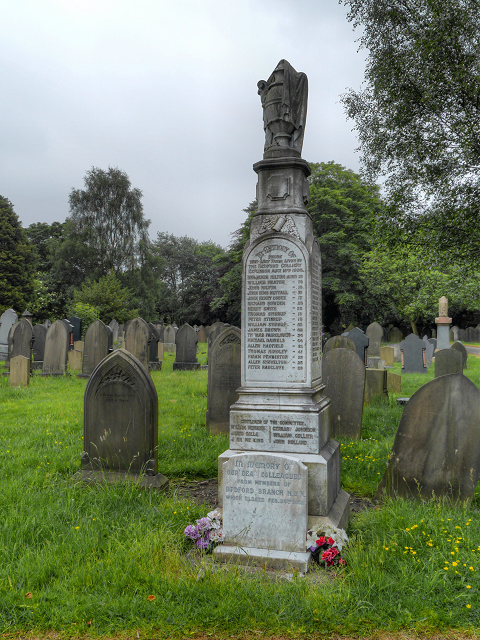
A monument in Leigh Cemetery commemorates those killed. The colliery subscribed to the Lancashire and Cheshire Miners' Permanent Relief Society, and a committee of local dignitaries raised money for the relief of widows and orphans, advertising an appeal in The Times.
Recorded claims
Individual factual claims, each attached to the source(s) that support it below. Where sources disagree, both are kept.
- 38 men and boys were killed, the youngest 15 and the oldest 65, at an average age of 32; 48 children were left fatherless. 1
- 159 men and boys were underground on a shift begun at 6 a.m.; the explosion came at about 10.45 a.m. in the Crombouke mine, about 530 yards down and 700 yards from the pit-eye. 1
- Firedamp released by the fracturing roof as pit props were drawn was ignited when a miner whose lamp had fired shook it and tried to blow it out, letting the flame through the gauze. 1
- John Woolley, drawing props, saw the flame in his Davy lamp turn blue — the sign of explosive gas — and did not report it; work continued, and a few minutes later a nearby miner's lamp fired. 1
- The explosion preceded the formation of mines rescue teams; exploring parties came from Bickershaw Colliery, Astley and Tyldesley Collieries and the Wigan Coal and Iron Company, and concluded there would be no survivors. 1
- The owners subsequently bought 150 Masault lamps and 50 improved Clanny lamps fitted with bonnets, which protect the gauze from draughts and reduce the risk of flame passing through. 1
Related terminology
Mining terms this disaster is structurally linked to, with the nature of the relationship.
- Afterdamp (contextual relationship)
Named in this record’s rescue and recovery: “…son Harry Speakman led a rescue party but were driven back by afterdamp — 'very strong', in Calland's words, and making the men dizzy enough…” - Dataller (contextual relationship)
Named in this record’s narrative: “…in other parts of the pit were wound to the surface. John Woolley, a dataller working at the seat of the explosion, survived and, though burned,…” - Firedamp (contextual relationship)
Named 5 times in this record, first in the summary: “A firedamp explosion at Bedford No. 2 Pit, Leigh, on Friday 13 August 1886…” - Goaf (contextual relationship)
Named in this record’s contributing factors: “…the props drawn progressively so the roof settled into the goaf behind — the process that released the gas. John Woolley, drawing…” - Rescue Brigade (contextual relationship)
Named in this record’s rescue and recovery: “…up quickly for fresh air. This was before the formation of mines rescue teams, but help came from neighbouring collieries: an exploring party from…”
Sources
- (secondary) Bedford Colliery disaster — Wikipedia
- (secondary) Bedford Colliery — Wikipedia
- (secondary) Bedford Colliery — Engole
Record created: 3 September 2026 · Last researched: 3 September 2026