 MineArchive
Dataller
| Category | Labour & Roles |
|---|
A miner paid a fixed rate per day or per shift for general underground work — building and repairing roadways, moving material, and similar tasks — rather than being paid by the ton of coal cut, as a collier working at the face was.
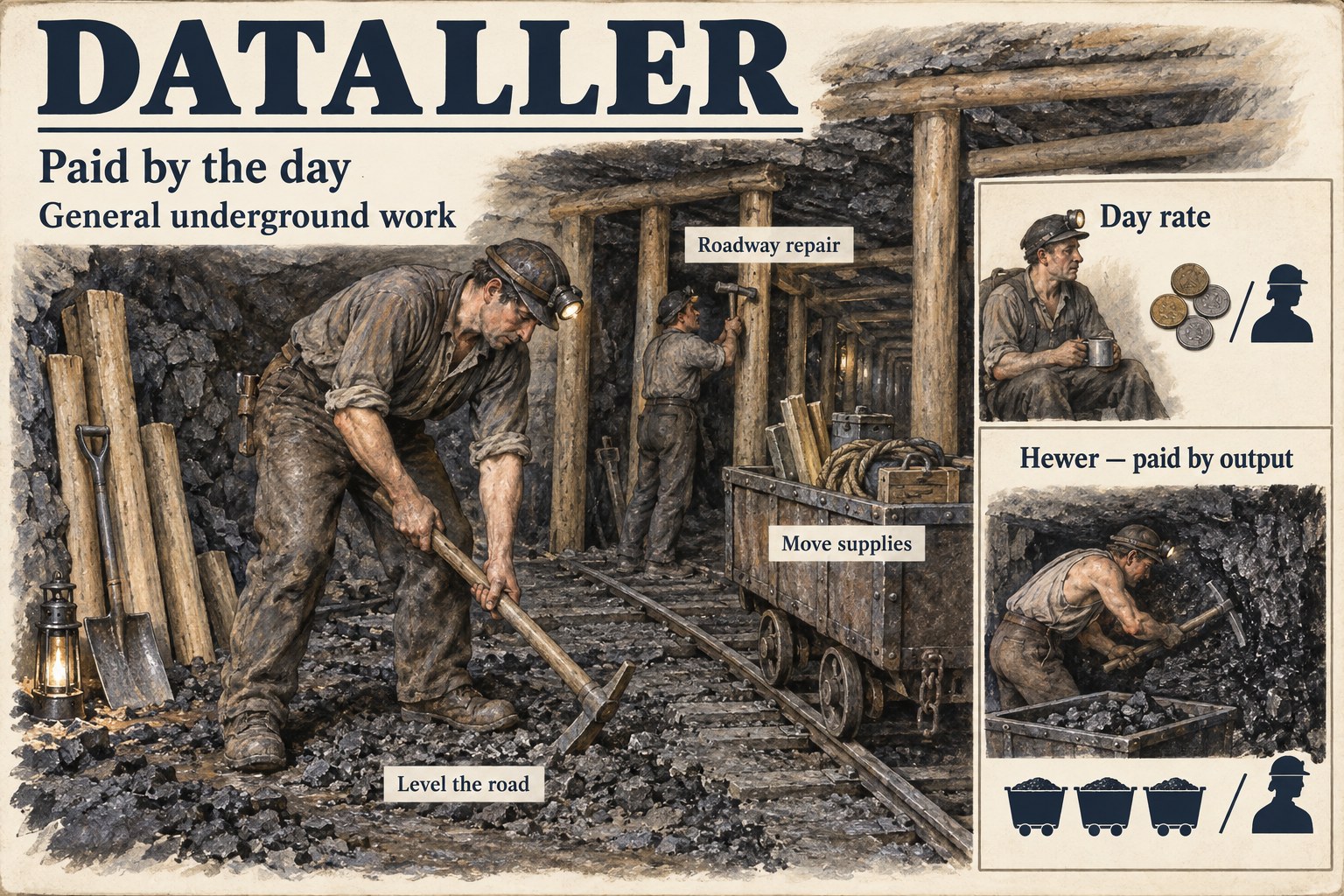
Historical usage
The term derives from 'day-taler', day plus an old word for reckoning or counting, and appears across British coalfields under several close variants, including daitler and daytaleman. Datallers formed a distinct tier of the underground workforce alongside face colliers (paid by output) and byeworkers, and their day-wage status meant a more predictable, if generally lower, income than a collier's could be on a good day at the face. Two datallers, John Ball and James Durkin, were among the six men killed in Bickershaw Colliery's 1942 explosion, doing exactly this kind of general underground work when the disaster struck.
How it worked
A dataller was simply engaged and paid on a day-rate basis, distinct from the tonnage or piece-rate contracts that governed a face collier's pay, and from the fixed-price contract arrangements under which byeworkers were sometimes engaged for specific jobs.
Why it was used
Much of a colliery's underground work — roadway repair, general haulage, clearing falls, moving supplies — could not sensibly be measured or paid by output the way coal-getting could, so day-wage employment let collieries staff this essential support work on a predictable basis.
Related terminology
Mines associated with this term
5 examples chosen from 7 linked records — the term page is not an index.
- Awsworth Colliery — Nottinghamshire (well documented example)
William Holland, a dataller of 40, finished his work in June 1890, sat down on the roadway and died; the verdict was death from natural causes. - Hafod Colliery — Wrexham (well documented example)
Named twice in this record, first in the history: “…December 1873, an explosion killed five men: Timothy Prichard, 34, a dataller; David Williams, 37, the master dataller; Thomas Davis, 26, and…” - Harriseahead Colliery — Staffordshire (well documented example)
Named in this record’s history: “…Alley, Holly Lane and Magpie seams, and 127 in 1923. In 1912 a dataller was killed by an explosion of firedamp or coal dust. In 1924 an…” - Meadow Colliery, Haigh — Greater Manchester (well documented example)
Named in this record’s history: “…when seven or eight yards of bars fell bodily as he took them out, a dataller killed in 1883 renewing bars at a junction, a contractor's man in…” - New Boston Colliery — Merseyside (well documented example)
Named in this record’s summary: “…a brow under repair killed the under-manager, his brother and three datallers.”
Disasters associated with this term
5 examples chosen from 24 linked records, most direct relationship first.
- Annesley Colliery runaway tubs, 1907 (contextual relationship)
Named twice in this record, first in the summary: “On 15 August 1907 two datallers were run down by a runaway train of tubs at Annesley Colliery, in…” - Bedford Colliery Explosion, 1886 (contextual relationship)
Named in this record’s narrative: “…in other parts of the pit were wound to the surface. John Woolley, a dataller working at the seat of the explosion, survived and, though burned,…” - Bickershaw Colliery explosion, 1942 (contextual relationship)
Two of the six men killed, John Ball and James Durkin, are named in this record specifically as datallers, general day-wage underground workers rather than face colliers. - Bickerstaffe Colliery gas ignition, 1927 (contextual relationship)
Named twice in this record, first in the summary: “…Bickerstaffe Colliery on 14 July 1927; two of the four men hurt, a dataller and the coal cutterman, died four days later.” - Black Park Colliery scalding, 1896 (contextual relationship)
Named in this record’s narrative: “…debris fell down that shaft onto the hot ashes from the boilers. Two datallers, James Francis, 33, and Benjamin Jones, 28, were playing a hose on…”
Sources
- (secondary) Glossary of coal mining terminology — Wikipedia
- (secondary) Glossary of mining terms (D) — North Staffordshire Mining Group
Record created: 27 August 2026 · Last researched: 27 August 2026