 MineArchive
Bickershaw Colliery explosion, 1942
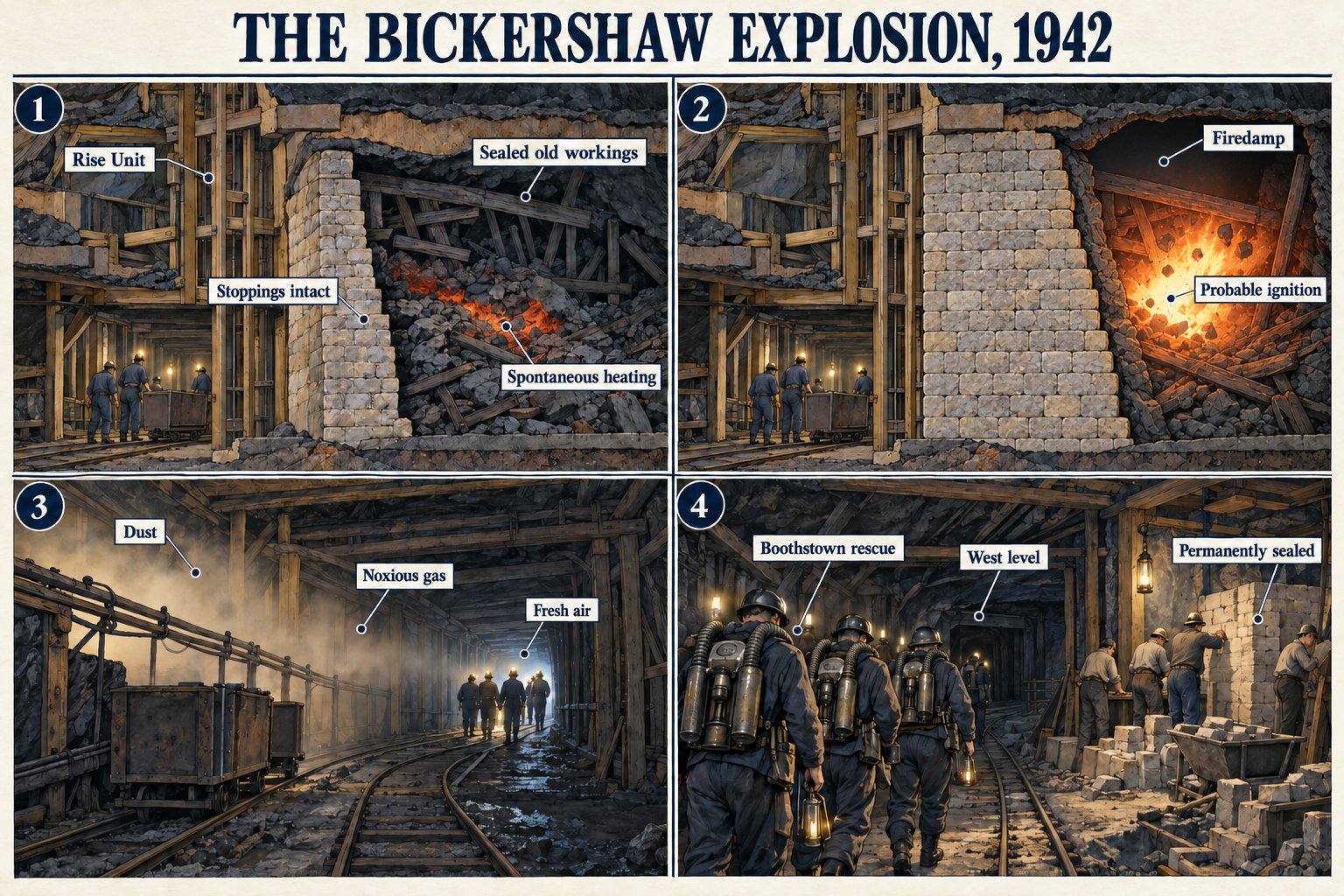
An explosion in No.4 pit's Rise Unit, probably caused by spontaneous combustion igniting gas in sealed-off old workings, killed 6 men shortly before midnight on 5 January 1942.
| Date | 5-6 January 1942 |
|---|---|
| Mine | Bickershaw Colliery |
| Region | Greater Manchester |
| Type | Explosion |
| Fatalities | 6 (The dead were night manager Thomas W. Monaghan (40), safety officer John Dykes (38), drillers Ernest Huyton (30) and Albert Brown (41), and datallers John Ball (61) and James Durkin (55).) |
| Injuries | Four men were injured, three of them hospitalised: Thomas Kennedy (21), William Houghton (22) and Thomas Rafferty (47); James Neville (49) was treated and released. |
| Context | During active mining |
Cause
General manager J.H. French concluded there had probably been an ignition of firedamp in a sealed-off area of old workings, most likely caused by spontaneous combustion; the stoppings sealing those old workings were found intact after the explosion, showing no evidence of a breach.
What happened
The explosion struck in the Rise Unit as night shift workers were assembling, with only 90 men underground at the time. Survivors described a dull thud followed by volumes of dust and smoke; one worker, sensing the atmosphere felt wrong, prompted his group to move to fresher air before the full extent of the danger was known.
Rescue & recovery
The Lancashire Mines Rescue Station at Boothstown began recovering bodies from 12:40am on 6 January, finding victims face-down along the belt level and travelling road; noxious gases continued emerging from the west level, and the affected area was subsequently sealed permanently.
Investigation & inquiry
The inquest recorded a verdict of death from misadventure. Post-mortem examinations found carbon monoxide levels of 58-82% in blood specimens taken from the dead, and some victims had fractured skulls from the blast itself.
Changes to practice & legislation
The affected area of old workings was permanently sealed following the explosion.
Recorded claims
Individual factual claims, each attached to the source(s) that support it below. Where sources disagree, both are kept.
- General manager J.H. French concluded firedamp had probably ignited in a sealed-off area of old workings through spontaneous combustion; the stoppings sealing that area were found intact, showing no evidence of a breach. 1,2
- Six men died: night manager Thomas W. Monaghan, safety officer John Dykes, drillers Ernest Huyton and Albert Brown, and datallers John Ball and James Durkin. 2
Related terminology
Mining terms this disaster is structurally linked to, with the nature of the relationship.
- Dataller (contextual relationship)
Two of the six men killed, John Ball and James Durkin, are named in this record specifically as datallers, general day-wage underground workers rather than face colliers. - Firedamp (contextual relationship)
Named in this record’s cause: “…manager J.H. French concluded there had probably been an ignition of firedamp in a sealed-off area of old workings, most likely caused by…” - Level (contextual relationship)
Named twice in this record, first in the rescue and recovery: “…from 12:40am on 6 January, finding victims face-down along the belt level and travelling road; noxious gases continued emerging from the west…” - Mines Rescue Station (contextual relationship)
Named in this record’s rescue and recovery: “The Lancashire Mines Rescue Station at Boothstown began recovering bodies from 12:40am on 6 January,…” - Spontaneous Combustion (contextual relationship)
Named twice in this record, first in the summary: “An explosion in No.4 pit's Rise Unit, probably caused by spontaneous combustion igniting gas in sealed-off old workings, killed 6 men shortly before…” - Winze (contextual relationship)
Named in this record’s summary: “An explosion in No.4 pit's Rise Unit, probably caused by spontaneous combustion igniting gas in…”
Sources
- (secondary) Bickershaw Colliery — Wikipedia
- (secondary) Bickershaw Colliery Explosion - Leigh - 1942 — Northern Mine Research Society
Record created: 27 August 2026 · Last researched: 27 August 2026