 MineArchive
Winze
| Category | Mine Workings & Access |
|---|
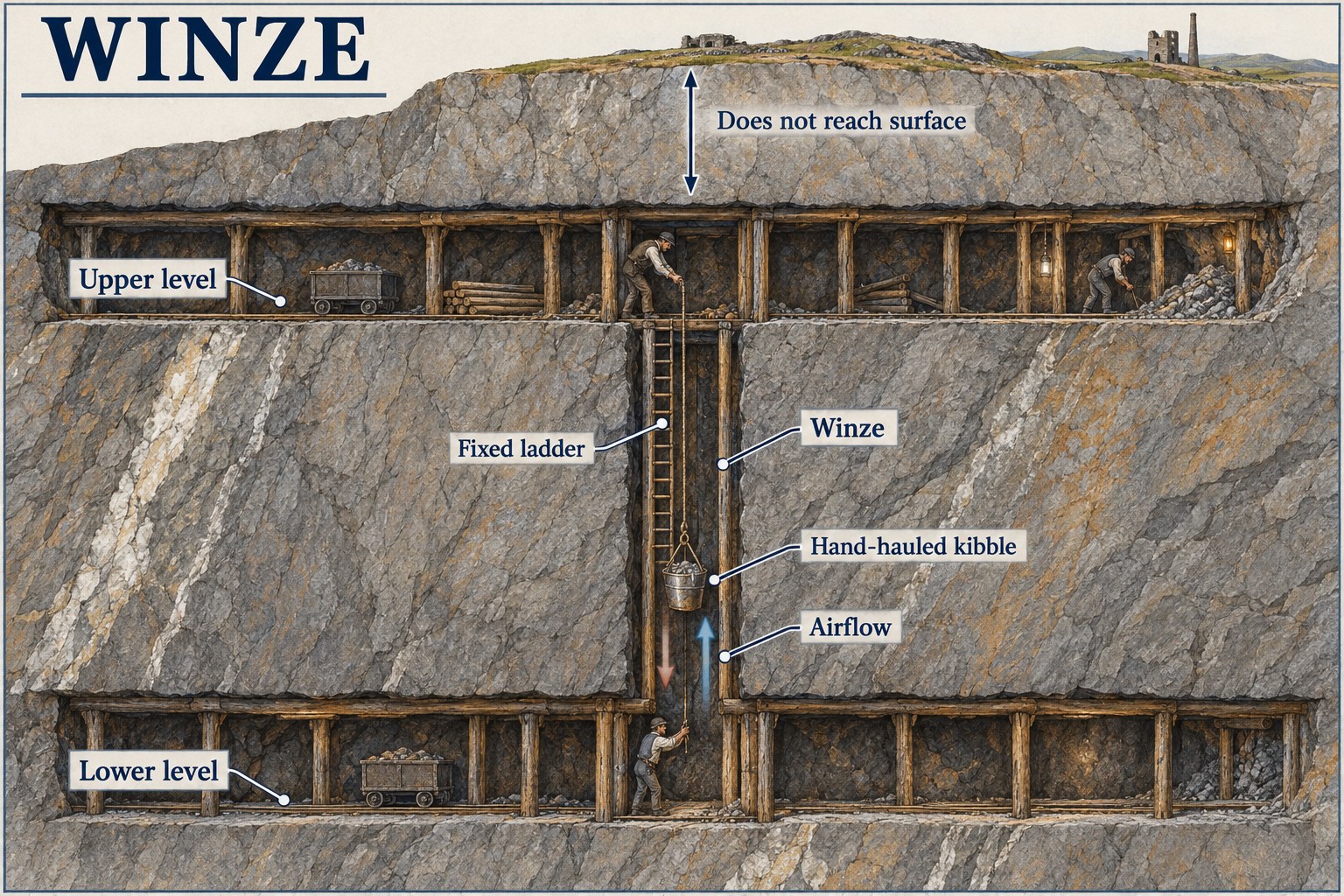
An internal shaft driven downward from one underground level to connect with a lower one, without reaching the surface.
Historical usage
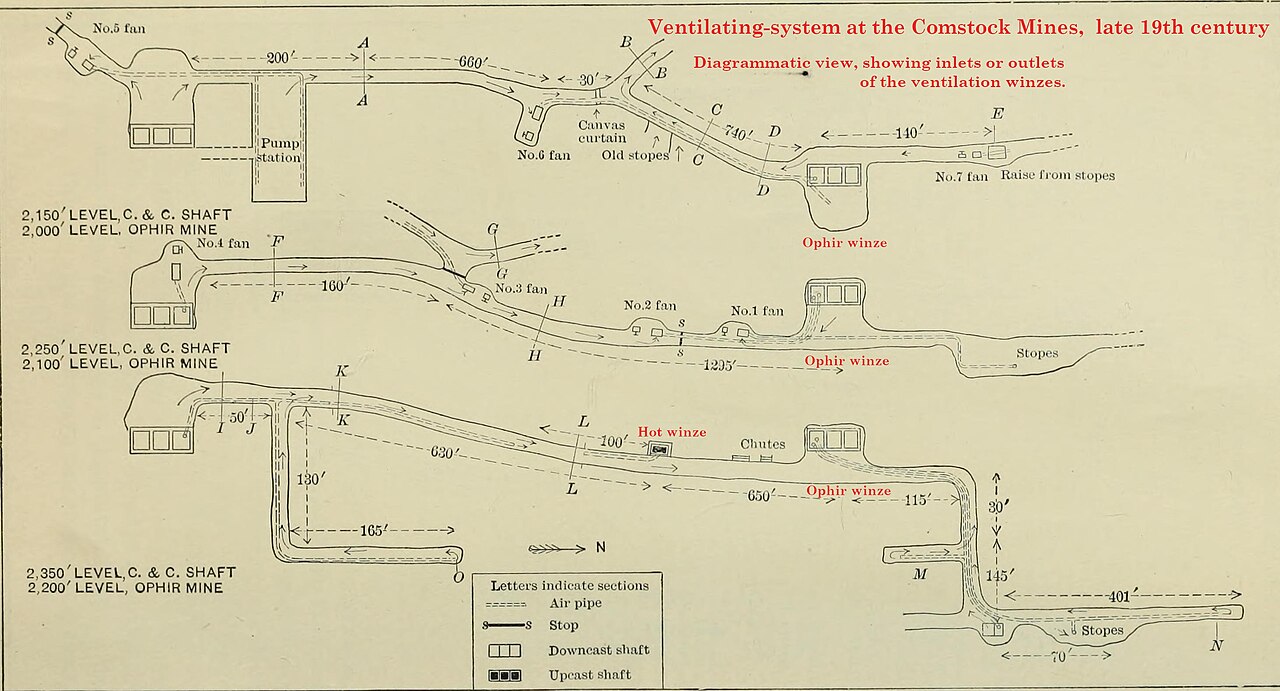
Winzes have been driven wherever miners needed to connect workings at different depths without the expense of a full surface-to-surface shaft — commonly to explore or work a lode ahead of the main workings, to improve ventilation between levels, or to give a second way in or out.
How it worked
Because a winze's top opening is underground rather than at the surface, it is not fitted with winding gear the way a shaft is — access up and down is normally by ladder. The same excavation is named according to the direction it was driven: sunk downward from the upper level it's a winze; driven upward from the lower level to meet it, the identical opening is instead called a rise (or raise). The naming is not quite as tidy in practice as it looks in a glossary. Healey Hero's pit terminology gives the same feature three names by direction and use: a winze when sunk from a higher level, a raise when worked upward from a lower one, and a sump when it is simply sunk downward and left. Barrowman's 1886 glossary of Scotch mining terms records the Scottish coalfield word for the same thing as a blind pit or blind bore, a shaft or bore driven upward or downward from an underground position and not reaching the surface.
Why it was used
Driving a winze between two already-connected levels was far cheaper than sinking a new shaft from surface, letting mine captains explore or work a lode at depth before deciding whether it justified full shaft-sinking investment. A winze also opened a second air path between levels, improving ventilation without any new surface opening.
Risks & limitations
With no winding gear, everything travelling through a winze — miners, tools, and any rock raised through it — had to go by ladder or hand-hauled kibble, far slower and more strenuous than a proper shaft. As a secondary, less-maintained opening, winzes were also a common site of falls, and in wet ground could flood suddenly if they broke into old, water-filled workings below.
Regional variation
The winze/rise naming convention — the same physical connection named by the direction it was driven, not by any difference in the excavation itself — is standard across British and international hard-rock mining terminology. The word itself is a hard-rock and Cornish inheritance rather than a coalfield one: Scottish collieries said blind pit, and the North East glossaries prefer staple or staple pit for a small shaft between seams. All describe an opening that never sees daylight.
Related terminology
Mines associated with this term
5 examples chosen from 11 linked records — the term page is not an index.
- Slitt Mine — County Durham (well documented example)
Named in this record’s history: “…Moses's team and Stephen Freak's team — contracting to drive or rise specific levels at rates such as 160 shillings per fathom and 35…” - Clive Mine — Shropshire (well documented example)
Named twice in this record, first in the workings: “…worked by shaft and level with a long tramming level and an 80-foot winze; the 19th-century stopes contrast with earlier, narrower hand-worked…” - Coalpit Heath Colliery — South Gloucestershire (well documented example)
Named in this record’s history: “…water levels across the linked underground workings began to rise, and by 1949 the pumps at Frog Lane could no longer keep pace. The…” - Huglith Mine — Shropshire (well documented example)
Named in this record’s workings: “…to a stope with intermediate levels above it and the other to a winze dropping 110 feet to the main tramming level. At surface the Main…” - Milldam Mine — Derbyshire (well documented example)
Named in this record’s workings: “…the shale cap and prevent subsidence at surface, and ventilation and rise holes carried up as the workings advance. Ore is trucked out by a…”
Disasters associated with this term
Included only where MineArchive's own research gives a reasonable evidential basis, with the nature of the relationship stated — not every disaster where this term might plausibly apply.
- Bickershaw Colliery explosion, 1942 (contextual relationship)
Named in this record’s summary: “An explosion in No.4 pit's Rise Unit, probably caused by spontaneous combustion igniting gas in…” - East and North Wheal Rose Flooding Disaster (contextual relationship)
Named in this record’s memorials: “…House North Shaft — carved with the inscription 'Though waters rise, Hold onto Hope, He will not leave you', and dedicated to the more…” - Greenside Mine fire, 1952 (contextual relationship)
Four men went down the 940 North winze and were overcome and killed there; others who got as far as the 175 Fathom Level were gassed but escaped. - Keppel Cove dam burst, 1927 (contextual relationship)
Named in this record’s cause: “…combined with gale-force winds caused the tarn at Keppel Cove to rise until it overtopped the earth dam; wave action eroded the crest and…” - The Longannet Flooding (contextual relationship)
Named in this record’s narrative: “…average inflow rate exceeding 110,000 gallons a minute. The sudden rise in water interrupted mine ventilation and tripped the surface fan.”
Sources
- (primary) Glossary of Scotch Mining Terms — James Barrowman (1886), via Scottish Mining Website
- (secondary) A Glossary of Mining Terms — Coal Mining History Resource Centre
- (secondary) Definition of winze — Mindat.org Glossary
- (secondary) Pit Terminology — Healey Hero
- (secondary) Winze — Wikipedia
Record created: 20 August 2026 · Last researched: 11 September 2026