 MineArchive
Cwm Ciprwth Mine
| Also known as | Gilfach Copper Mine, Cae Helig Mine |
|---|---|
| Location | Cwm Ciprwth, high on the steep western side of Cwm Pennant, with the Gilfach workings on the wooded hillside below, Gwynedd — 53.0070, -4.1988 (exact) |
| Commodity | Copper |
| Type | Metal |
| Worked | c. 1800–c. 1900 |
| Maximum depth | At least 18 fathoms (33 m) in the pump shaft |
Overview
A small copper mine high on the side of Cwm Pennant, worked on and off with its neighbour Gilfach from about 1800 to 1900 for a lifetime output of 65 tonnes of ore; its Truro-cast waterwheel and flat-rod pump survive.
History
Cwm Ciprwth and Gilfach, also known in their working lives as the Cwm and Cae Helig mines, lie within 350 metres of one another on the steep western side of Cwm Pennant and were worked as one concern. Some exploration may have begun around 1800, and about two-thirds of the mines' whole output was sold in 1828-9, apparently through the landowner, the Brynkir estate. In 1850 the mines were taken into the Mining Company of Wales, which sought £200,000 for its mines and quarries and dissolved within two years amid suggestions that it had never been properly formed. In 1854 25 tons of ore were sold with no company recorded.
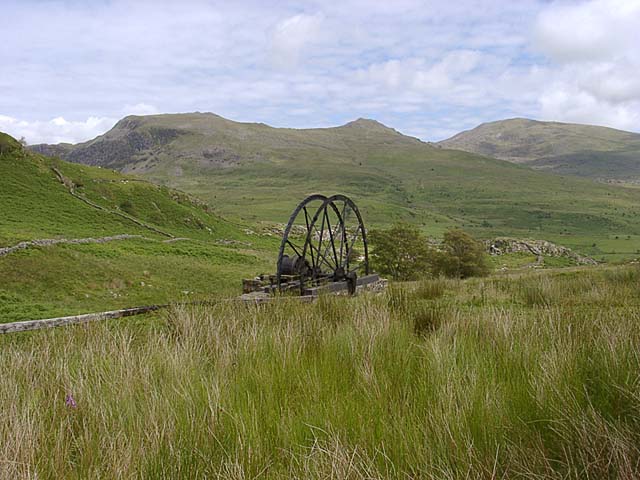
From 1889 to 1893 several men were employed under the short-lived Brynkir Gold Exploration Syndicate, but little beyond maintenance seems to have been done, and most of the remaining equipment was disposed of around 1900. The Swansea smelter records put the mines' entire output at 65 tonnes of ore, which yielded about 5.2 tons of copper. Their story is typical of the speculative 'adventurer' mining of the time: an impressive mine that produced very little. The waterwheel, made by Dingey & Son of Truro, and its flat-rod pumping system were partly renovated in 1987.
Geology
Copper mineralisation worked from a flooded adit, winze and shafts; Gilfach's deep adit found no workable ore.
Workings
At Cwm Ciprwth a 56-metre adit with a winze and four shafts, the pump shaft at least 18 fathoms deep; at Gilfach three adits, the deep adit 304 metres long, with stopes in the middle adit and a waterwheel pit. The Cwm Ciprwth wheel pumped one shaft by flat rods and wound in the next.
Closure
Work stopped after the Brynkir Gold Exploration Syndicate of 1889-93; a couple of men stayed until around 1900, when most of the equipment was disposed of.
What remains
Cwm Ciprwth is a scheduled monument; its waterwheel and flat-rod pumping system were partly restored in 1987. The adits and shafts are flooded.
A cast-iron suspension waterwheel with a crank and clutch-driven winding drum, the flat rods on A-frames, two shafts, leats and ruined stone buildings; at Gilfach a wheel pit, a ruined crusher house and trackbeds.
Redevelopment
Unknown.
Nearby mines
- Prince of Wales Quarry — 1.6 miles (2.5 km) E
- Gorseddau Quarry — 3.3 miles (5.3 km) SE
- Tymawr West Quarry — 3.4 miles (5.5 km) NW
- Plassddu Quarry — 3.5 miles (5.6 km) NW
- Dorothea Quarry — 3.7 miles (6.0 km) W
Straight-line distance, within 9 miles (15 km). Show on the map.
What's uncertain
Points where sources disagree or the record could not be settled; both accounts are kept. All open questions in the archive.
- The Cwm Ciprwth waterwheel is seven metres in diameter. (disputed) 2
- The Cwm Ciprwth waterwheel is eight metres in diameter. (disputed) 4
- The waterwheel dates from 1889. (uncertain) 4
Recorded claims
Individual factual claims, each attached to the source(s) that support it below. Where sources disagree, both are kept.
- Cwm Ciprwth and Gilfach, within 350 metres of one another, were worked as one concern, known in their working lives as the Cwm and Cae Helig mines. 1
- In 1850 the mines were acquired by the Mining Company of Wales, which dissolved within two years. 1
- The mines' entire output was 65 tonnes of ore, yielding about 5.2 tons of copper. 1
- The waterwheel, made by Dingey & Son of Truro, worked a flat-rod pump on one shaft and a winding drum on the next. 2,3,4
- The Cwm Ciprwth waterwheel is seven metres in diameter. (disputed) 2
- The Cwm Ciprwth waterwheel is eight metres in diameter. (disputed) 4
- The waterwheel dates from 1889. (uncertain) 4
- The waterwheel and its mechanism were restored with the Welsh Development Agency and the National Park, partly in 1987. 1,3
Sources
- (secondary) Cwm Ciprwth and Gilfach copper mines, Cwm Pennant (NPRN 33777) — Coflein (RCAHMW)
- (secondary) Water Wheel and Flat Rod Pumping System, Cwm Ciprwth Mine; Gilfach Copper Mine (NPRN 288124) — Coflein (RCAHMW)
- (observational) Cwm Pennant, Cwm Ciprwth — Heritage Photo Archive
- (observational) Cwm Ciprwth copper mine (Blipfoto journal entry) — Blipfoto
Record created: 19 October 2026 · Last researched: 19 October 2026