 MineArchive
Gorseddau Quarry
| Location | head of Cwm Ystradllyn, Gwynedd — 52.9855, -4.1279 (exact) |
|---|---|
| Commodity | Slate |
| Type | Slate |
| Worked | 1854–c.1867 |
| Maximum depth | Unknown. |
| Operators | Robert Gill and John Harris (1854–1867) |
Overview
A short-lived but heavily capitalised slate quarry at the head of Cwm Ystradllyn, developed from 1854 alongside a purpose-built workers' village, Treforys, and closed within little more than a decade when the rock proved too poor to work profitably.
History
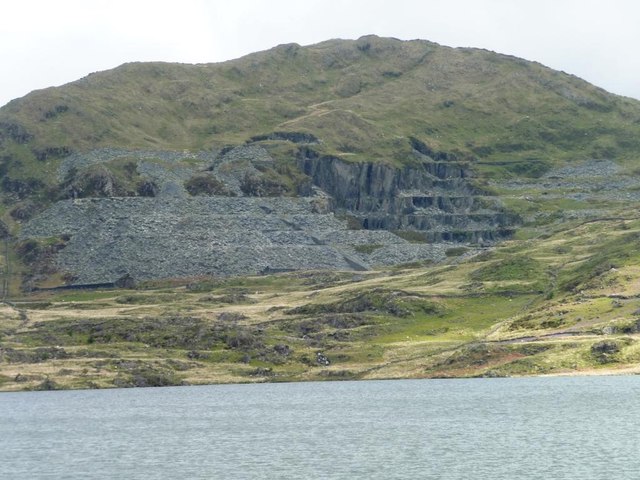
Small-scale working at Gorseddau began as early as 1807, but the quarry's real development came from 1854, when Robert Gill and John Harris took it over with substantial capital investment during the 'Golden Age' of the Gwynedd slate industry, joined by the German mining engineer Henry Tobias Tschudy von Uster. The quarry was laid out on the gallery system pioneered at Penrhyn, with a spinal counterbalance incline linking a sequence of terraces, each with its own gallery, rubble tips and slate-trimming sheds, eventually eight terraces in all. A narrow-gauge railway to Porthmadog, engineered by Brunlees and Fox and built to a high standard for horse haulage, opened in 1857 -- the same year construction began on the nearby Ynysypandy slate mill built to process Gorseddau's output, which itself operated only from 1857 to 1866. Alongside the quarry, a purpose-built village, Treforys -- named for the Porthmadog banker Richard Morris Griffith, who helped finance the venture -- was laid out in three parallel streets of eighteen pairs of rubble-built, single-storey cottages on marshy ground; conditions were hard enough that smallpox was recorded there in 1859. Despite the investment, the rock proved too poor in quality to sustain the operation, and the quarry failed within a few years, probably closing around 1867, having worked for little more than a decade.
Geology
Slate at the head of Cwm Ystradllyn, worked on the gallery system pioneered at Penrhyn, with a spinal counterbalance incline linking a sequence of terraces.
Workings
Worked on the terraced gallery system pioneered at Penrhyn Quarry, with a spinal counterbalance incline serving eight galleries, each with its own rubble tips and trimming sheds; slate was hauled by horse-powered narrow-gauge railway to Porthmadog for export.
Closure
Closed after little more than a decade of heavily capitalised working, once the poor quality of the rock made the operation unviable; the associated Ynysypandy slate mill had already ceased processing by 1866.
What remains
The quarry's original mid-19th-century layout survives largely undisturbed, never overwritten by later, more successful working -- terraces, tips and trimming shelters remain visible, along with the ruins of Treforys village and the route of the Gorseddau tramway, cared for by the Snowdonia (Eryri) National Park Authority and the local community.
Quarry terraces, rubble tips, trimming shelters, the ruined Treforys village, and the trackbed of the Gorseddau tramway.
Related mines
- Prince of Wales Quarry — The two quarries shared the Gorseddau Junction and Portmadoc Railway, and are jointly listed as component parts of the same UNESCO World Heritage Site.
Nearby mines
- Prince of Wales Quarry — 1.8 miles (2.8 km) NW
- Fron-Boeth and Pant Mawr Quarry — 2.1 miles (3.4 km) E
- Sygun Copper Mine — 2.9 miles (4.7 km) NE
- Croesor Quarry — 5.3 miles (8.5 km) E
- Drws-y-Coed Copper Mine — 5.3 miles (8.6 km) N
Straight-line distance, within 9 miles (15 km). Show on the map.
Recorded claims
Individual factual claims, each attached to the source(s) that support it below. Where sources disagree, both are kept.
- The Ynysypandy slate mill, built to process Gorseddau's output, itself operated only from 1857 to 1866. 1
- The quarry's original mid-19th-century layout, including its terraces and the ruins of Treforys village, survives largely undisturbed since the site was never reworked after its early failure. 1,2
- The narrow-gauge railway to Porthmadog, engineered by Brunlees and Fox and opened in 1857, was built to an unusually high standard given it was worked entirely by horse haulage. 1
Photographs & further reading
The fullest account of the quarry's development, the Treforys village and the site's current condition.
View sourceSources
- (secondary) Gorseddau and Prince of Wales Slate Quarries, Railway and Mill — Llechi Cymru (Wales Slate World Heritage Site)
- (observational) Gorseddau Quarry, below Fridd Uchaf (Geograph) — Geograph Britain and Ireland
Record created: 31 August 2026 · Last researched: 31 August 2026