 MineArchive
Prince of Wales Quarry
| Also known as | Bwlch y Ddwy Elor |
|---|---|
| Location | Cwm Trwsgl, Gwynedd — 52.9994, -4.1633 (approximate) |
| Commodity | Slate |
| Type | Slate |
| Worked | 1873–By 1886 |
Overview
A remote Cwm Trwsgl slate quarry, grandly named by its Victorian promoters after Bwlch y Ddwy Elor, worked for barely a decade before poor rock quality and its own overambitious infrastructure brought it to an early close — leaving its buildings and workings unusually intact as a snapshot of a mid-19th-century venture that never had the chance to be modernised.
History
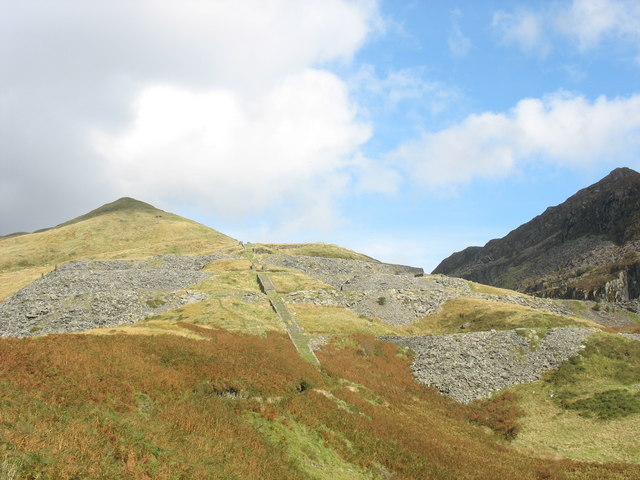
Prince of Wales Quarry — properly named Bwlch y Ddwy Elor, but styled 'Prince of Wales' by the investors who developed it — was opened in 1873 during the 'Golden Age' of the Welsh slate industry, worked across seven gallery levels at the head of Cwm Trwsgl. Its promoters built on an ambitious scale from the outset: a mill for processing slate slab, worker barracks, and its own narrow-gauge railway extension — engineered by James Davids of Caernarfon to a lighter standard than the earlier line it extended — running via Braich-y-bib and Cwm Pennant to link with the existing tramway to the coast at Porthmadog. That original tramway had itself been built in 1857 to serve the neighbouring, equally short-lived Gorseddau quarry, and the extended line, worked from 1875 as the Gorseddau Junction and Portmadoc Railway, added a further five miles to reach Prince of Wales, for a total of thirteen; Prince of Wales in turn supplied most of whatever traffic the line carried during its short life.
Despite the scale of the investment, the quarry proved a costly disappointment: the rock at Cwm Trwsgl turned out to be of poor quality, and the venture failed within only a few years of opening, closing by 1886. Because it closed so early and was never reworked or modernised, Prince of Wales survives today in an unusually complete state — its galleries, barracks, mill and both inclines still showing the site much as it looked at the very start of operations, rather than overlaid by decades of later development as at most surviving Welsh slate quarries. The site was inscribed in July 2020 as part of the Slate Landscape of Northwest Wales UNESCO World Heritage Site, as component part 4 jointly with the neighbouring Gorseddau quarry, railway and mill.
Geology
Slate in Cwm Trwsgl; the rock proved poor, which is why the quarry lasted barely a decade.
Workings
Seven gallery levels reached by upper and lower inclines, served by a purpose-built slab mill, worker barracks, and a dedicated narrow-gauge railway extension linking the quarry to the coast at Porthmadog via the earlier Gorseddau line.
Closure
The quarry closed early and was never reworked or modernised, which is why it survives so completely.
What remains
No public access, but the site is unusually well preserved for its short working life: galleries, splitting and blasting shelters, the barracks and mill, and both inclines survive largely as built, protected within the Slate Landscape of Northwest Wales UNESCO World Heritage Site (inscribed July 2020) and cared for by the local community and the National Park Authority.
Related mines
- Gorseddau Quarry — The two quarries shared the Gorseddau Junction and Portmadoc Railway, and are jointly listed as component parts of the same UNESCO World Heritage Site.
- Lanterdan Quarry — An inland Tintagel slate quarry the sources compare Lanterdan with, both working back from the cliff rather than down to the sea.
- Long Grass Quarry — A neighbouring Tintagel slate quarry.
Nearby mines
- Gorseddau Quarry — 1.8 miles (2.8 km) SE
- Fron-Boeth and Pant Mawr Quarry — 3.5 miles (5.6 km) E
- Sygun Copper Mine — 3.7 miles (5.9 km) E
- Drws-y-Coed Copper Mine — 4.1 miles (6.6 km) N
- Tymawr West Quarry — 4.8 miles (7.7 km) NW
Straight-line distance, within 9 miles (15 km). Show on the map.
Recorded claims
Individual factual claims, each attached to the source(s) that support it below. Where sources disagree, both are kept.
- The quarry, properly named Bwlch y Ddwy Elor but styled 'Prince of Wales' by its developers, was opened in 1873 during the Golden Age of the Welsh slate industry. 1
- The quarry was developed across seven gallery levels with worker barracks and a slab mill, connected by a dedicated narrow-gauge railway extension engineered by James Davids of Caernarfon. 1,2
- The Gorseddau Junction and Portmadoc Railway's extension to Prince of Wales, opened 1875, added five miles to the existing line for a total of thirteen, and the quarry supplied most of the railway's traffic during its existence. 2
- The venture failed within a few years of opening, closing by 1886, owing to the poor quality of the rock at the site. 1
- Because it closed so early and was never reworked, the site survives in an unusually complete, unmodernised state, and was inscribed in July 2020 as component part 4 of the Slate Landscape of Northwest Wales UNESCO World Heritage Site. 1
Sources
- (secondary) Gorseddau and Prince of Wales Slate Quarries, Railway and Mill — Llechi Cymru (Wales Slate World Heritage Site)
- (secondary) Gorseddau Junction and Portmadoc Railway — Wikipedia
Record created: 26 August 2026 · Last researched: 26 August 2026