 MineArchive
Miners' Barracks
| Also known as | Mine shop (North Pennines), Mineshop (North Pennines), Lodging shop (North Pennines), Barracks (Cornish and Welsh) |
|---|---|
| Category | Structures & Machinery |
A lodging house built at a mine for men who lived too far away to walk home — a barracks, mine shop or lodging shop where a shift slept, ate and dried its clothes from Monday to Saturday.
Historical usage
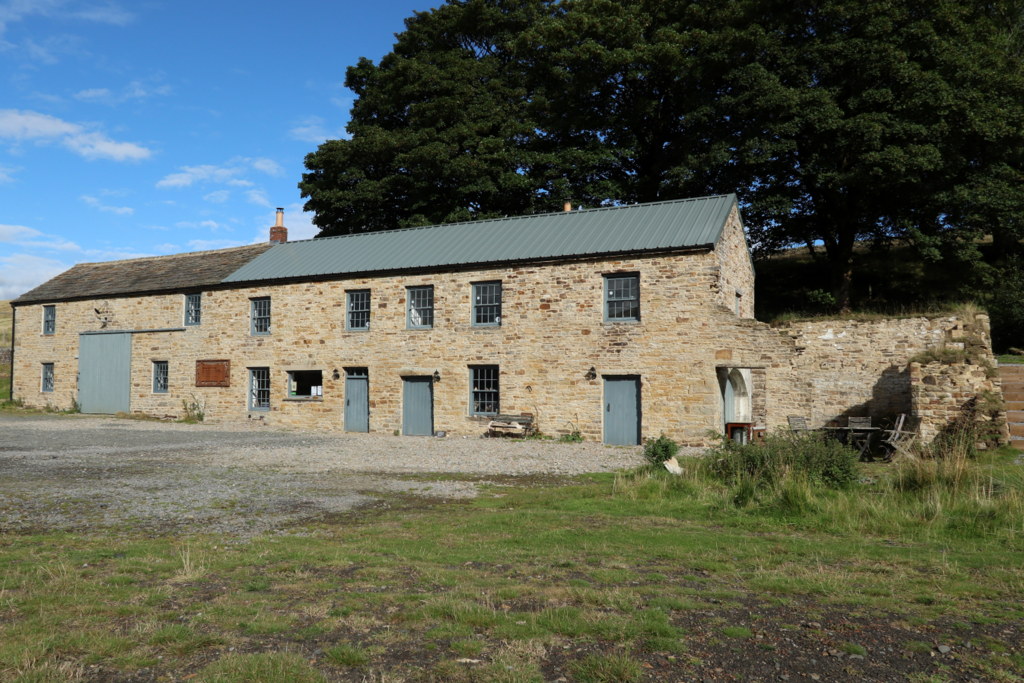
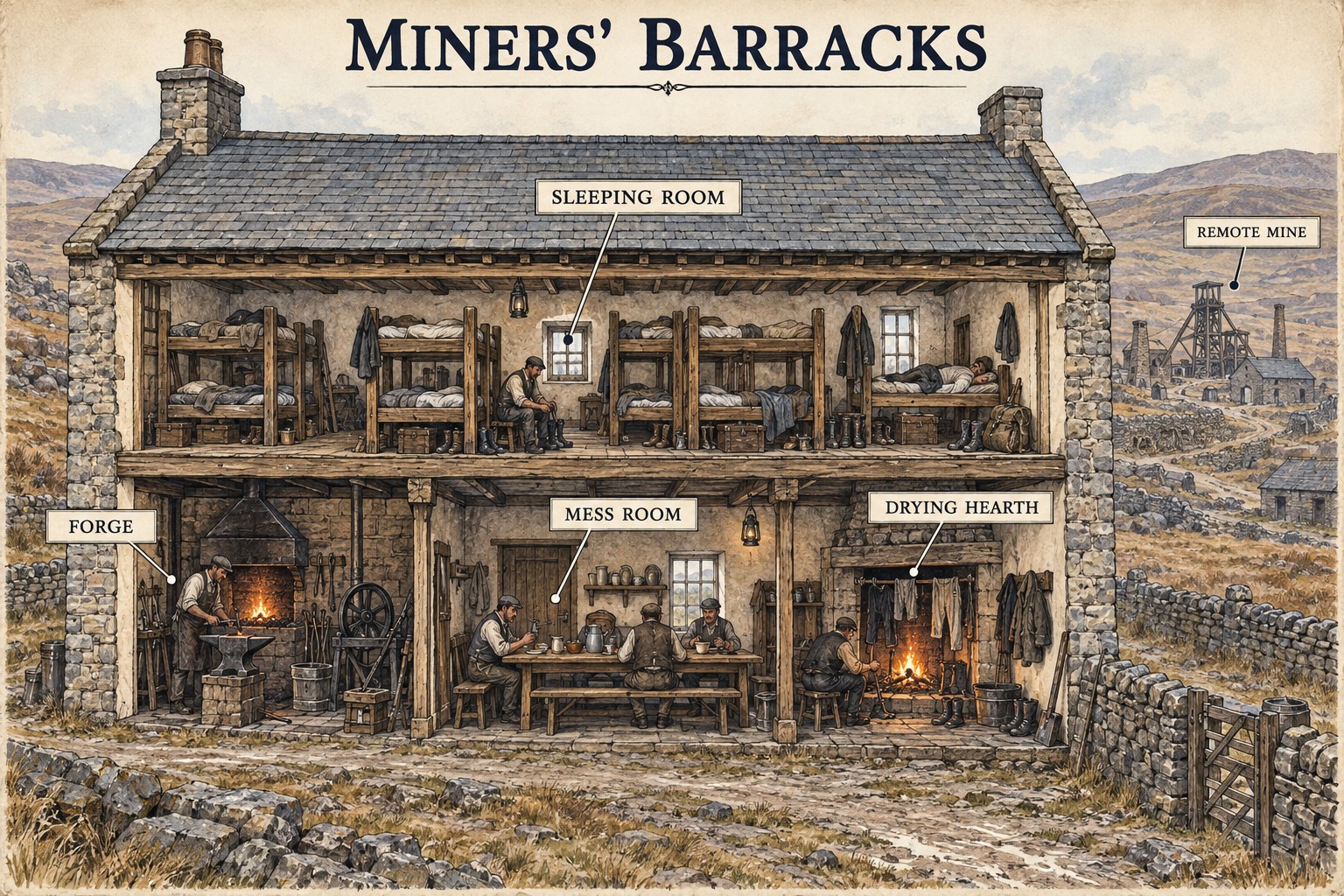
Wherever mines were high, remote and far from any village, the alternative to a barracks was a walk of many miles over open moor twice a day, in all weathers. The North Pennines companies built them as a matter of course: Killhope's mineshop went up in 1858, and the lodging shop at Carrshield in the West Allen valley — the largest in the north Pennines, two storeys, with arched furnace openings and a blacksmith's forge inside — served the lead mines there. Nenthead had two mineshops standing south of its assay house. The practice was not confined to the Pennines: the Britannia mine on Snowdon built a barracks beside Llyn Llydaw for a hundred men, and the Lundy Granite Company housed its workers first in wooden huts and then in stone buildings north of Quarter Wall.
How it worked
The building was usually the largest at the mine after the dressing floor, and often did more than one job: at Carrshield the same structure held the forge, and at other mines the lodging shop stood alongside the agent's office and the smithy as part of one range. Men walked in at the start of the week and back out at the end of it, sleeping at the mine in between — which is why the barracks, rather than the shaft, is frequently the largest ruin left standing on a remote site today.
Why it was used
Because the ore was where it was. A mine at 1,500 feet on Alston Moor or above Llyn Llydaw could not draw on a local workforce, and a company that wanted men underground for a full shift could not have them spending three hours a day walking to it.
Risks & limitations
The reputation of the mine shops was poor and their conditions were a standing complaint of 19th-century mining reform: crowded rooms, wet clothes drying where men slept, and no separation between living and working life for six days a week. Their remoteness is also why so many are now roofless — once the mine closed there was no other use for a large stone building miles from anywhere.
Regional variation
'Mine shop' and 'lodging shop' are the North Pennines words, and the surviving examples there are the best known; 'barracks' is the usual term in Wales and Cornwall for the same thing. Some have found new uses — the Carrshield shop, saved from collapse in 2017-18, is now a camping barn, and Killhope's mineshop was the first building restored when the site became a museum.
Related terminology
Captain, Coe, Count House, Mine Dry, Putter
Mines associated with this term
5 examples chosen from 32 linked records — the term page is not an index.
- Killhope Lead Mine — County Durham (surviving physical example)
Killhope's mineshop was the first building restored when the site became a museum, opening to the public in 1984. - Nenthead Mines — Cumbria (surviving physical example)
Two mineshops — lodging houses for the miners — stand south of the assay house. - Carrs Mine — Cumbria (well documented example)
Named twice in this record, first in the history: “…Alston Moor; the Old Carrs Level, whose collapsed arched portal and mineshop, Carr's Shop, survive 150 m south-east of the smelt mill, was worked…” - Carshield Mine — Northumberland (well documented example)
Named 6 times in this record, first in the history: “…many men lived in scattered smallholdings, so the company provided lodging shops. The Barney Craig mine shop is the biggest in the North Pennines:…” - Esgair Hir and Esgair Fraith Mines — Powys (well documented example)
Named twice in this record, first in the current condition: “A substantial range of ruins survives, including barracks, the 1872 engine house and crushing mill, blocked Crown Pits shafts,…”
Sources
- (primary) Lead mines, ore works and smeltmill at Nenthead, Alston Moor — scheduled monument — Historic England (via Ancient Monuments)
- (secondary) Carrshield mine shop history — Carrshield Camping Barn
Record created: 25 August 2026 · Last researched: 25 August 2026