 MineArchive
Carshield Mine
| Also known as | Carrshield Mine, Carr Shield Mine, Barney Craig Mine |
|---|---|
| Location | Carrshield, West Allendale, Northumberland — 54.8149, -2.3070 (approximate) |
| Commodities | Lead, Barite, Fluorspar, Zinc |
| Type | Metal |
| Worked | 1770s–1913 |
| Maximum depth | Unknown. |
| Operators | W. B. Lead Company (1770–1880), Vieille Montagne Zinc Company (1899–1914), Allendale Metalliferous Mining Company (1950–?) |
Overview
Carrshield sits in West Allendale in the North Pennines, and the mining around it runs through three centuries. The Beaumont Lead Company opened the Barney Craig Horse Level in the 1770s and it stayed in use through the nineteenth century, when the mine was the centre of a community of more than five hundred. By 1880 the lead was regarded as exhausted; in 1899 the Belgian firm Vieille Montagne reopened the workings for zinc and worked them until 1913. The 1914 statutory return still enters Carshield under that company with eighty-eight men underground.
History
The visible remains of the lead industry at Carrshield represent several phases of working over three centuries. The earliest known activity is the Barney Craig Horse Level, opened by the Beaumont Lead Company in the 1770s and continued in use throughout the nineteenth century - though the first workings on the Barneycraig Vein were older still, from three surface shafts called the Low, Middle and High Whimseys. The level itself is a substantial piece of driving: it starts beneath the Great Limestone, runs straight for more than 1,110 metres, then branches west by the Flank Level towards the Low Coalcleugh Vein and carries on another 880 metres to the Whitewood and Barneycraig veins. The workings on its west side came in between 1808 and 1823 and proved very rich, with many large flats in the Great Limestone belt.
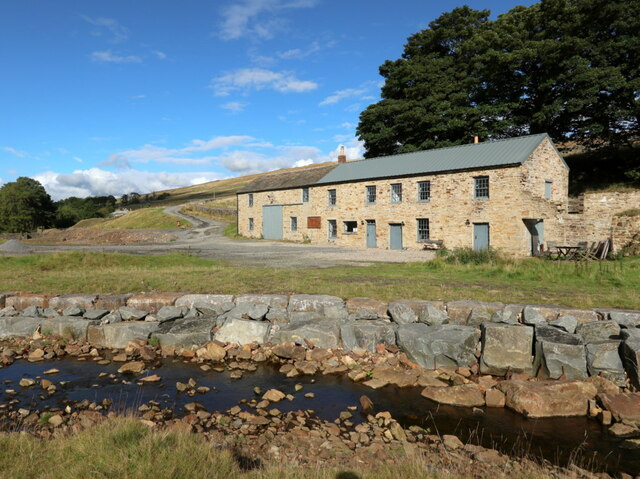
At its height the mine was the centre of a large community. It employed more than five hundred people at one time, and in 1861 there were forty-four houses in the Coalcleugh and Carrshield area, most of the farms round about occupied by miners or smelters and others connected with the mine. There was not enough private accommodation for the workforce, and many men lived in scattered smallholdings, so the company provided lodging shops. The Barney Craig mine shop is the biggest in the North Pennines: besides somewhere for the miners to eat and sleep it held blacksmiths' forges and other workshops, and it still has several of its arched furnace openings and a forge inside. The chief agent of the London Lead Company, writing of Alston Moor in 1857, caught the character of such places - the population was so mixed up, the farming with the mining, that they were almost all as one.
By 1880 the lead deposit was regarded as exhausted. In 1899 the Vieille Montagne Zinc Company reopened the workings to mine for zinc ore, and mining continued until 1913. The 1914 List of Mines nonetheless still enters Carshield at West Allendale under Vieille Montagne of Nenthead, working lead ore and zinc ore, with eighty-eight men underground and two at surface - a substantial return for a mine generally described as having stopped the year before, and the two statements are recorded here side by side rather than reconciled. The Belgian company worked the ground in a way that left Carrshield out of it altogether: it drove from Rampgill Shaft at Nenthead to meet the Barneycraig Level and the Four Fathom Limestone Level below it, and every ton came out at the Rampgill portal on the other side of the watershed. Taking Coalcleugh and Barneycraig together, the 1952 trade-journal survey puts the Beaumont Company's output at 187,924 tons of lead concentrates between 1729 and 1878, and Vieille Montagne's at 6,687 tons of lead and 52,566 tons of zinc concentrates between 1899 and 1920.
Further reworking of the deposits was carried out in 1950 by the Allendale Metalliferous Mining Company, and the complex's second mine, Scraithole, reopened in the 1950s and worked until 1981. Lead first, then zinc, then barytes and fluorspar: the mid-1700s to the early 1980s, on ground that kept finding another use for what the last generation had left.
Geology
This is the North Pennine orefield, where lead occurs in near-vertical veins cutting a Carboniferous sequence of limestones, sandstones and shales, and is richest where a vein crosses a competent bed. Zinc, as sphalerite, sits alongside the galena in the same veins, and it is the reason the ground had a second life: the nineteenth-century lead miners left the zinc as waste, and when the lead was worked out the zinc was still there for a company that wanted it. Witherite and barytes occur in the same district. During the 18th and 19th centuries Britain was the main producer of lead in the world, the North Pennines was the main lead-producing area in Britain, and about a third of the country's lead came from this ground.
Geological setting: Veins and Lodes (well documented example)
Workings
The Barney Craig Horse Level, driven from the 1770s, is the earliest known working and remained in use through the nineteenth century - a horse level being one driven large enough to bring wagons out by horse rather than by hand. It starts beneath the Great Limestone and runs straight for over 1,110 metres, branching west by the Flank Level to the Low Coalcleugh Vein and continuing another 880 metres to the Whitewood Vein on the east, which is the continuation of the Rampgill Vein, and the Barneycraig Vein on the west, which connects through to Rampgill Mine; eastward the same vein reaches the Swinhope Low Level as Williams Vein. Before the level there were three surface shafts, the Low, Middle and High Whimseys, and an internal level, the Galloway Level, was later driven in the shale above the Great Limestone. Around the portal are the ore works: bouse teams, a washing floor, settling reservoirs and the dressing floors whose remains survive by the West Allen, with the Barney Craig mine shop, the largest miners' lodging shop in the North Pennines. The 1914 return's eighty-eight men underground against two at surface indicates the Vieille Montagne working was almost entirely below ground - and that company took its ore out at Rampgill, not here.
Closure
Two endings for the lead and zinc, and they do not quite agree. The lead deposit was regarded as exhausted by 1880, and the zinc working that the Vieille Montagne Zinc Company began in 1899 is described as continuing until 1913 - yet the statutory return for 1914 still enters the mine under that company with eighty-eight men underground. Both are recorded. There was a further reworking of the deposits in 1950 by the Allendale Metalliferous Mining Company, and the complex's other mine, Scraithole, reopened in the 1950s and worked on until 1981, which is where mining at Carrshield actually stops.
What remains
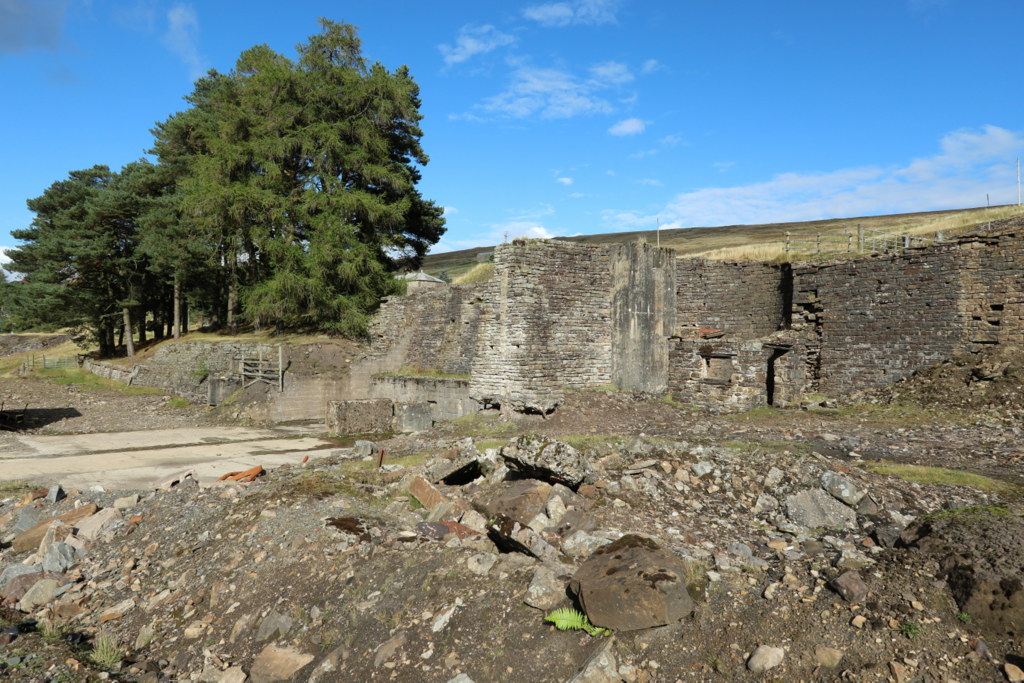
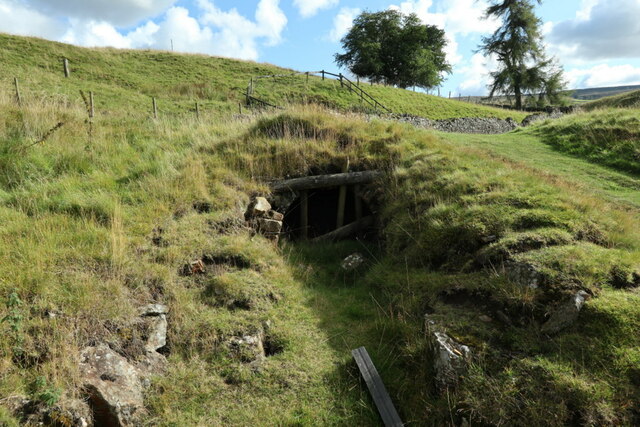
The complex is a scheduled monument, list entry 1015849, and a good deal of it survives: the bouse teams, the washing floor buried under later dressing waste, the settling reservoirs, the revetted river with some of its arches, and the Grade II listed adit portal of the Barney Craig Horse Level. The mine shop, at imminent risk of collapse in 2017, was renovated in 2017-18 with Historic England and Heritage Lottery funding and its upper floors are now a camping barn. Underground the Barneycraig Level is blocked, and an attempt to dig through near the Flank Level junction was defeated by air low in oxygen and high in carbon dioxide. The site's other legacy is in the river: metal-bearing water draining mainly from the Barney Craig adit pollutes at least 40 kilometres of the West Allen and South Tyne, with zinc downstream running at up to 180 times the level safe for river wildlife. The tailings dam has been reprofiled and stabilised and a mine-water treatment scheme is being developed.
The Grade II listed round-arched adit portal of the Barney Craig Horse Level; the Barney Craig mine shop, the largest miners' lodging shop in the North Pennines, with arched furnace openings and a blacksmiths' forge inside and culverts around it; a series of bouse teams 26 metres long; the washing floor beneath later dressing waste, with two settling reservoirs above it; the stone revetment of the West Allen, listed Grade II on the east side, with some of the arches that carried a raised extension of the washing floor; a Grade II listed early nineteenth-century bridge and the portal and chamber of a drainage tunnel; two probable hushes twelve to fourteen metres wide; an extensive spoil heap overlying an earlier lynchet; and the remains of a railway line and the tracks to the waste heaps.
Redevelopment
The Barney Craig mine shop was gifted by the Allendale Estate to Allen Valleys Enterprise, a community benefit society, in 2017 when it was close to collapse, and renovated over 2017-18 with Historic England and Heritage Lottery Fund money using traditional methods and the building's own materials. Its upper floors are now a camping barn, which keeps the largest lodging shop in the North Pennines doing roughly what it was built for.
Related mines
- Coalcleugh — Two mines of one sett, worked together by the Beaumont Company from 1729 to 1878 and by Vieille Montagne from 1899, and physically joined: the Barneycraig Horse Level, driven from the Carrshield end about 1760, branches west by the Flank Level to the Low Coalcleugh Vein. The 1952 trade-journal survey gives their output as one figure.
- Nentsbury Mine — Both were held by the Vieille Montagne Zinc Company, which bought up the Alston Moor leases in 1896 and reopened the worked-out lead ground at Carrshield for zinc in 1899. The two are a few miles apart across the Cumberland-Northumberland watershed and appear in successive statutory returns under the same Belgian owner.
- Rampgill Mine — The Barneycraig Vein connects with Rampgill Mine and the Whitewood Vein is the continuation of the Rampgill Vein; Vieille Montagne drove from Rampgill Shaft to join the Barneycraig Level and took every ton of this ground's ore out through the Rampgill portal.
- Rodderup Fell Mine — Two of the Vieille Montagne company's North Pennine mines, taken up within a few years of its arrival in 1896 — Carrshield reopened for zinc in 1899, Rotherhope Fell's lease bought in 1900 — and worked by it until the company left England in 1949.
- Scraithole Mine — The two mines of the same scheduled complex at Carrshield, sharing its lodging shop, washing floor and hushes; Scraithole is the second of the two and outlasted the other by a century.
- Swinhope Mine — The Barneycraig Vein runs east and connects with the Swinhope Low Level, where the same structure is called Williams Vein.
Nearby mines
- Scraithole Mine — 0.2 miles (0.3 km) N
- Coalcleugh — 0.9 miles (1.5 km) S
- Swinhope Mine — 1.3 miles (2.1 km) E
- Brownley Hill Mine — 1.9 miles (3.1 km) SW, Cumbria
- Rampgill Mine — 2.0 miles (3.3 km) S, Cumbria
Straight-line distance, within 9 miles (15 km). Show on the map.
What's uncertain
Points where sources disagree or the record could not be settled; both accounts are kept. All open questions in the archive.
- By 1880 the lead deposit was regarded as exhausted, but in 1899 the Vieille Montagne Zinc Co reopened the workings to mine for zinc ore and mining continued until 1913. (disputed) 1
- The 1914 List of Mines records Carshield at West Allendale under the Vieille Montagne Zinc Co. of Nenthead, working lead ore and zinc ore, with 88 employed underground and 2 at surface. (disputed) 2
Recorded claims
Individual factual claims, each attached to the source(s) that support it below. Where sources disagree, both are kept.
- The visible remains at Carrshield represent several phases of mining over three centuries, the earliest known activity being the Barney Craig Horse level, opened during the 1770s and continued in use throughout the 19th century. 1
- The mine was the centre of a huge community and at one time employed more than 500 people; in 1861 there were 44 houses in the Coalcleugh and Carrshield area. 1
- The mining company provided lodging shops for men who could not be housed privately, and the Barney Craig mine shop is the biggest in the North Pennines, containing two blacksmiths' forges and other workshops as well as sleeping and eating quarters. 1
- By 1880 the lead deposit was regarded as exhausted, but in 1899 the Vieille Montagne Zinc Co reopened the workings to mine for zinc ore and mining continued until 1913. (disputed) 1
- The 1914 List of Mines records Carshield at West Allendale under the Vieille Montagne Zinc Co. of Nenthead, working lead ore and zinc ore, with 88 employed underground and 2 at surface. (disputed) 2
- Further reworking of the deposits was carried out in 1950 by the Allendale Metalliferous Mining Company. 1
- Carrshield is surrounded by fell ground littered with old disused mines, and the remnants of the old stone works where the lead was mined can still be seen next to the river. 3
- The scheduled monument, list entry 1015849 and first listed on 8 July 1997, includes the remains of two lead mines and an ore works on the base and lower slopes of the West Allen valley. Historic England's reason for designating it is that despite later working, the site retains a good number of components including the largest lodging house in the north Pennines and an intact washing floor beneath later waste heaps. 4
- Ore was stored in tall stone containers called bouse teams, of which a series 26 metres long survives in the central area, modified later but still readable in its nineteenth-century form. North of them lay the washing floor, now buried under later dressing waste but thought largely to survive; the Ordnance Survey editions of 1859 and 1895 show the small structures and tanks used there and the 1919 edition shows more. Two reservoirs of 50 by 12 metres and 65 by 20 metres above the washing floor are thought to have been settling tanks, and documentary sources record a crushing mill at Barney Crag in the 1860s and 1870s whose position is unknown. 4
- The River West Allen runs through the centre of the complex, revetted with stone walls that are thought originally to have carried nineteenth-century arches along their whole length, supporting a raised floor that extended the washing area; a number of the arches survive, and the eastern revetment is listed Grade II. So are the early nineteenth-century bridge across the river and the portal and chamber of a drainage tunnel twenty metres from it. 4
- Two water-cut features twelve to fourteen metres wide, on the left bank opposite the lodging house, are thought to be hushes - gullies excavated by a controlled torrent of water released to strip the ground and expose a vein - and are probably nineteenth century. 4
- The two-storey lodging shop, the largest in the north Pennines, retains original internal features including several arched furnace openings and a blacksmiths' forge, and is surrounded by a series of culverts, some thought to have drained the mines and others part of the water-management system for ore processing. 4
- The round-arched adit of the Barney Crag Horse Level, built of roughly squared rubble, is listed Grade II and probably eighteenth century; it stands at NY 803 467 on the east bank of the River West Allen. 4,5
- The Barneycraig Horse Level starts beneath the Great Limestone and runs straight for over 1,110 metres before branching west by the Flank Level towards the Low Coalcleugh Vein, carrying on a further 880 metres to the Whitewood Vein - the continuation of the Rampgill Vein - and the Barneycraig Vein, which connects with Rampgill Mine. Eastward the Barneycraig Vein connects with the Swinhope Low Level, where it is known as Williams Vein. The first workings were from three surface shafts, the Low, Middle and High Whimseys. 6
- Vieille Montagne drove from Rampgill Shaft in Rampgill Mine to join the Barneycraig Level and the Four Fathom Limestone Level, 16 and 40 metres below the Rampgill Horse Level horizon, and all the ore from both was taken to Rampgill Shaft and raised through the Rampgill portal - so the zinc from this ground never came out at Carrshield at all. 6
- The 1952 trade-journal survey treats Coalcleugh and Barneycraig as one sett: 187,924 tons of lead concentrates under the Beaumont Company from 1729 to 1878, with 311 tons of zinc concentrates between 1874 and 1880, then 6,687 tons of lead and 52,566 tons of zinc concentrates under Vieille Montagne between 1899 and 1920, with silver at about 8 ounces to the ton of lead. 7
- The workings on the west side of the Barneycraig Level became active between 1808 and 1823 and proved very rich in the Great Limestone belt, where many large flats were found. 7,6
- The Mining Remediation Authority's account of the site records that the two mines, originally worked for lead, were also later mined for barytes, fluorspar and zinc, and dates working across the complex from the mid-1700s to the early 1980s. 8
- The second mine of the complex was Scraithole, worked through the nineteenth century by the Beaumont Company, reopened in the 1950s and operational until 1981. 4
- The River West Allen is polluted by metal-bearing mine water draining from these workings, the main source being the Barney Craig adit dug in the 1760s. The pollution reaches at least 40 kilometres of the West Allen and the South Tyne, and zinc concentrations measured downstream of the mine can be up to 180 times the safe level for river wildlife. The tailings dam has been reprofiled and stabilised and a treatment scheme for the mine water is being developed, with public engagement held in the mine shop in October 2025. 8
- By 2017 the mine shop was at imminent risk of collapsing beyond repair. It was gifted by the Allendale Estate to Allen Valleys Enterprise, a community benefit society, and renovated during 2017-18 with funding from Historic England and the Heritage Lottery Fund using traditional methods and the existing materials; its upper floors are now in use as a camping barn. 4
Photographs & further reading
A local account of the mining that built the village — the Barney Craig level, the five hundred-strong workforce, the lodging shops, and the shift from lead to Belgian-owned zinc after 1899.
View sourceThe Mining Remediation Authority's project page for the site, on the mine water draining from the workings, how far down the West Allen and South Tyne it reaches, and the treatment scheme being developed.
View sourceThe society's account of the level: its length and branches, the veins it reaches, the connections to Rampgill and Swinhope, and its blocked and airless state today.
View sourceThe restored mine shop's own history page, which reproduces Historic England's scheduling text for the Carrshield lead mines and ore works in full and describes the 2017-18 renovation.
View sourceSources
- (secondary) Steeped in history — Carrshield Village Hall
- (primary) 1914 List of Mines under the Metalliferous Mines Act: Northumberland — Durham Mining Museum
- (observational) Carrshield lead mines and ore works (photograph) — Geograph Britain and Ireland
- (secondary) Carrshield mine shop history — Carrshield Camping Barn
- (secondary) Adit portal of Barneycraig Horse Level, east bank of the River West Allen (listed Grade II) — British Listed Buildings
- (observational) Barneycraig Level — Mine Explorer Society — Mine Explorer Society
- (secondary) Lateral Science: A Couple of North Pennines Lead Mine Articles from Mine & Quarry Engineering — Lateral Science
- (primary) Barney Craig — Water and Abandoned Metal Mines Programme — Mining Remediation Authority
Record created: 5 September 2026 · Last researched: 28 September 2026