 MineArchive
Horse Level
| Category | Mine Workings & Access |
|---|
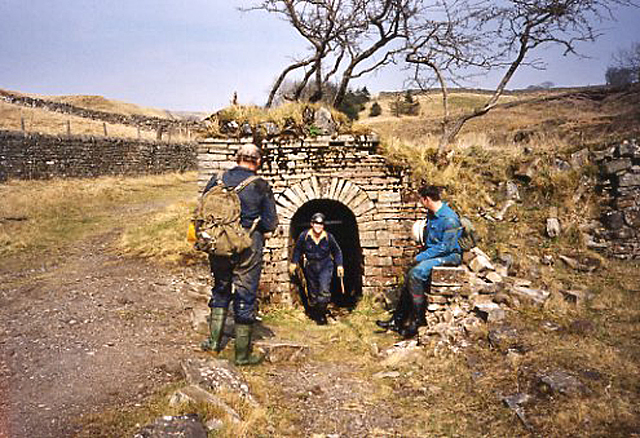
An adit or level driven deliberately large enough for a horse to walk through pulling a loaded cart or wagon, rather than sized for miners on foot alone — a specific, purpose-built category of level found throughout the North Pennine lead orefield and beyond, distinct from a narrower man-only adit.
Historical usage
Horse levels began to be driven in the North Pennine orefield from the 1780s and 90s onward, as mines pushed deeper and the volume of ore needing to be hauled out grew beyond what men alone could economically carry. They remained a standard feature of the region's larger lead mines throughout the 19th century, and several — including Coalcleugh's mile-long Barneycraig Horse Level, begun around 1760, and Allenheads' horse track, a spiral incline at 1-in-4 descending nearly 100 metres — represent some of the most substantial single pieces of underground infrastructure their mines ever built.
How it worked
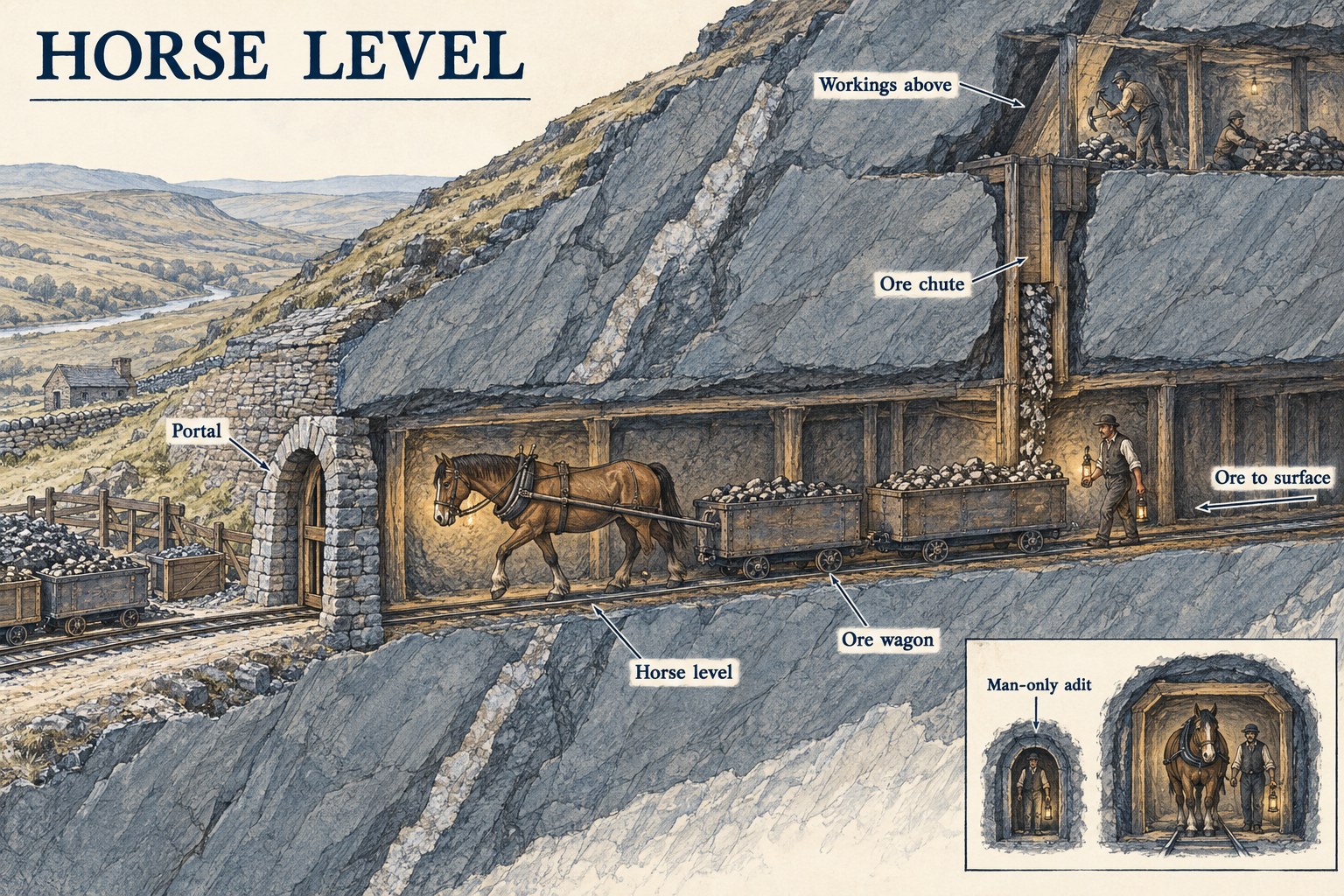
Built to a recognised standard size well beyond that of an ordinary man-height adit, a horse level let a horse, harnessed to a rail-mounted wagon or cart, walk directly into the workings and haul ore straight out to the surface, sometimes for a mile or more. Where a vein lay some way underground, ore could be dropped straight down from workings above into waiting horse wagons at the level itself, cutting out a separate stage of hand-carrying or hoisting altogether.
Why it was used
Hauling ore by horse and cart through a large level was far faster and cheaper per ton than carrying it out by hand, or than a series of smaller shafts and separate hoisting stages — a single well-driven horse level could serve as the main haulage route for a large mine's entire output, justifying the substantial up-front cost of driving a tunnel far bigger than strictly needed for access alone.
Risks & limitations
Driving a level to horse-sized dimensions, rather than the minimum needed for men to pass, meant substantially more rock to remove for the same distance, a real cost that only paid off on a mine large and long-lived enough to make full use of the resulting haulage capacity — smaller or shorter-lived workings had little reason to build on this scale.
Regional variation
The North Pennine orefield is where the purpose-built horse level is most concentrated, but the practice was not confined to it. In the Yorkshire Dales lead mines ponies hauled the wagons in levels large enough to take them, where elsewhere in the same district miners pushed the wagons themselves. Two features of level driving worked in the horse's favour wherever it was used: levels were normally driven slightly uphill from the entrance so that water drained out, which meant a loaded wagon ran downhill towards daylight, and metal track-ways were laid along them for the wagons to run on.
Related terminology
Mines associated with this term
5 examples chosen from 18 linked records — the term page is not an index.
- Caplecleugh Mine — Cumbria (well documented example)
Named twice in this record, first in the history: “…Montagne Zinc Company took over in 1896 and extended the Caplecleugh Horse Level both east and west along the Browngill Vein specifically to work…” - Carrs Mine — Cumbria (well documented example)
Named 5 times in this record, first in the summary: “…in the district. The London Lead Company drove its stone-arched horse levels in the early nineteenth century, the Belgian Vieille Montagne…” - Carshield Mine — Northumberland (well documented example)
Named 4 times in this record, first in the summary: “…three centuries. The Beaumont Lead Company opened the Barney Craig Horse Level in the 1770s and it stayed in use through the nineteenth century,…” - Hurst Mines — North Yorkshire (well documented example)
Named in this record’s workings: “…Shaft, 40 fathoms deep with its own chimney and steam engine; Hurst Horse Level, the highest major level at 1277ft; and Wellington Whim Shaft on…” - Allenheads Mines — Northumberland (well documented example)
The mine's own recorded history explicitly describes Fawside Level as a horse level.
Disasters associated with this term
Included only where MineArchive's own research gives a reasonable evidential basis, with the nature of the relationship stated — not every disaster where this term might plausibly apply.
- Mossfield Colliery explosion, 1889 (contextual relationship)
Named in this record’s narrative: “…ran right up to the face; in the Cockshead the air crossing on the horse level was destroyed and almost all the timber blown out. Sixty-four of the…”
Sources
- (secondary) Adit — Wikipedia
- (secondary) Lateral Science: A Couple of North Pennines Lead Mine Articles from Mine & Quarry Engineering — Lateral Science
- (secondary) Mining Methods: Levels, Stopes, Deads and Spoil — Lead Mining in the Yorkshire Dales — MyLearning / Yorkshire Dales
Record created: 22 August 2026 · Last researched: 9 September 2026