 MineArchive
Carrs Mine
| Location | Nenthead, Alston Moor, Cumbria — 54.7828, -2.3358 (approximate) |
|---|---|
| Commodities | Lead, Zinc |
| Type | Metal |
| Worked | By 1679–early 1940s |
| Maximum depth | Worked by horizontal levels driven from the valley side rather than by shafts; the horse level sits below the Smallcleugh Cross Vein and drains through sumps down into the Rampgill mine beneath, so no depth figure applies in the usual sense. |
| Operators | London Lead Company (1800–1882), Vieille Montagne Zinc Company (1896–?) |
Overview
A lead and zinc mine at the heart of the Nenthead complex on Alston Moor, first recorded in 1679 and by 1750 one of the largest mines in the district. The London Lead Company drove its stone-arched horse levels in the early nineteenth century, the Belgian Vieille Montagne company reworked it for zinc with compressed-air drills in the twentieth, and its outer workings now form the Nenthead Mines visitor mine, the only part of the complex regularly opened to the public underground.
History
Carrs Mine takes its name from the Carr Burns that join to form the River Nent below Nenthead, and is divided into Carrs East of Nent and Carrs West of Nent, the western part now inaccessible where its levels have collapsed. It was first recorded in 1679, and by 1750 was among the largest mines on Alston Moor; the Old Carrs Level, whose collapsed arched portal and mineshop, Carr's Shop, survive 150 m south-east of the smelt mill, was worked from before 1737 until at least 1772, and Carrs Mine appears on the Alston Moor plan of 1773. From about 1800 the Quaker London Lead Company, already running most of the Nenthead mines under lease from the Greenwich Hospital estate, took the mine over and applied its methods: horse haulage on tram rails through levels lined with superb dry-stone arching, corbelled and walled from the mine's own deads. The company worked Carrs East principally between 1848 and 1881, following the Rampgill Hangingshaw branch level and the Smallcleugh Cross Vein beneath Smallcleugh Mine, and opening flats, the horizontal replacement bodies in the limestone, on more than one level. When the London Lead Company gave up Alston Moor in 1882 the Nenthead leases passed to the Nenthead and Tynedale Company and then, in 1896, to the Vieille Montagne Zinc Company of Belgium, which reworked Carrs for zinc in the early twentieth century, bringing in compressed-air rock drills fed from a hydraulic compressor house on the Nent that still stands. Zinc working at Nenthead ended in the early 1940s. In 1966 the Northern Cavern and Mine Research Society found Carr's Level open for a short distance, with a collapse reported to have cut off the innermost workings. From the 1990s the North Pennines Heritage Trust developed the outer levels as a show mine, and since the Trust's collapse the Nenthead Mines Conservation Society has owned the site and opens Carrs on advertised days and to booked groups, with trips beyond the gate into the flats for experienced parties.
Geology
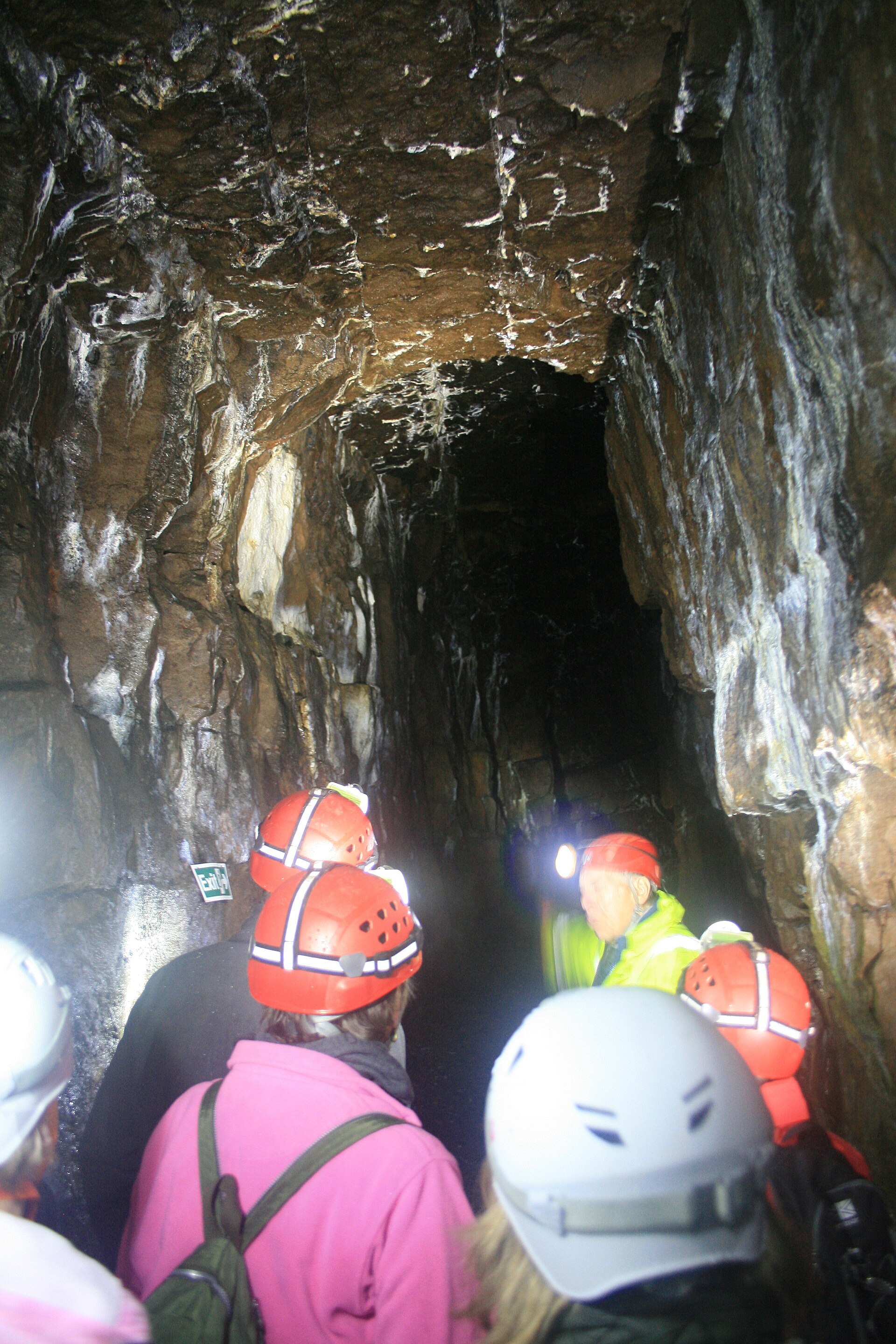
A vein-and-flat deposit of the Alston Block of the North Pennine Orefield: lead and zinc ores (galena and sphalerite) with fluorite and other gangue in near-vertical veins cutting the Carboniferous limestones and sandstones, and in flats, the bedded replacement bodies that spread out from the veins into the Great Limestone. Carrs worked the Smallcleugh Cross Vein and Carrs Cross Vein West, with three flats beyond the show mine, and the horse level shows the mineralisation in the walls; secondary hydrozincite, some pristine white, has formed on the old zinc workings.
Geological setting: Veins and Lodes (surviving physical example)
Workings
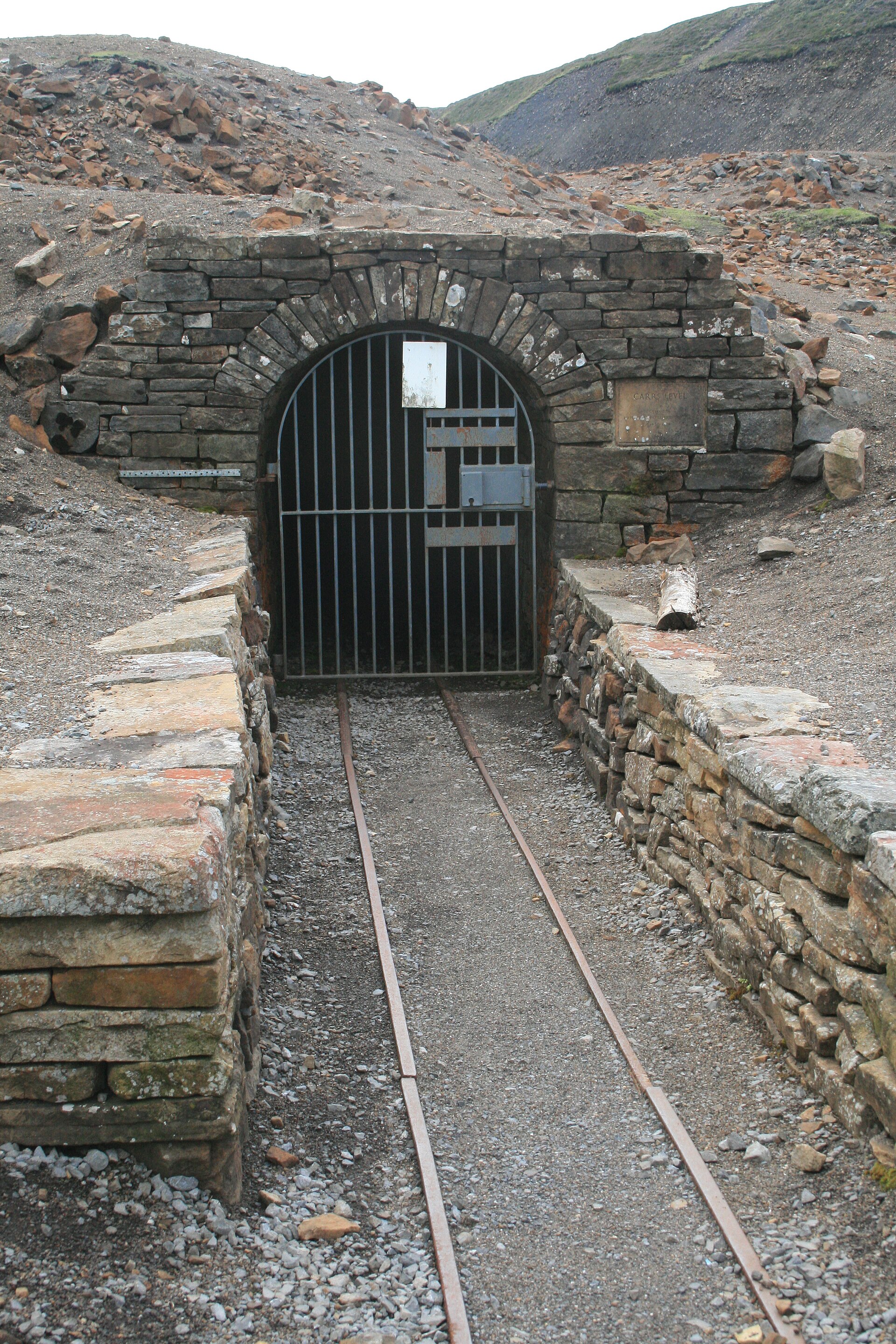
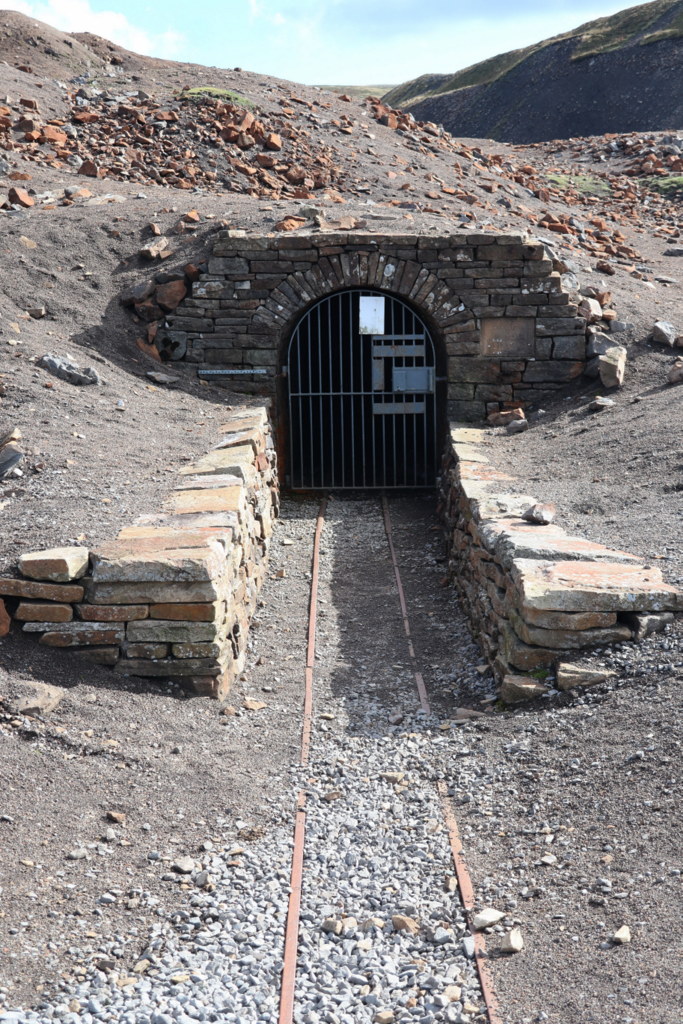
Adit levels at successive horizons, connected by walled shafts and ladders: the show mine along the horse level with its iron rails and a surviving mine wagon, then the gate and the 'real' mine beyond, a middle level used as a dump for deads, three flats reached by ladder up a walled shaft, and a waterfall branch level. The horse levels are lined with dry-stone arching and corbelling of unusual quality; timbered rises, ore chutes, a calcite-lined 'grotto' and open sumps dropping to deeper workings lie beyond the show mine. The mine lies beneath Smallcleugh and above Rampgill and is connected to both, so that a through route from Smallcleugh into Carrs exists though it is difficult.
Closure
Lead working under the London Lead Company ended with the company's withdrawal from Alston Moor in 1882 as lead prices collapsed against cheap imports; the Vieille Montagne Zinc Company's reworking of the Nenthead mines for zinc ran on until the early 1940s. No source gives a closing date specific to Carrs.
What remains
Open, maintained and partly a show mine. The outer levels are gated and lit for visitors; the workings beyond are explored by the Conservation Society, mine-exploration clubs and the Northern Mine Research Society, whose 2019 visit found the arching, walled shaft and flats in good order and the horse level draining through sumps to Rampgill. On the surface the collapsed Old Carrs Level portal, its spoil tips and Carr's Shop are part of the scheduled monument covering the Nenthead mines.
Old Carrs Level portal (collapsed for its first 4 m), two spoil tips and the roofed single-storey mineshop known as Carr's Shop, within the scheduled lead mines, ore works and smelt mill at Nenthead; the Vieille Montagne compressor house on the Nent nearby.
Redevelopment
Show mine and heritage site under the Nenthead Mines Conservation Society.
Related mines
- Nenthead Mines — Carrs is one of the constituent mines of the Nenthead complex and its visitor mine, worked under the same London Lead Company and Vieille Montagne leases.
- Rampgill Mine — Carrs follows the Rampgill Hangingshaw branch level and its horse level drains through sumps down into Rampgill beneath.
- Smallcleugh Mine — Carrs lies directly beneath Smallcleugh and worked the Smallcleugh Cross Vein; the two are connected underground and a through route from Smallcleugh into Carrs exists.
Nearby mines
- Nentsbury Mine — 0.2 miles (0.4 km) E
- Dowgang Mine — 0.4 miles (0.6 km) N
- Longcleugh Mine — 0.4 miles (0.6 km) N
- Middlecleugh Mine — 0.4 miles (0.6 km) SE
- Smallcleugh Mine — 0.5 miles (0.7 km) NW
Straight-line distance, within 9 miles (15 km). Show on the map.
Recorded claims
Individual factual claims, each attached to the source(s) that support it below. Where sources disagree, both are kept.
- Carrs was first recorded in 1679 and by 1750 was one of the largest mines in the Nenthead area. 1
- The Old Carrs Level was worked from before 1737 until at least 1772; its collapsed portal, two spoil tips and the mineshop Carr's Shop lie 150 m south-east of the smelt mill within the scheduled monument. 2
- Carrs East was principally operated by the London Lead Company from at least 1848 to 1881, having been shown on the Alston Moor plan of 1773. 3
- From about 1800 the London Lead Company took the mine over and introduced horse haulage on tram rails; in the early twentieth century the Vieille Montagne company worked it for zinc with compressed-air rock drills. 1
- The mine follows the Rampgill Hangingshaw branch level and worked the Smallcleugh Cross Vein beneath Smallcleugh Mine; Carrs West of Nent is inaccessible where its levels have collapsed. 3
- Beyond the show-mine gate are three flats reached by ladder up a walled shaft; the horse level below the Smallcleugh Cross Vein slopes inward and drains through sumps into Rampgill Mine rather than out of the adit. 4
- In 1966-67 Carr's Level (NY 7850 4315) was open for a short distance with several workings, a collapse reportedly blocking the innermost workings. 5
- Part of the workings is run as a visitor mine, opened underground on advertised days by the Nenthead Mines Conservation Society. 6,7
- Carrs Cross Vein West is exposed at a level entrance recorded by the 1969 NMRS survey. 5
Photographs & further reading
The society that owns the site and runs the Carrs Mine underground open days.
View sourceExploration reports from 2004-05 with photographs of the show mine and the flats beyond it.
View sourceA 31-minute video tour of the show mine and the workings beyond, guided by Peter Wilkinson.
View sourceSources
- (secondary) A Tour of Carrs Mine: exploring the Nenthead visitor mine (I.A. Recordings production notes) — I.A. Recordings
- (primary) Lead mines, ore works and smeltmill at Nenthead, Alston Moor: scheduled monument list entry 1015858 — Historic England
- (secondary) Carr's / Carrs Mine, Nenthead (Mine Explorer Society) — Mine Explorer Society
- (observational) Carrs Level, Nenthead: NMRS underground meet, 28 July 2019 — Northern Mine Research Society
- (secondary) Preliminary report on the mines of the northern Pennines (NMRS Memoirs 1969) — Northern Mine Research Society
- (secondary) Carrs Mine (Nenthead Mines Conservation Society) — Nenthead Mines Conservation Society
- (secondary) Nenthead Mines (Co-Curate, Newcastle University) — Co-Curate
Record created: 9 September 2026 · Last researched: 9 September 2026