 MineArchive
Rock Drill
| Also known as | Rock Drills (Plural form, used where a mine had more than one) |
|---|---|
| Category | Structures & Machinery |
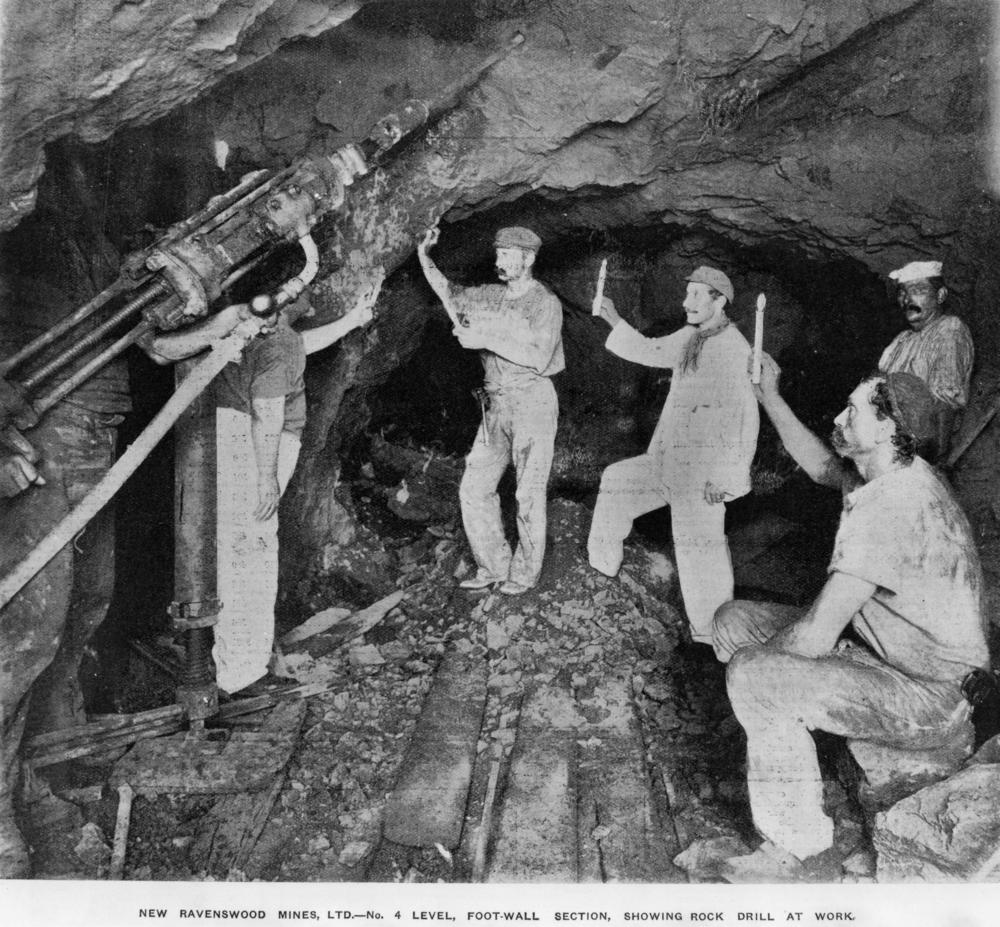
A mechanical drill, driven by compressed air or (earlier) steam, used to bore the shot-holes packed with explosive to break rock — replacing the slow, exhausting work of driving a hole by hand with a hammer and gad.
Historical usage
Early mechanised rock drills were steam-powered — Richard Trevithick patented a rotary steam drill as early as 1813 — but steam proved impractical underground, generating unbearable heat and humidity in confined workings. The first mechanised percussive drill using compressed air was built in 1844, and the technology matured through the following decades; a pneumatic drill was successfully used driving the Mont Cenis Tunnel from 1861. In Britain, compressed-air rock drills were not widely adopted in Cornwall and west Devon until the last quarter of the 19th century, well behind American practice. Holman Brothers of Camborne, working with James McCulloch, patented their own design in 1881 — the 'Cornish Rock Drill' — which was in use at Dolcoath, South Crofty, East Pool and Tincroft by 1882, and had spread to mines in south Wales by the same year.
How it worked
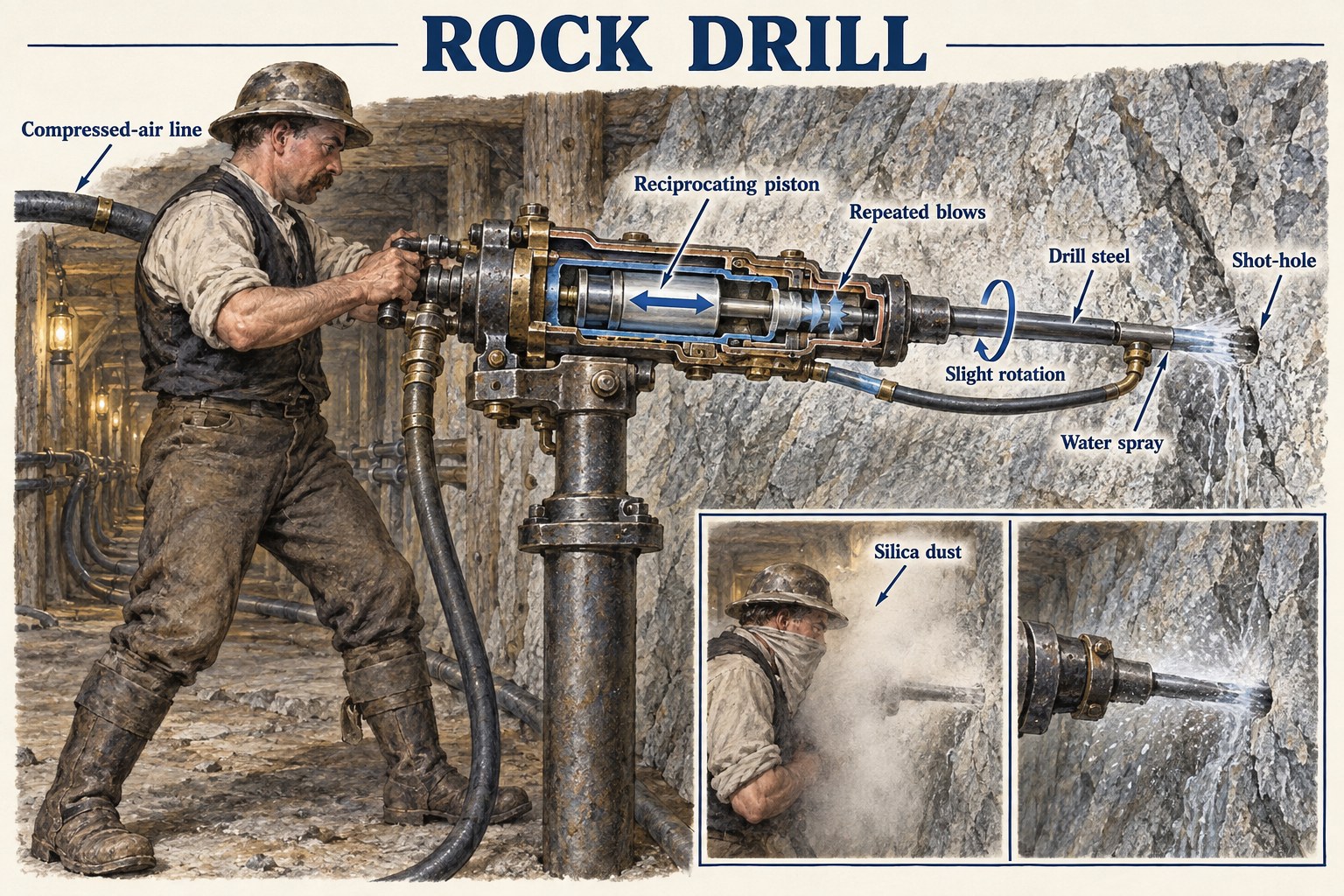
Compressed air, delivered from a surface or underground compressor through pipework, drove a reciprocating piston that struck the drill steel with rapid, repeated blows while simultaneously rotating it slightly between strikes, boring a clean, round shot-hole far faster than a miner striking a hand-held drill with a hammer ever could.
Why it was used
Rock drills dramatically increased the rate at which shot-holes could be bored, and the compressed air that powered them had the useful side effect of improving ventilation and reducing working temperatures in deep, poorly aired workings — a real benefit in Cornwall's increasingly deep late-19th-century mines.
Risks & limitations
Early dry rock drills produced fine, sharp silica dust at a rate far beyond anything hand-drilling had ever generated, and the resulting epidemic of 'miner's phthisis' — silicosis — killed thousands of British miners, before Cornish manufacturers pioneered water-spray dust suppression at the drill tip, cooling and lubricating the bit while also damping down the dust.
Regional variation
Cornwall and west Devon developed their own distinctive manufacturing tradition around the rock drill, led by firms such as Holman Brothers of Camborne, whose designs were exported to mines across Britain and, eventually, the wider world.
Related terminology
Mines associated with this term
5 examples chosen from 10 linked records — the term page is not an index.
- Carrs Mine — Cumbria (well documented example)
Named in this record’s history: “…for zinc in the early twentieth century, bringing in compressed-air rock drills fed from a hydraulic compressor house on the Nent that still stands.…” - Rhiwbach Quarry — Gwynedd (well documented example)
Named in this record’s workings: “…wire saws for slate cutting around 1900, adopted compressed-air rock drills in 1902, and converted from steam to electric power in 1935.” - Skelton Park Pit — North Yorkshire (well documented example)
Named in this record’s workings: “…thick, ~32% iron content) over 115m deep; compressed-air Walker rock drills and underground haulage introduced from 1876.” - South Wheal Frances — Cornwall (well documented example)
Named in this record’s workings: “…feet a minute; an air-compressor house drove up to 30 compressed-air rock drills. Water pumped from the mine helped supplement Redruth's public water…” - Croesor Quarry — Gwynedd (well documented example)
The mine's own recorded history explicitly describes manager Kellow's own patent rock drill design.
Sources
- (primary) Drills — Cornish Mining World Heritage Site
- (secondary) Blasting Through the Ages: A brief history of drilling — Pit & Quarry
Record created: 23 August 2026 · Last researched: 23 August 2026