 MineArchive
South Wheal Frances
| Location | Carnkie, near Carn Brea, Cornwall — 50.2080, -5.2520 (exact) |
|---|---|
| Commodities | Copper, Tin |
| Type | Metal |
| Worked | 1820s–December 1919 |
| Operators | Basset Mines Ltd (1896–1918) |
Overview
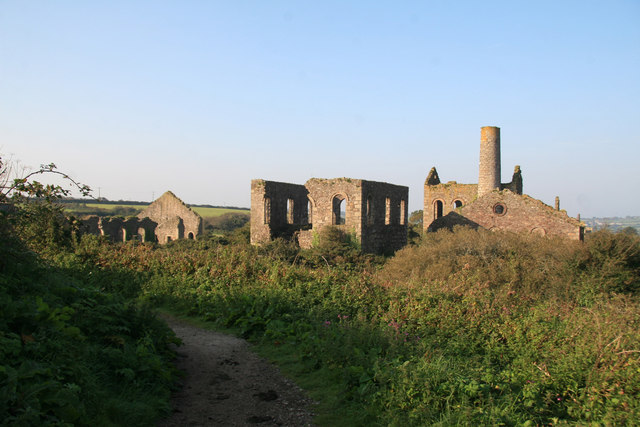
A major Great Flat Lode copper and tin mine near Camborne whose Marriott's Shaft complex — among Cornwall's most substantial and unusual surviving groups of mine buildings, some almost cathedral-like in scale — was still the best-equipped shaft in the county when it closed in 1918.
History
Mining in the district dates back to the early 1720s, with copper working at South Wheal Frances itself first documented in the 1820s; after Lady Frances Bassett, the mineral lord, granted a new lease in 1834, production resumed, and tin working began in 1852. The mine was at its most productive between 1844 and 1895, drawing on the Great Flat Lode, whose full extent was established in 1872-74 and prompted major infrastructure investment. In 1895 the mine's original 80-inch Cornish beam pumping engine at Marriott's Shaft was destroyed by fire, probably arson; the following year the concern was reorganised as Basset Mines Ltd, merging South Wheal Frances with the neighbouring Wheal Basset, and in 1897-98 a new, much larger inverted compound pumping engine (40-inch and 80-inch cylinders) was erected in its place, built by Hathorn Davey & Co. of Leeds.
South Wheal Frances was a notoriously wet mine — at times pumping an estimated hundred times the weight of ore raised during wet winters — and was a genuine technical pioneer: from 1860 it was the first mine in Cornwall to use wire rope permanently in place of hemp or chains, and in 1879, when part of the old Wheal Basset sett was allowed to flood, the first cast-iron underground dam in Cornwall was installed here to hold the water back. Total recorded output reached 67,866 tons of copper ore and 9,716 tons of tin ore. World War I brought crippling shortages of labour, horses and materials, and the mine closed in 1918 — by then still the best-equipped shaft in Cornwall — with its pumps finally stopped in December 1919 as continued working became uneconomical against the flooding.
Geology
South Wheal Frances worked the Great Flat Lode, a major, gently-dipping copper and tin lode system south of Camborne whose full extent was established by exploration in 1872-74; the mine's workings were notoriously wet, requiring continuous heavy pumping throughout its working life.
Workings
The mine was centred on two shafts: Marriott's, developed as the principal shaft with its own extensive surface complex, and Pascoe's, 90 yards to the north-east. Pascoe's pumping engine house held an 80-inch engine originally built in 1881 for Old Shepherd's Mine at St Newlyn East, bought secondhand and re-erected here by engineer Nicholas Trestrail, starting work in 1888. Marriott's Shaft's 1897-98 replacement pumping engine was matched by a winding house holding a cross-compound engine built by Holman Bros. of Camborne, its bi-conical drum giving a maximum winding speed of 2,000 feet a minute; an air-compressor house drove up to 30 compressed-air rock drills. Water pumped from the mine helped supplement Redruth's public water supply until the completion of Stithians Dam.
Closure
Wartime shortages of labour, horses and materials during the First World War pushed South Wheal Frances into closure in 1918, by which point it was still the best-equipped shaft in Cornwall; pumping was finally stopped in December 1919 once continued working could no longer be justified against the cost of holding back the flooding.
What remains
The Marriott's Shaft complex survives as one of Cornwall's most substantial and unusual groups of mining remains, its buildings set in open countryside and, in places, cathedral-like in scale; the site forms part of the Cornwall and West Devon Mining Landscape World Heritage Site, inscribed in 2006, within its Camborne and Redruth Mining District.
Marriott's Shaft's surface complex retains its pumping engine house, boiler house (with arches for six Lancashire boilers), winding house, air-compressor house, capstan house and the base of its ore-sorter/stone-breaker; the shaft's collar survives with its original grille. At Pascoe's Shaft the pumping engine house survives, along with faint traces of its former boiler house.
Related mines
- Wheal Basset (Basset Mines) — Amalgamated with Wheal Basset into Basset Mines Ltd in 1896.
Nearby mines
- Wheal Grenville — 1.0 miles (1.6 km) SW
- Wheal Buller — 1.1 miles (1.8 km) NW
- Cook's Kitchen Mine — 1.4 miles (2.2 km) NW
- Tincroft Mine — 1.4 miles (2.2 km) NW
- Wheal Uny — 1.3 miles (2.2 km) N
Straight-line distance, within 9 miles (15 km). Show on the map.
Recorded claims
Individual factual claims, each attached to the source(s) that support it below. Where sources disagree, both are kept.
- Copper working was documented from the 1820s and tin from 1852, the mine's most productive period running 1844-1895; in 1896 it merged with the neighbouring Wheal Basset to form Basset Mines Ltd, following a fire, probably arson, that destroyed the original Marriott's Shaft pumping engine in 1895. 1,2
- A new inverted compound pumping engine (40-inch and 80-inch cylinders), built by Hathorn Davey & Co. of Leeds, replaced the fire-destroyed original at Marriott's Shaft in 1897-98; the mine had already been the first in Cornwall to use wire rope permanently from 1860, and installed the county's first cast-iron underground dam in 1879. 2
- Pascoe's Shaft's 80-inch pumping engine, originally built in 1881 for Old Shepherd's Mine, was bought secondhand and re-erected here from 1887 by engineer Nicholas Trestrail, starting work in 1888; total recorded output from the mine reached 67,866 tons of copper ore and 9,716 tons of tin ore. 1,2
- Wartime shortages of labour, horses and materials pushed the mine into closure in 1918, though still the best-equipped shaft in Cornwall at the time, with pumping finally stopped in December 1919. 2,3
- The site forms part of the Cornwall and West Devon Mining Landscape World Heritage Site, inscribed in 2006, within its Camborne and Redruth Mining District. 1,2
- Located at about 50.208 N, 5.252 W. 1
Sources
- (secondary) South Wheal Frances Mine — Wikipedia
- (primary) Delve Deeper Audio Trail Four: On the Great Flat Lode - the Basset Mines at South Wheal Frances — Cornish Mining World Heritage Site
- (secondary) South Wheal Frances — Northern Mine Research Society
Record created: 27 August 2026 · Last researched: 27 August 2026