 MineArchive
Boiler House
| Also known as | Boiler-house |
|---|---|
| Category | Structures & Machinery |
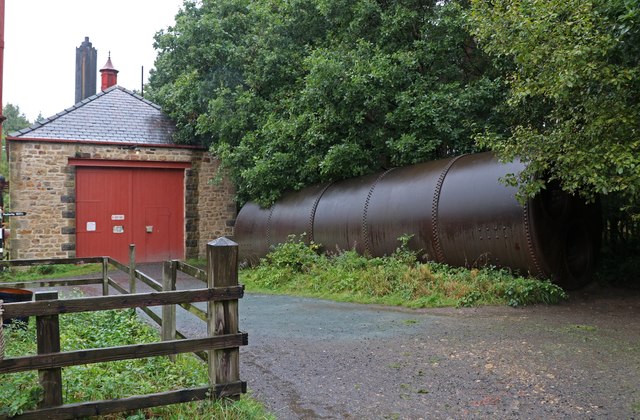
The building, usually a light lean-to against the engine house, that held a steam engine's boilers and the firing floor in front of them, with the chimney stack either attached to it or built into a corner of the engine house.
Historical usage
Every steam-worked mine had one. In Cornwall and west Devon the boiler house was generally lightly built — far lighter than the engine house it leaned on, which had to carry the engine — and held the long horizontal boilers of a beam engine; at collieries the same arrangement served pumping and winding engines alike, as at Stublick in Northumberland, where the boiler house of the 1830s stands with the engine house and chimney as a listed group. Because the boilers were the first thing sold or scrapped when a mine closed and the walls were thin, boiler houses survive far less often than engine houses, and are usually traced only as low walls or a levelled platform beside the stack.
How it worked
The boilers were set in brickwork with fire grates at the front and flues running beneath and beside them to the chimney; a firing floor along the front gave the stoker room to feed and clean the fires. Steam was piped through the wall to the cylinder in the engine house, and the exhaust or the flue gases went to the stack. A water supply, often a small reservoir or leat, fed the boilers.
Why it was used
Keeping the boilers out of the engine house kept the fire, ash and water away from the engine and let the house be built as a light shed rather than the massive frame the engine needed. It could be extended or rebuilt as boilers were added or changed without touching the engine house.
Risks & limitations
Boilers held fire and pressure, and the light construction that made boiler houses cheap is also why so few are left to see: the boilers were sold or scrapped at closure and the thin walls went soon after.
Regional variation
A Cornish boiler house held the horizontal boilers of a beam engine, the chimney stack attached to it or built into a corner of the engine house; a colliery boiler house like Stublick's served pumping and winding engines alike. The word is the same everywhere.
Related terminology
Beam Engine, Engine House, Winding Engine
Mines associated with this term
5 examples chosen from 29 linked records — the term page is not an index.
- Califat Coal Mine — Leicestershire (well documented example)
Named 4 times in this record, first in the history: “…Heritage Trust arranged the consolidation of the engine house and boiler house structures with financial help from the Leicestershire National…” - Chatterley Whitfield Colliery — Staffordshire (well documented example)
Named in this record’s surface remains: “…structures include the 1891 brick chimney, the 1938 Lancashire boiler house, the pithead baths, the Platt Shaft headgear (c. 1900), the…” - Derwent Lead Mines — County Durham (well documented example)
Named 4 times in this record, first in the workings: “…are the low remains of a four-metre engine house, an 11 m by 3 m boiler house and the base of a 2.5 m chimney, with spoil and boiler clinker…” - Marke Valley Mine — Cornwall (well documented example)
Named twice in this record, first in the current condition: “The Salisbury Shaft's pumping and winding engine houses, their boiler-house chimneys and the freestanding chimney between them are Grade II…” - Millclose Mine — Derbyshire (well documented example)
Named in this record’s current condition: “…around 9 metres and 1.5 metres thick — along with winding house and boiler house foundations, a capstan site, and extensively reworked spoil…”
Disasters associated with this term
Included only where MineArchive's own research gives a reasonable evidential basis, with the nature of the relationship stated — not every disaster where this term might plausibly apply.
- Fordell Colliery boiler explosion, 1876 (contextual relationship)
Named 3 times in this record, first in the summary: “…four people outright — mostly young women sheltering near the boiler house during a work stoppage — with a possible fifth victim dying later of…”
Sources
- (primary) Earthwork and buried remains of Stublick Colliery, immediately south east of Stublick, Haydon (List entry 1021259) — Historic England
- (secondary) A Cornish mining glossary — Cornish Mining World Heritage Site (UNESCO)
Record created: 22 September 2026 · Last researched: 22 September 2026