 MineArchive
Fordell Colliery boiler explosion, 1876
A steam boiler exploded at Fordell Colliery's William Pit near Dunfermline on 30 September 1876, killing four people outright — mostly young women sheltering near the boiler house during a work stoppage — with a possible fifth victim dying later of her injuries.
| Date | 30 September 1876 |
|---|---|
| Mine | Fordell Colliery |
| Region | Fife |
| Type | Explosion |
| Fatalities | 4 (Contemporary newspaper reports named four dead in the immediate aftermath: engineman Andrew Arnot (36), and three young women employed at the pit head — Helen Cook (24), Isabella Harrower (16) and Catherine Penman (16), the last of whom died later the same evening. A specialist secondary source (fifepits.co.uk) gives a final toll of five, naming a further victim recorded as 'May Cook'; this is consistent with the contemporary account's note that one of the badly scalded injured, Isabella Philp, was 'gradually sinking' and not expected to recover as of early October 1876, but a fifth death could not be independently confirmed, so fatalities is recorded here at the confirmed figure of four.) |
| Context | During active mining |
Cause
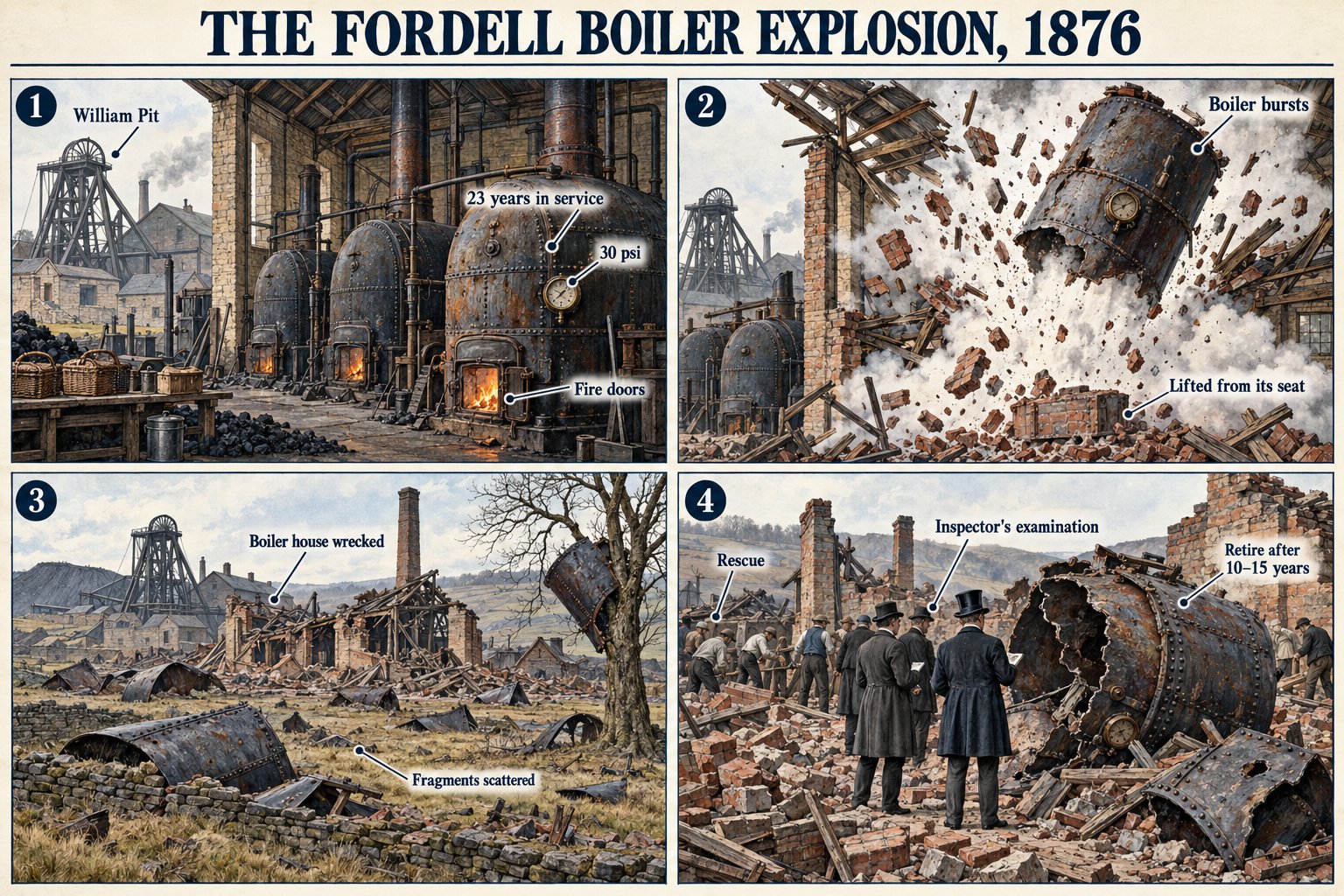
The boiler, which had been in service at 30 pounds per square inch for over 23 years, burst without any conclusively established cause; the Government Inspector of Mines who examined the wreckage afterwards recommended that colliery boilers should not remain in service beyond 10 to 15 years.
What happened
On the Saturday afternoon of 30 September 1876, work was temporarily halted at Fordell Colliery's William Pit to await material from below, giving eight pit-head girls the chance to take lunch. Seven of them gathered by the fire doors of the northernmost of several large boilers in the works' central boiler house to warm themselves. The boiler exploded with tremendous force, lifted clean off its seat and thrown clear over the pithead; the other boilers were wrenched from their mountings and overturned, and most of the boiler house was wrecked. Fragments of the boiler, each weighing two to three tons, were found scattered up to 120 yards from the works, one piece driven through a tree at the edge of a nearby field; the blast was heard three miles away.
The pit-head girls were buried beneath fallen brick and rubble at the spot where they had been sitting; it took over an hour to free them all, most severely scalded by escaping steam. Engineman Andrew Arnot's body was found around 40 yards from the works, apparently thrown from an elevated position — likely standing on the boiler itself — with no external injury beyond an abrasion to the mouth. Fireman Archibald George was found badly scalded beneath the pithead platform. Four others on the platform — William Speed the coal-weigher, Robert Archibald, William Archibald and Mary Black — had narrow escapes; Speed leapt around twelve feet from the platform to the loading ground below. Damage to the works was estimated at over £5,000, and around 100 men were thrown idle by the destruction.
Rescue & recovery
It took rescuers over an hour to free all of the pit-head girls buried under fallen brick and masonry, several severely scalded by escaping steam. Doctors from Crossgates, Cowdenbeath and Dunfermline attended promptly, and the colliery's owner, G. W. Mercer Henderson, and its manager, Mr Hogg, were on site directing the response.
Investigation & inquiry
The works were officially visited the day after the explosion by Sir Ralph Moore, the Government Inspector of Mines, while the ruptured boiler itself was examined by engineers Dale and Grant of Kirkcaldy. The precise cause of the failure was never established, not least because engineman Andrew Arnot, who might have been able to explain it, had been killed. Inspector Moore's report noted that the boiler had already been in service for more than 23 years at 30 psi, and recommended that colliery boilers should generally be retired after 10 to 15 years' use.
Changes to practice & legislation
The Inspector of Mines' recommendation that colliery boilers be retired after 10 to 15 years of service, made in his official report on this explosion, is the specific practice change recorded.
What's uncertain
Points where sources disagree or the record could not be settled; both accounts are kept. All open questions in the archive.
- A specialist secondary source records a fifth fatality under the name 'May Cook', not named in the contemporary newspaper account, though consistent with that account's report of a badly scalded survivor not expected to recover. (uncertain) 2
Recorded claims
Individual factual claims, each attached to the source(s) that support it below. Where sources disagree, both are kept.
- A steam boiler in service over 23 years exploded at William Pit on 30 September 1876, killing engineman Andrew Arnot and pit-head workers Helen Cook, Isabella Harrower and Catherine Penman. 1
- A specialist secondary source records a fifth fatality under the name 'May Cook', not named in the contemporary newspaper account, though consistent with that account's report of a badly scalded survivor not expected to recover. (uncertain) 2
- Government Inspector of Mines Sir Ralph Moore examined the site and, unable to establish a definite cause, recommended colliery boilers be retired after 10-15 years of service given this one had run for over 23. 1
Related terminology
Mining terms this disaster is structurally linked to, with the nature of the relationship.
- Boiler House (contextual relationship)
Named 3 times in this record, first in the summary: “…four people outright — mostly young women sheltering near the boiler house during a work stoppage — with a possible fifth victim dying later of…” - Colliery (contextual relationship)
Named 6 times in this record, first in the summary: “A steam boiler exploded at Fordell Colliery's William Pit near Dunfermline on 30 September 1876, killing four…” - Fireman (contextual relationship)
Named in this record’s narrative: “…itself — with no external injury beyond an abrasion to the mouth. Fireman Archibald George was found badly scalded beneath the pithead…” - HM Chief Inspector of Mines (contextual relationship)
Named 3 times in this record, first in the cause: “…burst without any conclusively established cause; the Government Inspector of Mines who examined the wreckage afterwards recommended that colliery…” - Pithead (contextual relationship)
Named 5 times in this record, first in the narrative: “…Colliery's William Pit to await material from below, giving eight pit-head girls the chance to take lunch. Seven of them gathered by the fire…”
Sources
- (secondary) Fordell 1876 — Scottish Mining Website
- (secondary) Pit-W-4. William Pit (Fordell Colliery) — Fife Pits
Record created: 27 August 2026 · Last researched: 27 August 2026