 MineArchive
Fireman
| Category | Labour & Roles |
|---|
The underground official responsible for testing for firedamp and inspecting the workings for hazards before a shift began.
Historical usage
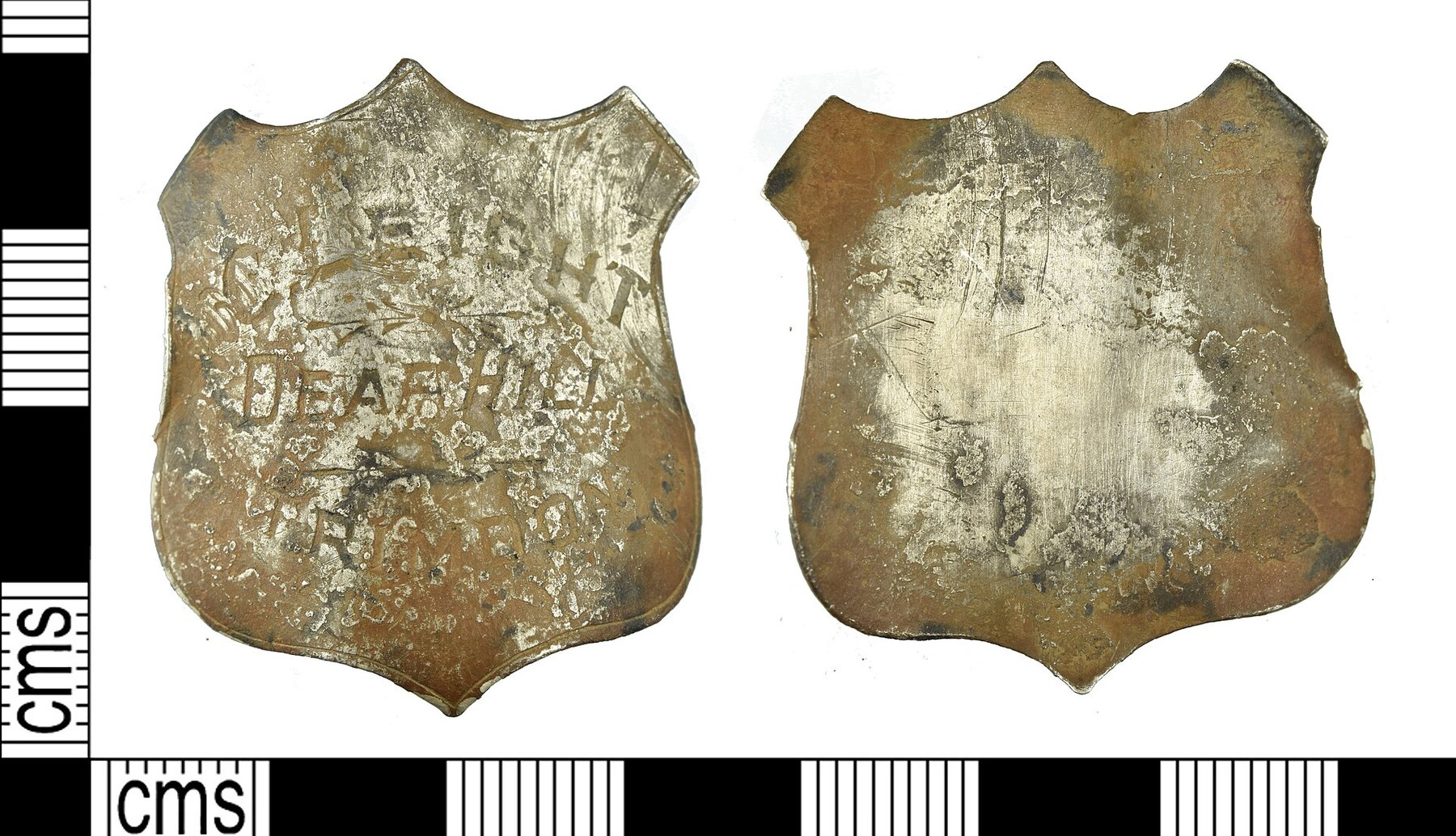
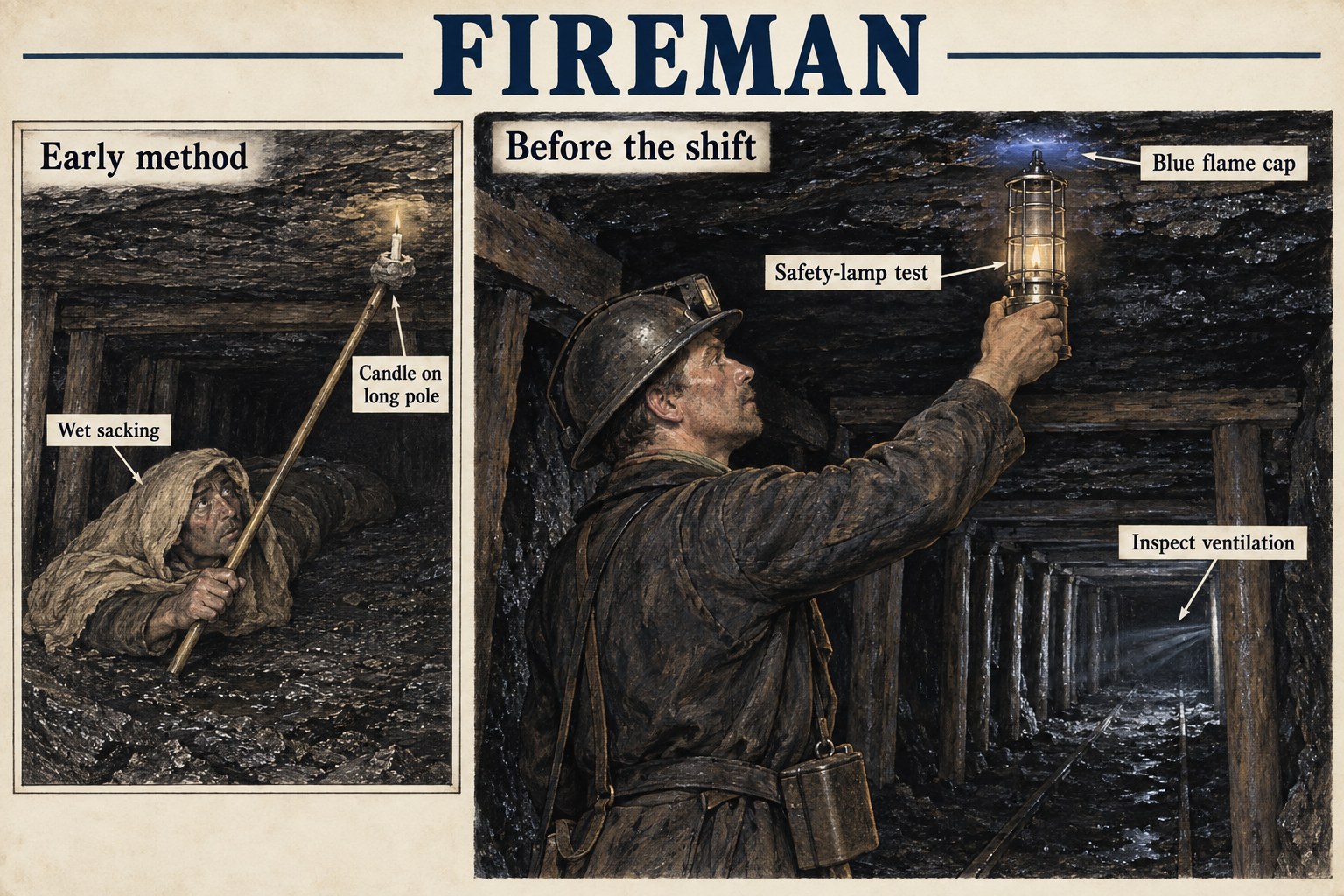
From at least the 17th century, a colliery fireman's grim original task was to seek out and deliberately ignite pockets of accumulated firedamp before the rest of the shift went underground, so that any explosion happened while only he was present rather than the full workforce; in some districts the role's dangerous, shrouded appearance earned firemen the nickname 'the penitent'. The introduction of the safety lamp gradually turned the job from deliberate ignition into inspection: firemen made rounds of the workings with a flame safety lamp before each shift, and miners were kept from working with open lights until the fireman had confirmed the air was safe. By the 20th century the title had merged, in many coalfields, with the broader role of Deputy, which absorbed the fireman's gas-testing duties alongside wider safety and production oversight. The office had a badge, and it survives archaeologically. The yardstick a deputy carried underground — used for measuring and for sounding the roof, and recognised as the mark of his rank — was sometimes finished with a decorated silver mount; one such mount, dated between 1880 and 1930, has been recorded as a find in County Durham.
How it worked
In the role's earliest, most dangerous form, a fireman crawled into the workings wrapped in wet cloth, carrying a small candle — often stuck in a lump of wet clay to shield and reduce its flame — on the end of a long pole, raising it slowly toward the roof; a blue 'cap' of flame above the candle's own flame revealed gas in the air, and a sufficient concentration would ignite with a rush of noise rather than a catastrophic explosion, since only the fireman himself was then underground. Later, the same basic gas-testing principle continued using a flame safety lamp instead of an open candle, without the fireman needing to court an explosion deliberately.
Why it was used
Firedamp accumulating unseen in the workings was one of the most persistent hazards in coal mining, and a dedicated official checking for it before each shift, whether by deliberate ignition or later by safety lamp, was the standard way collieries tried to keep the rest of the workforce out of an explosion's way.
Risks & limitations
The earliest form of the role was extraordinarily dangerous in its own right — in spite of every precaution, firemen did not always survive the explosions they deliberately set off, and the job's later, safety-lamp-based form still carried real risk if gas was found where a lit lamp was already present.
Regional variation
Known by the same title in most English and Welsh coalfields; by the 20th century the role had merged into that of Deputy in North Wales and parts of Lancashire. Scotland kept its own spelling and a narrower definition: Barrowman's 1886 glossary gives fireman or firesman as a subordinate colliery official charged with the supervision of the ventilation of the workings, which is the inspecting job rather than the igniting one. The older and grimmer sense survives in the nickname Healey Hero records, the penitent, for the man wrapped in wet sacking who crawled in with a candle on a pole. The same glossary preserves the firing-line, an appliance used in former times for clearing a room of firedamp, from the days when clearing meant burning. By the 20th century the title had also split in a different direction: the shot firer, who fires the shots, is a separate certificated grade from the fireman who tests for gas, and the two should not be confused.
Related terminology
Mines associated with this term
5 examples chosen from 55 linked records — the term page is not an index.
- Abercwmboi Colliery — Rhondda Cynon Taf (notable incident)
John Howells, the fireman, was among the five killed in 1870 after deciding to let the furnace burn up rather than draw it. - Benarty Colliery — Fife (well documented example)
Named in this record’s history: “…Casey of Lochore, two men doing repair work, and badly hurting the fireman James Morton who had joined them. The Fife Coal Company took the…” - Birley Collieries — South Yorkshire (well documented example)
Named in this record’s summary: “…branch railway. Six men died in an explosion in 1876 that put the fireman in the dock for manslaughter, and four more in an explosion in 1924.…” - Blairmuckhill Colliery — North Lanarkshire (well documented example)
Named twice in this record, first in the history: “…Addie and Sons. Coal-cutting machines were at work by 1913, when a fireman was killed by a stone from the roof waiting for a cutter to finish.…” - Blaydon Main Colliery — Tyne and Wear (well documented example)
Named in this record’s history: “…at the change of shift, killing the brakesman William Holmes, a fireman, Daniel Johnson, and two men crushed under the rubble, and on 4 May…”
Disasters associated with this term
5 examples chosen from 176 linked records, most direct relationship first.
- Bryndu Colliery explosion, 1852 (contributing factor)
They went in before the fireman's examination. - Henwain Colliery explosion, 1882 (contributing factor)
The fireman took men in before examining. - Henwaun Colliery explosion, 1882 (contributing factor)
The fireman broke the rules. - Jamage Colliery explosion, 1876 (contributing factor)
Shots were to be fired only by the fireman. - Kingseat Colliery roof fall, 1873 (contributing factor)
The fireman knew the place was bad but let them in.
Sources
- (primary) Glossary of Mining and Geordie Words — Durham Mining Museum
- (primary) Glossary of Scotch Mining Terms — James Barrowman (1886), via Scottish Mining Website
- (primary) Silver stick mount from a colliery deputy's yardstick, Portable Antiquities Scheme record DUR-D61CE6 — Portable Antiquities Scheme
- (secondary) Colliery Fireman — Welsh Coal Mines (forum)
- (secondary) Glossary of coal mining terminology — Wikipedia
- (secondary) Pit Terminology — Healey Hero
Record created: 27 August 2026 · Last researched: 11 September 2026