 MineArchive
Silver
| Category | Commodities |
|---|---|
| Commodity page | Silver → |
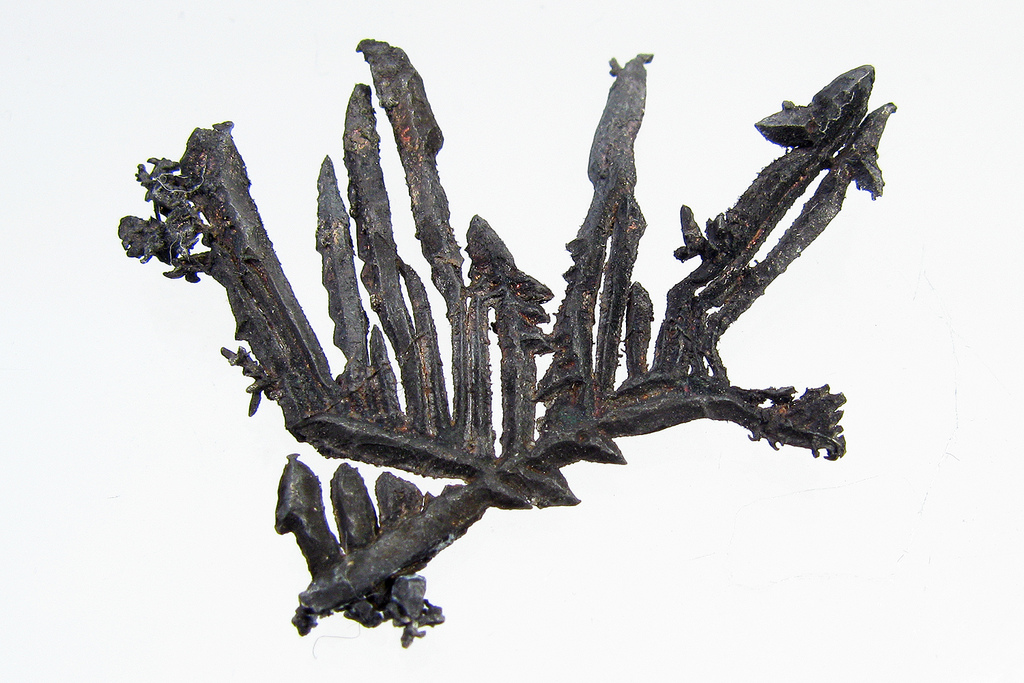
A precious metal (Ag) almost never mined for itself in Britain, recovered instead as a by-product of lead ore, and historically valuable enough that lead mines were sometimes worked chiefly for the silver locked inside their galena.
Historical usage
Combe Martin in north Devon and Bere Alston/Bere Ferrers on the Tamar were medieval England's principal silver sources, worked from at least 1292 and, at Bere Alston, on an industrial scale unmatched in England and not equalled elsewhere in Europe until much later. Combe Martin's silver at times helped fund England's wars with France and supplied royal coinage. From the 18th century, the Leadhills and Wanlockhead lead-mining villages in the Scottish Lowther Hills became Britain's other major silver source, extracting it from argentiferous galena by cupellation; Wanlockhead operations continued until flooding, rising costs and cheap lead imports ended large-scale working around 1880.
How it worked
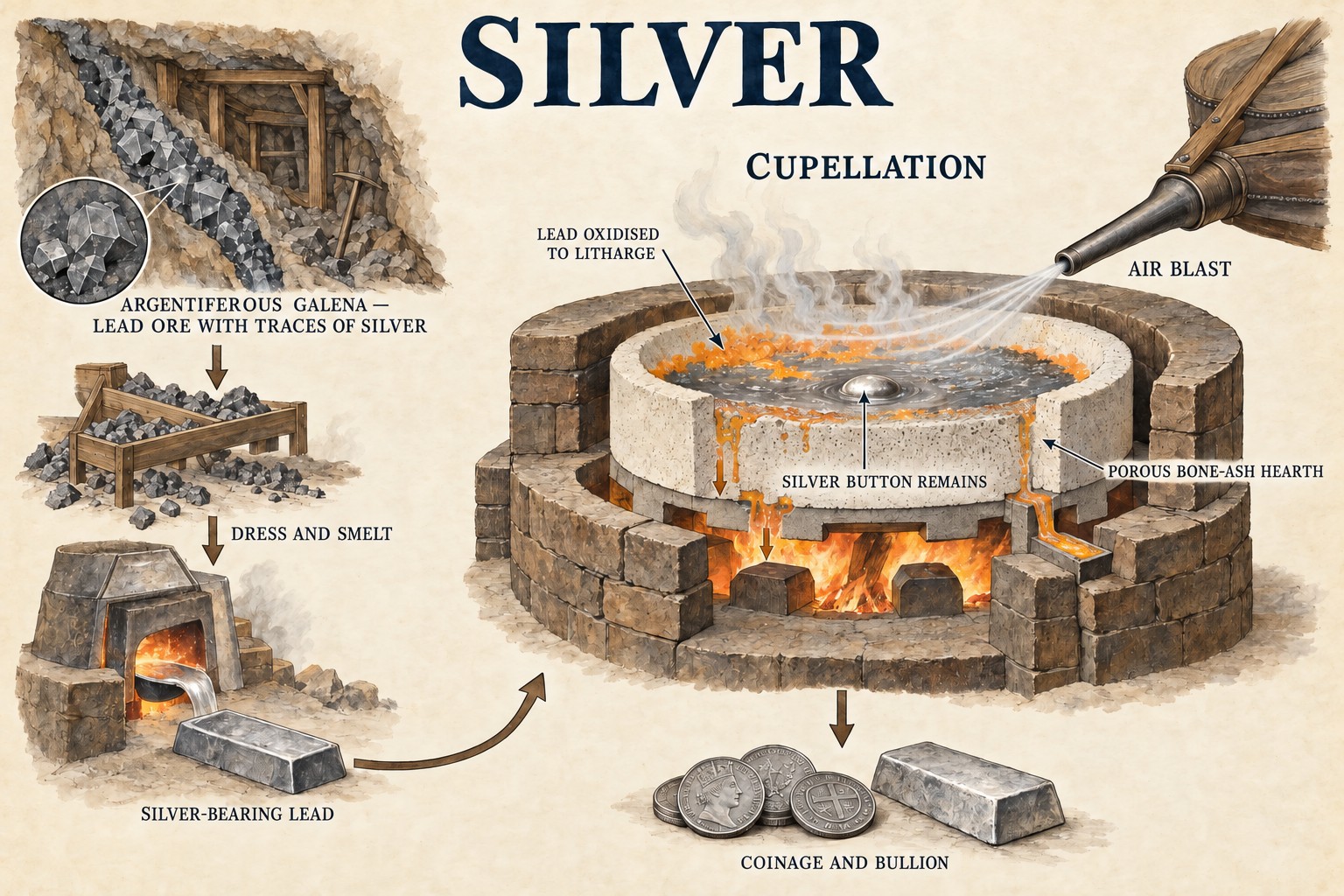
Silver occurs in Britain overwhelmingly as a trace impurity within galena (lead sulphide) rather than as workable native metal or its own ore. After lead smelting produced argentiferous lead bullion, the silver was recovered by cupellation: the lead was melted in a shallow bone-ash hearth and a blast of air oxidised it to litharge, which was absorbed into the porous hearth lining, leaving a button of pure silver behind.
Why it was used
Silver's value as coinage and bullion made even a small silver content in lead ore worth extracting — cupellation turned an otherwise ordinary lead-mining operation into one that could mint currency and fund the Crown directly.
Value over time
Silver underpinned the English currency itself for most of its history — the medieval penny was, by weight, a standard fraction of a Troy pound of silver, with 240 pennies to the pound — but that standard was repeatedly debased, the silver content of a penny falling from around 92% in 1300 to just 60% by 1412 as the Crown stretched scarce bullion further. Silver's bullion value has fallen relative to gold over the very long run, but the medieval and early modern Crown's direct dependence on domestic mines like Combe Martin and Bere Alston for currency it could not otherwise obtain made British silver briefly a matter of state importance rather than simple commerce.
Hazards & challenges
Cupellation required continuous exposure to molten lead and lead oxide fumes in a way ordinary lead smelting did not — the process exists specifically to concentrate lead loss as litharge — making plumbism (lead poisoning) an occupational hazard recognised since antiquity, with documented symptoms including colic, weakness and neurological damage among smelter workers and their families living near the furnaces.
Risks & limitations
Silver content in British galena was typically low, meaning silver mining was economically viable only as an adjunct to lead production, not as a standalone pursuit — when lead prices or ore grades fell, so did the silver output that depended on them.
Regional variation
Combe Martin and Bere Alston/Bere Ferrers (Devon) for medieval England's main silver sources; Leadhills and Wanlockhead (Scotland) for the later, longer-running silver-lead industry.
Related terminology
Mines associated with this term
5 examples chosen from 54 linked records — the term page is not an index.
- Bere Alston Silver-Lead Mines — Devon (well documented example)
A medieval royal silver operation on an industrial scale unmatched elsewhere in England. - Combe Martin Silver Mines — Devon (well documented example)
Medieval England's primary silver source alongside Bere Alston, worked from the reign of Edward I. - Snaefell Mine — Isle of Man (well documented example)
Named twice in this record, first in the summary: “…after Laxey and Foxdale, worked chiefly for zinc alongside lead and silver. It is remembered above all for the Isle of Man's worst mining…” - West Chiverton Mine — Cornwall (well documented example)
Named 3 times in this record, first in the summary: “…around 45,800 tons of lead ore and over 1.24 million ounces of silver between 1859 and 1886, paying £157,000 in dividends on a £30,000…” - Alva Silver Mine (Silver Glen) — Clackmannanshire (well documented example)
The richest deposit of native silver ever found in the British Isles, discovered by Sir John Erskine in 1712 and worked in secret.
See every mine that worked silver →
Sources
- (primary) Further work on residues from lead/silver smelting at Combe Martin, North Devon — Historical Metallurgy
- (secondary) Early Silver Mining in Combe Martin — Combe Martin Village History
- (secondary) Lead Poisoning: A Historical Perspective — US EPA
- (secondary) Lead, Zinc and Silver — National Association of Mining History Organisations
Record created: 22 August 2026 · Last researched: 22 August 2026