 MineArchive
Combe Martin Silver Mines
| Location | Combe Martin, Devon — 51.2044, -4.0286 (approximate) |
|---|---|
| Commodities | Silver, Lead |
| Type | Metal |
| Worked | 1292–1880 |
| Operators | Sir Bevis Bulmer |
Overview
Combe Martin, on the north Devon coast, was worked for silver-bearing lead from the reign of Edward I to the late 19th century, at times profitable enough to help fund England's wars with France and to furnish silver for royal plate.
History
Silver mining at Combe Martin is first recorded in 1292 under Edward I, who is said to have brought 337 miners from Derbyshire and Wales to work the deposits; under Edward III the mines produced enough silver to materially help fund the wars against France. The workings lapsed into neglect for long periods before being revived under Elizabeth I, when the engineer Sir Bevis Bulmer introduced improved pumping technology to reach deeper ore. Bulmer had at least two commemorative cups made from Combe Martin silver: one, dated 1593 and weighing 137 ounces, was presented to Sir Richard Martin, then Lord Mayor of London, while a second, made at the Queen's own command, was presented by Elizabeth I to the Earl of Bath; that second cup was melted down in 1732 and recast into three tankards, which are still used at banquets in the London Mansion House today. A further revival between 1790 and 1802 saw 9,293 tons of lead and silver ore shipped to Wales for processing, and a further 203 tons were sent to Bristol in 1813, before the mines closed temporarily in 1817. An 1837 venture backed by £30,000 of capital attempted another revival, hampered by persistent flooding and rising extraction costs, and ore from Combe Martin was exhibited at the Great Exhibition in London in 1851; but production declined through the following decades as cheaper foreign lead imports depressed the wider market, and working at Combe Martin finally ceased around 1880.
Geology
Silver-bearing lead on the north Devon coast; the veins worked are not named on the record, and persistent flooding was the recurring obstacle to working them.
Workings
Reached deeper ore under Elizabeth I, when Sir Bevis Bulmer introduced improved pumping; persistent flooding limited every later attempt.
Closure
Working ceased as cheaper foreign lead imports depressed the market through the middle of the 19th century.
What remains
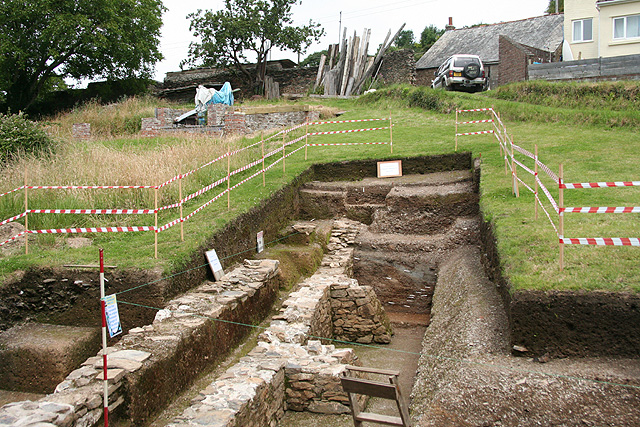
The Old Combmartin Mine Tenement on Bowhay Lane is preserved by the Combe Martin Silver Mines Society, which opens it for public tours on selected days and has rediscovered and partially excavated two mine shafts since the 1980s.
Recorded claims
Individual factual claims, each attached to the source(s) that support it below. Where sources disagree, both are kept.
- Under Edward I, 337 miners were reputedly brought from Derbyshire and Wales to work the Combe Martin silver mines from 1292; under Edward III the mines produced enough silver to materially help fund the wars against France. 1
- The Elizabethan engineer Sir Bevis Bulmer introduced improved pumping technology at Combe Martin to reach deeper ore, and had commemorative cups made from its silver — one of which survives in the London Mansion House collection. 1
- Between 1790 and 1802, 9,293 tons of lead and silver ore from Combe Martin were shipped to Wales for processing; a further 203 tons were sent to Bristol in 1813. 1
- Ore from Combe Martin was exhibited at the Great Exhibition in London in 1851. 1
- The Old Combmartin Mine Tenement on Bowhay Lane is preserved by the Combe Martin Silver Mines Society, which has rediscovered and partially excavated two mine shafts since the 1980s. 2
- Bulmer had at least two commemorative cups made from Combe Martin silver: one, dated 1593 and weighing 137 ounces, was presented to Sir Richard Martin, then Lord Mayor of London; a second, made at the Queen's own command, was presented by Elizabeth I to the Earl of Bath and later melted down in 1732 and recast into three tankards still used at London Mansion House banquets today. 1,2
- The 1837 revival was hampered by persistent flooding and rising extraction costs, and the mine's final decline around 1880 came as cheaper foreign lead imports depressed the wider market. 1,2
Photographs & further reading
The society preserving and opening the Old Combmartin Mine Tenement to the public.
View sourceSources
- (secondary) Early Silver Mining in Combe Martin — Combe Martin Village History
- (secondary) Combe Martin Silver Mines — Combe Martin Silver Mines Society
Record created: 20 August 2026 · Last researched: 31 August 2026