 MineArchive
Vein
| Category | Mine Workings & Access |
|---|
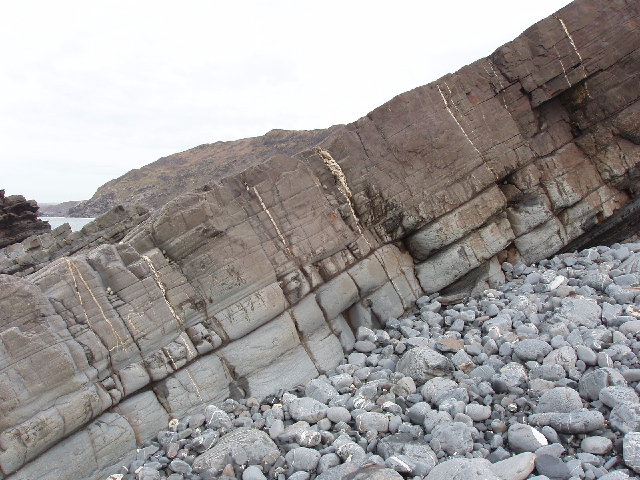
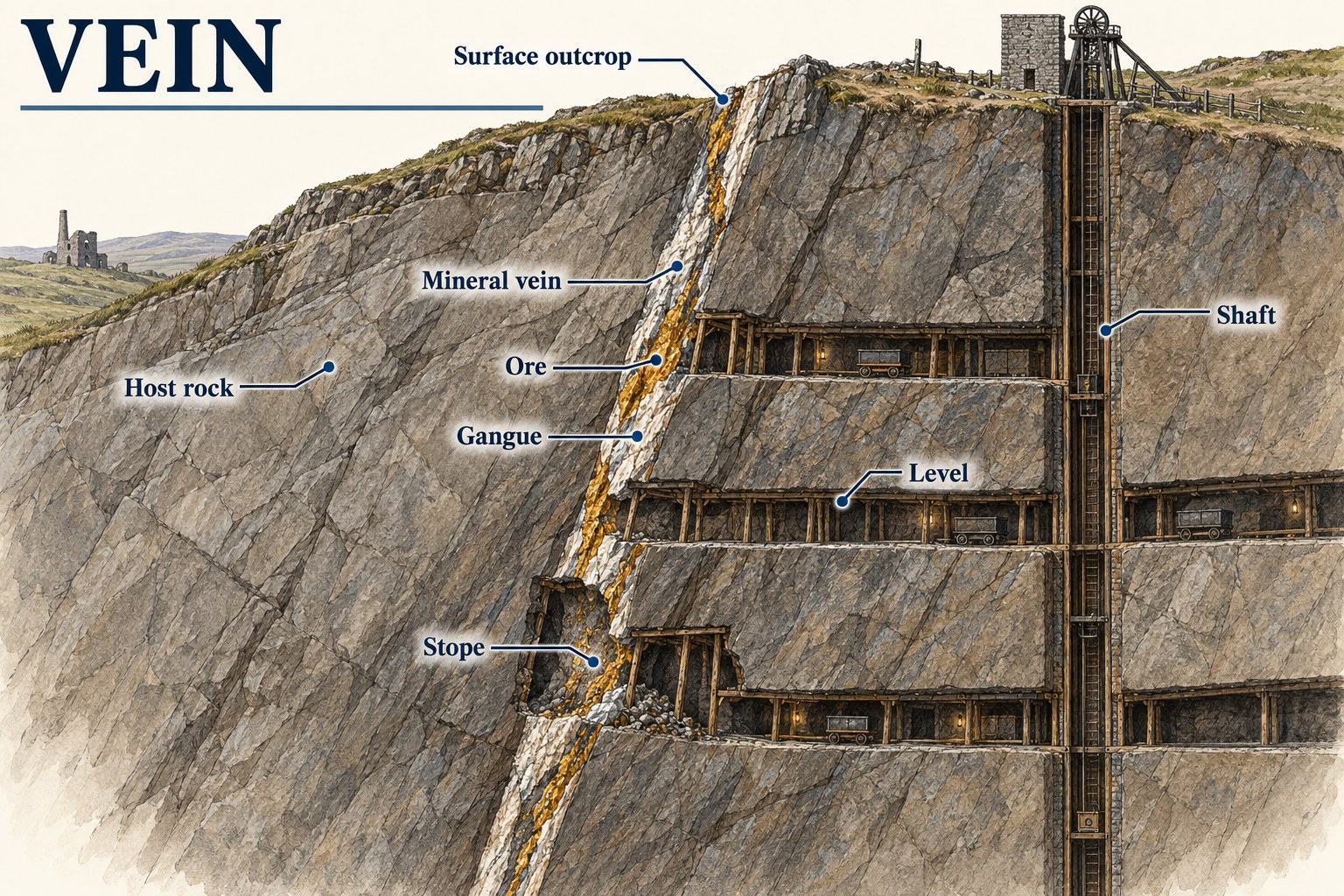
A single mineral-bearing fissure in rock — the basic geological feature almost all metal and mineral mining in Britain was aimed at following and exploiting.
Historical usage
Vein mining is as old as British mining itself: wherever a mineral-filled fissure reached or came close to the surface, prospectors could trace its outcrop and follow it down, a method that underpinned everything from Bronze Age copper working to 20th-century lead and tin mines.
How it worked
A vein was traced at surface, then followed downward and along its length by shafts, levels and stopes as ore was extracted from within it, with barren rock (gangue) discarded or left in place.
Why it was used
Because ore in Britain typically occurs concentrated in these narrow fissures rather than spread evenly through the surrounding rock, following a vein let miners extract concentrated ore efficiently rather than working through large volumes of barren ground.
Risks & limitations
A vein could pinch out, fault, or simply run out of workable ore at any point along its length or depth, and following one into unprofitable ground was a constant, unavoidable risk of vein mining.
Regional variation
The word is of Latin origin, distinct from the near-synonymous Cornish term 'Lode' (see below); in the Peak District a distinctive straight-running vein type is instead called a 'Rake' (see that term).
Related terminology
Mines associated with this term
5 examples chosen from 191 linked records — the term page is not an index.
- Bedwas Navigation Colliery — Caerphilly (well documented example)
Named in this record’s history: “…about 650 men raised 230,000 tons a year from the Black and Meadow veins. By 1980 geological problems had confined production to the Meadow…” - Bere Alston Silver-Lead Mines — Devon (well documented example)
Named in this record’s geology: “Silver-bearing lead of the Tamar valley; the veins worked are not named on the record.” - Combe Martin Silver Mines — Devon (well documented example)
Named in this record’s geology: “Silver-bearing lead on the north Devon coast; the veins worked are not named on the record, and persistent flooding was the…” - Fremington Edge Quarry — North Yorkshire (well documented example)
Named in this record’s geology: “…as well as chert ones; the same ground that yielded lead ore in veins yielded chert in beds, and the two industries overlapped in place…” - Manod Quarry — Gwynedd (well documented example)
Named in this record’s geology: “Slate east of Blaenau Ffestiniog; the vein is not named on the record.”
Disasters associated with this term
5 examples chosen from 7 linked records, most direct relationship first.
- Blaengwawr Colliery Explosion, 1861 (contextual relationship)
Named 4 times in this record, first in the cause: “An explosion of firedamp in the four-feet vein. The jury found the gas had gathered because the door between Nos. 9…” - Cwm Colliery roof fall, Merthyr, 1886 (contextual relationship)
Named twice in this record, first in the summary: “…28 January 1886 two falls of roof in a stall of the Seven Foot vein at Crawshay Brothers' Cwm Pit, Merthyr Tydfil, killed three men,…” - Cwmorthin Back Vein collapse (contextual relationship)
The Back Vein was the slate vein the mine depended on; its collapse halved production, put about half the workings out of reach, and eventually took the company into liquidation. - Cwmorthin fatal accident and mine-status test case (contextual relationship)
Named in this record’s narrative: “…at Cwmorthin was in fact worked underground, the chambers following veins that dip at 20 to 45 degrees. After a fatal accident in 1875 a test…” - Magpie Mine suffocation of three Maypitt miners (contextual relationship)
The whole quarrel was over a vein: Magpie and Maypitt were working the same lead vein, and the fires lit to drive the other side off it suffocated three men.
Sources
- (secondary) Definition of vein — Mindat
- (secondary) Vein — Encyclopaedia Britannica
Record created: 22 August 2026 · Last researched: 22 August 2026