 MineArchive
Gangue
| Also known as | Veinstone (Older English synonym for the same concept) |
|---|---|
| Category | Ore Processing |
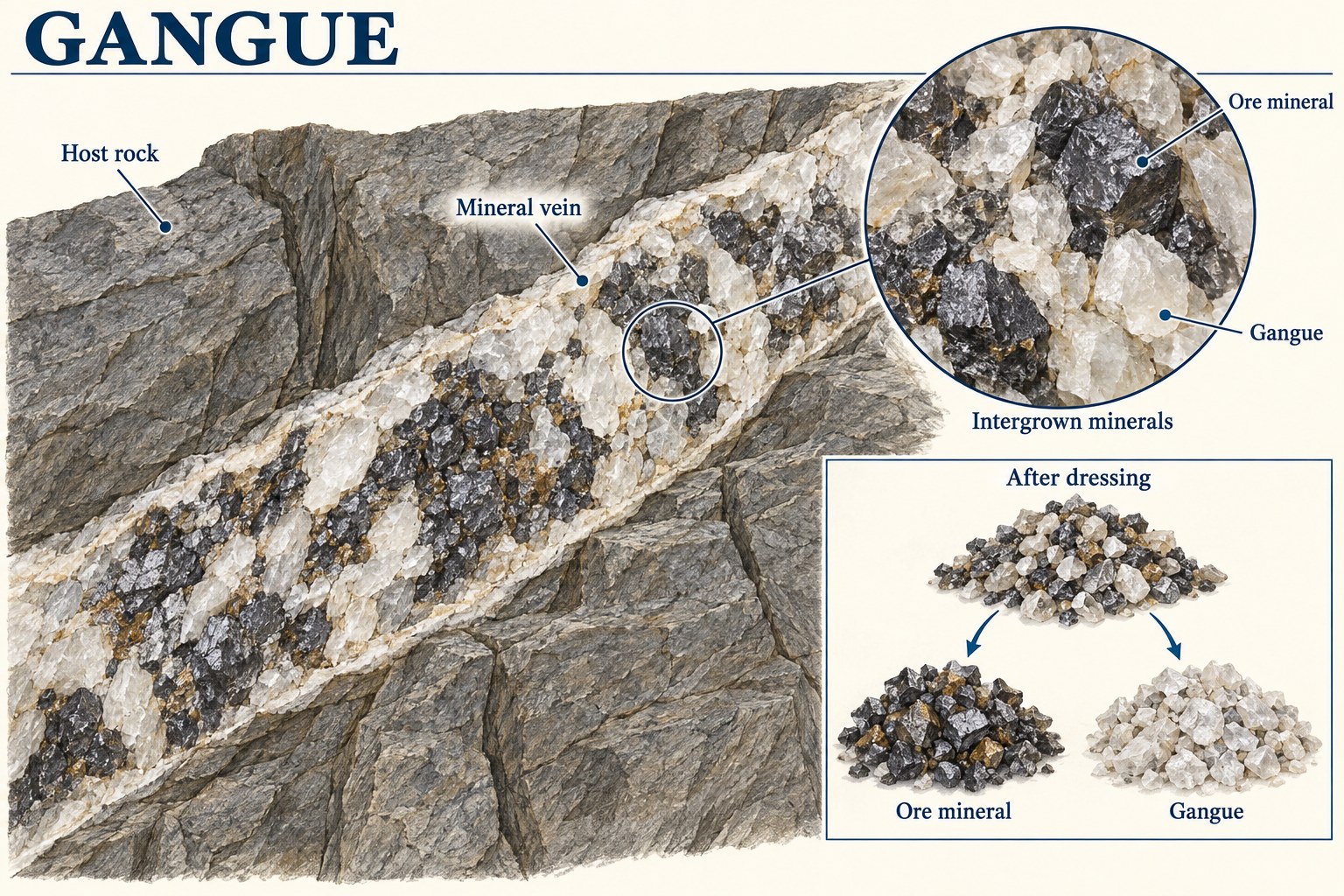
The worthless rock that comes up with the ore whether anyone wants it or not — the quartz, barite, calcite or other mineral that shares a vein with the metal actually being mined, and has to be broken away from it before the ore is worth anything.
Historical usage
The word came into English mining usage in the 19th century, borrowed by way of French from the German Gang, meaning a vein or lode — a reminder that ore minerals are almost never found alone, but grown together with other minerals in the same vein or deposit. Every vein mine in this archive that names both an ore mineral and a second mineral running with it — galena in a barite gangue, chalcopyrite in a quartz gangue — is describing exactly this relationship.
How it worked
Gangue is not waste rock in the sense of barren overburden dug through to reach a vein; it is intimately mixed with the ore mineral itself, grown in the same vein at the same time, and has to be physically separated from it after the whole lot is brought to the surface together. That separation — crushing, then jigging, buddling or otherwise sorting the crushed material by density or other physical property — is what ore dressing exists to do, and the specific mineral making up the gangue often shaped how a mine's dressing floor worked, since quartz, barite and calcite behave differently under a jigger or buddle.
Why it was used
Not a technique but an unavoidable geological fact: veins form from mineral-bearing fluids that rarely deposit only one mineral, so almost every metal ore mined underground came attached to some quantity of gangue that had to be dealt with rather than sold.
Risks & limitations
A vein rich in gangue relative to ore meant more rock had to be raised, crushed and dressed for the same amount of saleable metal, directly affecting a mine's economics; some gangue minerals, particularly barite, later found their own separate market and were dressed and sold in their own right rather than simply discarded, blurring the line between 'ore' and 'gangue' at mines that worked both. Gangue containing pyrite can also oxidise once exposed to air and water in spoil heaps, producing acid mine drainage long after a mine has closed.
Regional variation
Barite gangue is common in the lead veins of Wales, Derbyshire and the North Pennines; quartz gangue is typical of Cornish tin and copper lodes; calcite and fluorspar gangue occur widely in the Pennine orefield alongside lead and zinc ore.
Related terminology
Barite, Barytocalcite, Calcite, Deads, Galena
Mines associated with this term
5 examples chosen from 31 linked records — the term page is not an index.
- Hurst Mines — North Yorkshire (well documented example)
Named in this record’s workings: “…Lime and Chert and underlain by the Underset Lime and Chert; gangue minerals were chiefly pink barytes and calcite, with minor fluorspar…” - Lead Mines Clough — Lancashire (well documented example)
Named in this record’s geology: “…Pennine Moors, with baryte and witherite forming much of the vein's gangue material alongside the ore minerals themselves. Marine Band shale…” - Rodderup Fell Mine — Cumbria (well documented example)
Named in this record’s geology: “…sets the site apart is the fluorspar. Fluorite is common enough as a gangue mineral in these veins — the stuff the lead miners threw out — but…” - Blackdene Mine — County Durham (well documented example)
Named in this record’s history: “…working shifted from lead toward fluorspar — once discarded as waste gangue in the lead veins, but increasingly valuable as a chemical and…” - Cabbish Mine — Cumbria (well documented example)
Named twice in this record, first in the history: “…J. G. Reynoldson reopened the mine for barytes — the heavy white gangue mineral that lead miners had long discarded and that had since found…”
Sources
- (primary) Gangue — Wikipedia
- (secondary) Gangue — Mining Fundamentals — AZoMining
Record created: 25 August 2026 · Last researched: 25 August 2026