 MineArchive
Chalcopyrite
| Category | Commodities |
|---|
Copper iron sulphide (CuFeS₂), commonly called copper pyrites — the commonest and most widely worked ore of copper in Britain and worldwide.
Historical usage
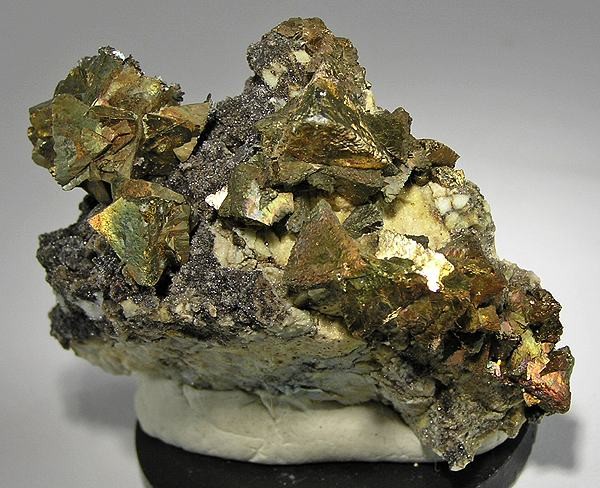
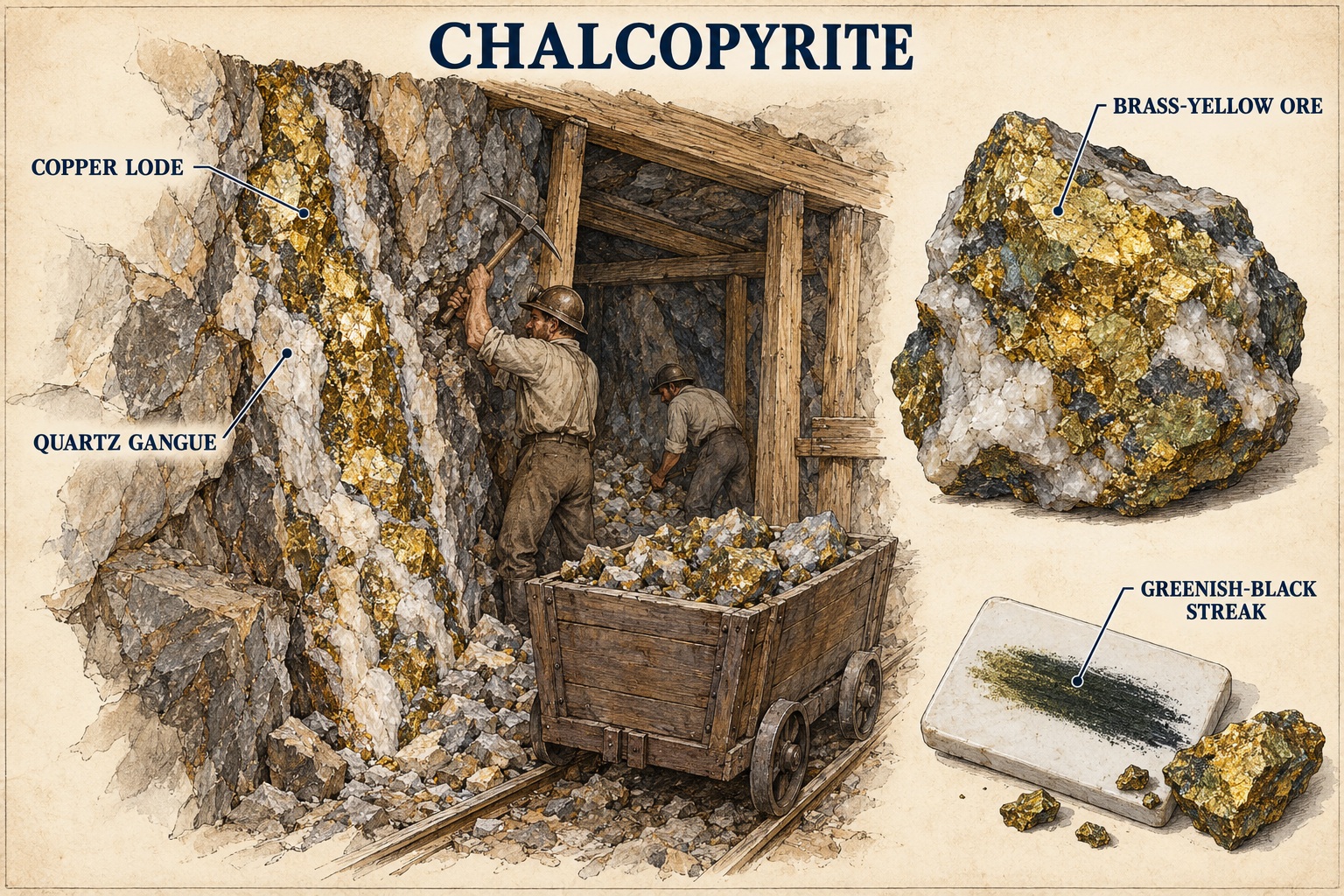
Chalcopyrite has been the world's leading source of copper for at least five thousand years, and was the principal copper ore raised across Cornwall and Devon, where large, well-formed crystals were noted at localities including Carn Brea. It typically occurs alongside cassiterite in the south-west's tin-copper lodes, as well as with iron pyrites, chalybite and blende elsewhere in the same veins.
How it worked
Brass-yellow with a metallic lustre and greenish-black streak, chalcopyrite is distinguished from the similarly coloured iron pyrites chiefly by being noticeably softer — it can be scratched with a knife or nail, where iron pyrites resists — and by its deeper colour; treated with nitric acid it releases sulphur and forms a green solution that turns deep blue with added ammonia, a simple field test miners and assayers used to confirm it.
Why it was used
As the commonest copper ore mineral by far, chalcopyrite was the everyday target of Cornish and Welsh copper mining, though it yields comparatively modest copper content compared with rarer, richer ore minerals — meaning large tonnages had to be raised and dressed to make a profitable return.
Value over time
Chalcopyrite's price is copper's. The Royal Navy's decision to copper-bottom its whole fleet in the 1780s drove copper from £78 a ton in 1785 to £200 in 1807, more than the Cornish and Welsh mines could supply, and Cornish copper production peaked in the 1850s with new discoveries in east Cornwall and west Devon holding it up into the early 1860s. Then the world changed: boulders of native copper in Michigan, Chilean and Cuban ores far richer than anything raised at Gwennap, and a banking crisis in 1866 broke the price, and within twenty years copper had gone from Cornwall's principal ore to an irrelevance, the population of the mining districts collapsing with it. A sustained fall from 1882 ended in the Secretan corner of 1887–89, when a French syndicate holding most of the world's copper failed and the London price fell from £100 a ton to £35 overnight, hanging around £36 for six years while the stockpile was sold off; by then Cornwall was out of the trade.
Hazards & challenges
Chalcopyrite itself is not toxic, but the lodes that carried it were. In Cornwall and Devon it came up with arsenical pyrites (mispickel) and iron pyrites, so that dressing and calcining copper ore drove off arsenic and sulphur, and the calciner and its arsenic flue were where the poisoning happened; arsenic in the concentrate also fouled the smelt. Matte smelting of the concentrate gives off sulphur dioxide, which in the nineteenth century went up the stack. Underground the hazards were those of any hard-rock metal mine — rock dust and the silicosis it caused, bad air and falls — rather than anything peculiar to the mineral.
Risks & limitations
Ore grade varied considerably by locality and depth, and because chalcopyrite is so much less copper-rich than some rarer secondary copper minerals, mines relying on it needed high throughput and efficient dressing to stay profitable as easily worked, near-surface ore ran out.
Regional variation
The dominant copper ore across Cornwall and Devon's tin-copper lodes, and worked wherever copper mining took place in Britain, from Anglesey's Parys Mountain to the orefields of mid-Wales.
Related terminology
Mines associated with this term
5 examples chosen from 32 linked records — the term page is not an index.
- Penlee Quarry — Cornwall (well documented example)
Named in this record’s geology: “…dipping 65 degrees west carries an assemblage unusual for Cornwall — chalcopyrite, arsenopyrite, löllingite, molybdenite, pyrite, pyrrhotite, quartz…” - Ramsley Mine — Devon (well documented example)
Named in this record’s geology: “…2,000 yards along the fault line. Ore minerals recovered included chalcopyrite, arsenopyrite (mispickel) and pyrite, typically yielding 4-5%…” - Auchencairn Mine — Dumfries and Galloway (well documented example)
Named in this record’s geology: “The mine worked a coastal vein carrying chalcopyrite alongside barytes and quartz, with malachite, cuprite and other…” - Castletown Mine — Argyll and Bute (well documented example)
Named in this record’s geology: “…quartz growth; the ore was mainly cupriferous pyrites with some chalcopyrite and galena, and assays showed a trace of gold at around 4…” - Cornish Hush Mine — County Durham (well documented example)
Named in this record’s geology: “…area of the North Pennine orefield, producing lead ore with calcite, chalcopyrite, fluorite, galena, pyrite and quartz. Two veins are named in…”
Sources
- (secondary) 1911 Encyclopædia Britannica/Copper-pyrites — Wikisource
- (secondary) Chalcopyrite — Wikipedia
- (secondary) Chalcopyrite: Mineral Uses and Properties — Geology.com
- (secondary) Copper-bottomed booms and busts — Winton
- (secondary) Cornish mining: a short history (Bernard Deacon) — Cornish studies resources
Record created: 27 August 2026 · Last researched: 8 September 2026