 MineArchive
Cornish Hush Mine
| Also known as | Cornish Mine |
|---|---|
| Location | Howden Burn, Bollihope, Weardale, County Durham — 54.6991, -1.9969 (exact) |
| Commodities | Lead, Fluorspar |
| Type | Metal |
| Worked | By 1863–1980 |
| Maximum depth | Unknown. |
| Operators | London Lead Company (1867–1902), Swiss Aluminium UK (1971–1980) |
Overview
A small lead mine in the Howden Burn valley in the Bollihope area of Weardale, worked by the London Lead Company from at least 1863 and never employing more than fourteen men. It is remembered less for its lead than for two things: the tiny Lewin locomotive 'Samson' that worked its 22-inch gauge railway, and the fluorspar that brought two brief reopenings in the 1970s.
History
The first publication about the mine describes a death. On 14 January 1863 the miner John Collinson was killed instantly when a mass of rock and lead ore fell on him; a colleague named Bainbridge had been working with him two minutes earlier and had moved about six feet away to smoke his pipe. The stones were cleared quickly but Collinson was already dead.
In 1867 the London Lead Company leased what was then called the Cornish Mine from the dean and chapter of Durham Cathedral. It was managed by R. W. Bainbridge, whose son Henry also worked there. Ore was cleaned and concentrated entirely by water-based machinery, operated by adolescents under an adult's supervision. That same year the Salmon Fishery Inspectors, touring the lead mines, examined the mine's waste water: three large tanks, each divided into compartments, cleared it of impurities, and large settling basins had been installed alongside them around 1863 on the Fisheries Commission's proposal at Darlington.
At its height in 1898 the mine employed fourteen men, twelve underground and two at surface. Its last agent was Joseph Anderson and its last manager a Mr Willis, before the London Lead Company went bankrupt in 1902.
Fluorspar brought it back. Decorative coloured fluorite had been a by-product of lead mining with no industrial use until the late nineteenth century; in the twentieth it was wanted for steel smelting and for making Teflon and CFCs, and Weardale fluorspar is reckoned by collectors among the finest in the world — it is the characteristic fluorescence of samples from this district, caused by europium impurities, that gave the phenomenon its name. Swiss Aluminium Mining UK recommissioned the mine in 1971–72 and again in 1979–80 to work the Cornish Hush Vein and the Sharnberry Vein, though the latter was never reached.
Geology
The mine worked mineral veins in the Bollihope area of the North Pennine orefield, producing lead ore with calcite, chalcopyrite, fluorite, galena, pyrite and quartz. Two veins are named in connection with the 1970s reworking, the Cornish Hush Vein and the Sharnberry Vein. The district's fluorite fluoresces under bluish-ultraviolet light because of europium impurities — the property that gave fluorescence its name.
Geological setting: Veins and Lodes (well documented example)
Workings
A small vein mine, never employing more than about fourteen people, with water-powered dressing machinery on the surface: the ore was cleaned and concentrated entirely by a water-based process worked by adolescents under adult supervision. Three large compartmented tanks and, from about 1863, large settling basins treated the waste water before it reached the burn. A light railway of 1 ft 10 in (559 mm) gauge ran a mile from the mine to Whitfield Brow, worked by a steam locomotive named 'Samson' built by Stephen Lewin of Poole in 1874 — an 0-4-0 of two and a half or three nominal horsepower weighing 2.6 tonnes loaded, with a left-side gear drive, a crankshaft above the boiler and a footplate so small the driver commonly sat on the rear buffer beam. It was probably scrapped around 1904.
Closure
Lead mining ended when the London Lead Company went bankrupt in 1902. The mine was reopened for fluorspar by Swiss Aluminium Mining UK in 1971–72 and again in 1979–80; the intended target of the Sharnberry Vein was never reached.
What remains
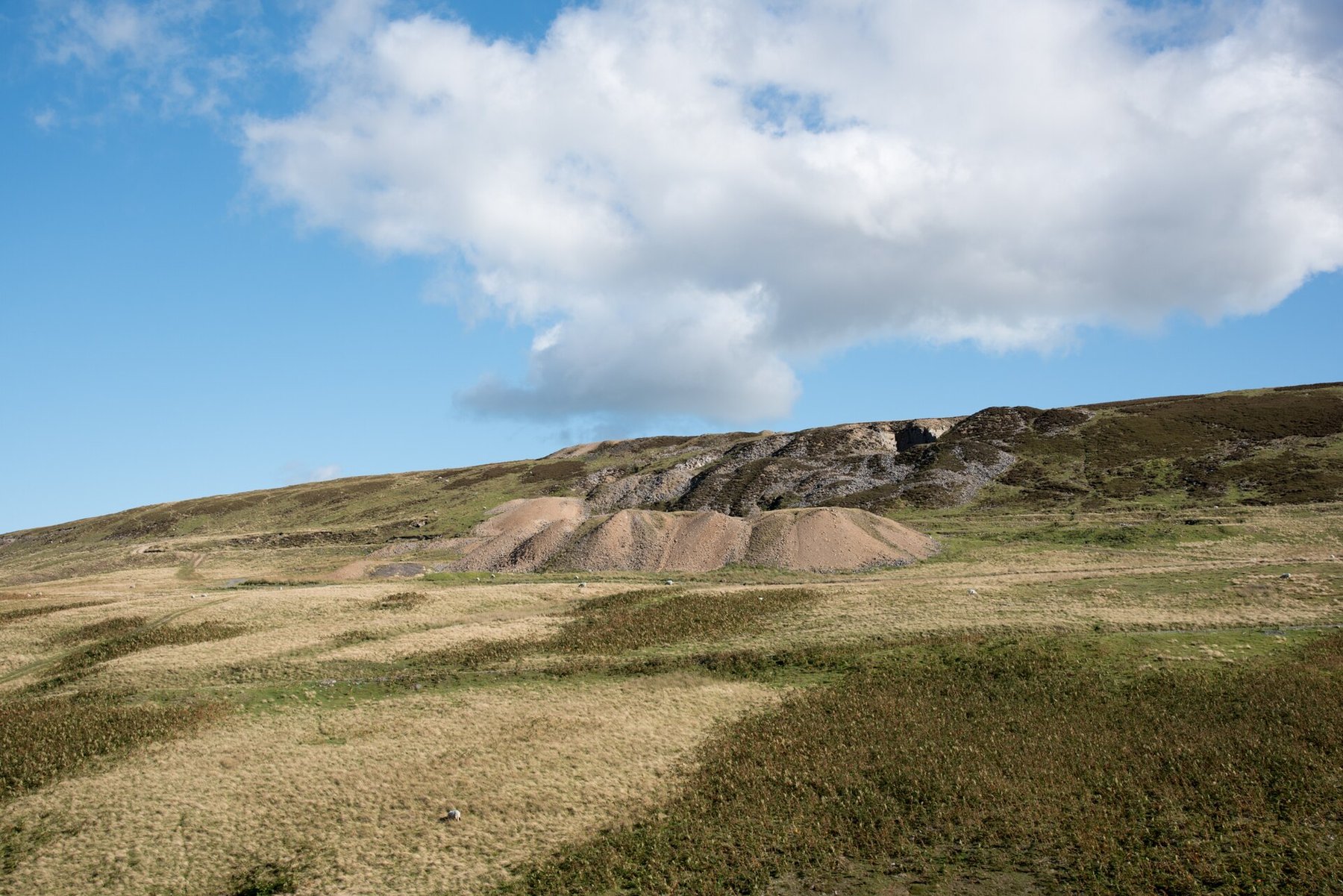
Derelict. Mine buildings survive in ruin at the site on the Howden Burn, and the workings and spoil can be seen from across the burn at Whitfield Brow, the terminus of the mine's own railway.
Ruined mine buildings and spoil in the Howden Burn valley, with the line of the narrow-gauge railway running to Whitfield Brow.
Nearby mines
- Harehope Gill Mine — 2.4 miles (3.8 km) NE
- Frosterley Marble Quarries — 2.5 miles (4.0 km) NE
- Rogerley Mine — 2.6 miles (4.2 km) N
- Diana Maria Mine — 3.3 miles (5.4 km) NW
- Lady Annabella Mine — 4.1 miles (6.6 km) NW
Straight-line distance, within 9 miles (15 km). Show on the map.
Recorded claims
Individual factual claims, each attached to the source(s) that support it below. Where sources disagree, both are kept.
- The mine operated from at least 1863 to 1902 for lead ore, and again from 1971 to 1972 and 1979 to 1980 for fluorspar. 1
- The London Lead Company leased the mine, then called the Cornish Mine, from the dean and chapter of Durham Cathedral in 1867; it was managed by R. W. Bainbridge. 1
- At its height in 1898 the mine employed fourteen men, twelve of them underground and two on the surface. 1
- All cleaning and concentration of the ore was done by machinery in a water-based process, operated by adolescents under the supervision of an adult. 1
- The Salmon Fishery Inspectors reported on 27 July 1867 that the mine's waste water passed through three large compartmented tanks, with large settling basins installed alongside them around 1863 on the Fisheries Commission's proposal. 1
- The mine was connected by a mile-long light railway of 1 ft 10 in (559 mm) gauge to Whitfield Brow, worked by 'Samson', an 0-4-0 steam locomotive built by Stephen Lewin of Poole in 1874, of 2½ or 3 nominal horsepower and 2.6 tonnes loaded weight; it was probably scrapped around 1904. 1
- One of the earliest publications about the mine records the death of the miner John Collinson on 14 January 1863, killed instantly by a fall of rock and lead ore. 1
- Swiss Aluminium Mining UK recommissioned the mine in 1971–72 and 1979–80 to work the Cornish Hush Vein and the Sharnberry Vein, but the Sharnberry Vein was never reached. 1
Photographs & further reading
The Northern Mine Research Society's memoir setting the Weardale lead and fluorspar mines in the context of the wider North Pennine orefield.
View sourceThe fullest account of this small mine, covering its London Lead Company years, its ore-dressing and water treatment, the 1970s fluorspar reworking, and unusually full detail on its narrow-gauge locomotive 'Samson'.
View sourceSources
- (secondary) Cornish Hush Mine — Wikipedia
- (secondary) British Mining No. 45: the Alston and Weardale orefields — Northern Mine Research Society
Record created: 3 September 2026 · Last researched: 3 September 2026