 MineArchive
Rogerley Mine
| Location | Stanhope, Weardale, County Durham — 54.7344, -1.9728 (approximate) |
|---|---|
| Commodity | Fluorspar |
| Type | Mineral |
| Worked | from early 1970s |
Overview
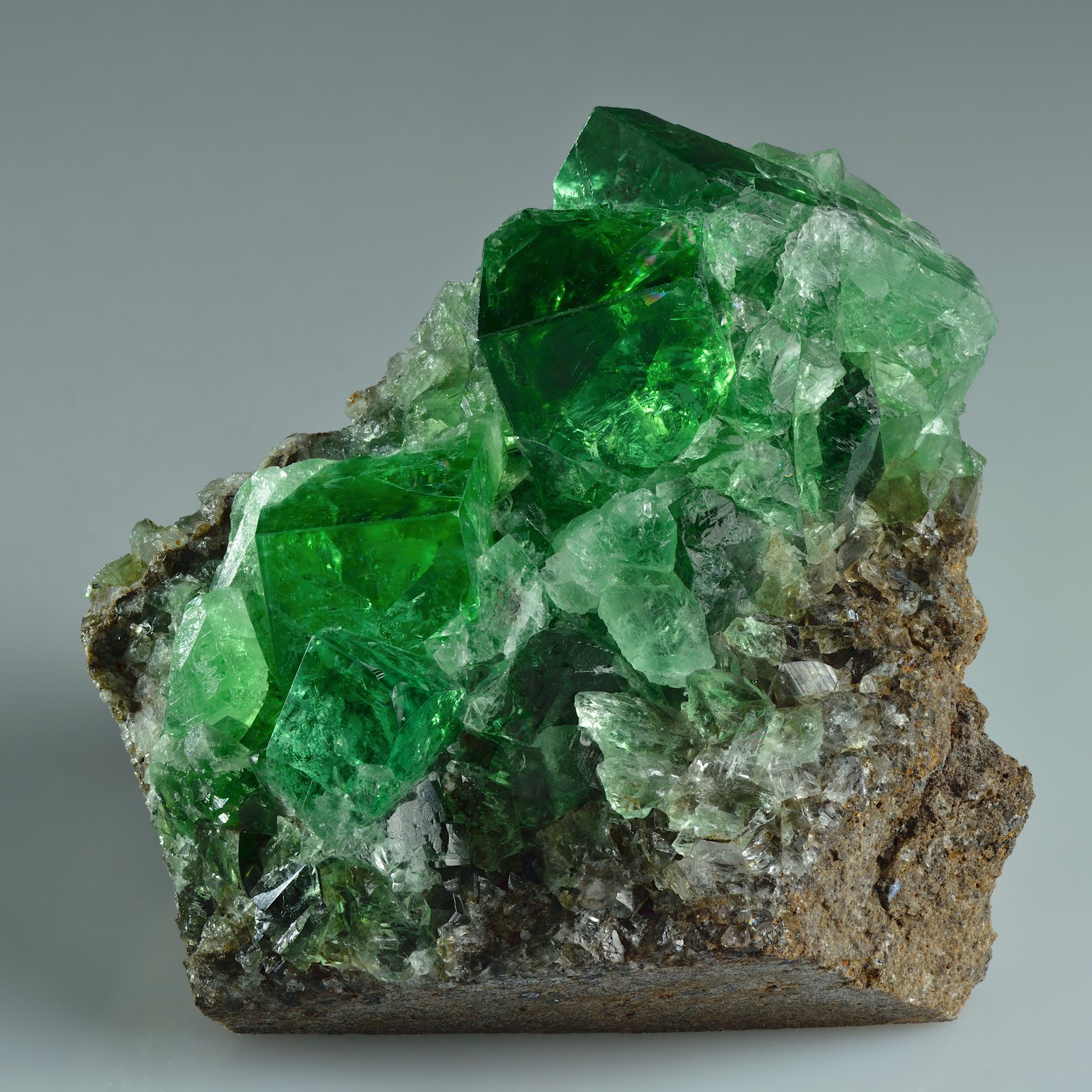
A disused mid-19th-century limestone quarry in Weardale that became, from the 1970s, the only mine in Britain worked commercially purely for mineral specimens — prized worldwide for fluorite that glows an intense blue-violet in ordinary daylight.
History
The quarry at Rogerley was originally worked in the mid-19th century for limestone, burned as flux for the iron foundries at Tow Law and Consett; there is no record of it being worked commercially for lead or fluorspar. Fluorite specimens were later found by local collectors along the base of the quarry wall, and in the early 1970s the Cumbria Mining and Mineral Company — Lindsay and Patricia Greenbank together with Michael and Brenda Sutcliffe — secured the mineral rights and began working the quarry on weekends, eventually for around twenty-five years. The same partnership also ran the Force Crag zinc mine in the Lake District between 1982 and 1990. A portal collapse in 1992-93 required rehabilitation before work could continue.
Lindsay Greenbank's illness ended that phase of operations, and in 1999 the American-owned UK Mining Ventures took over, rehabilitating the mine and beginning full-time specimen production. In 2017 the company, restructured as UK Mining Ventures Limited, opened a new working alongside the original mine on the same veins, named the Diana Maria Mine after Diana Maria Bruce, a director of the company.
Geology
Fluorite-bearing cavities in Carboniferous limestone within the Weardale orefield; Rogerley's fluorite carries an unusually high rare-earth content (yttrium, cerium and lanthanum), which is thought to be responsible for its intense fluorescence.
Workings
Worked by hand on a small, weekends-only scale from the 1970s, and since 1999 as a purpose-run specimen mine, extending the original quarry workings northward by tunnel.
Closure
Unknown.
What remains
Still an active, working specimen mine, the only one in the UK run commercially purely for mineral-specimen recovery rather than for bulk ore.
Related mines
- Diana Maria Mine — Both are worked by UK Mining Ventures in the same quarry at Frosterley; the Diana Maria was opened on the Sutcliffe Vein in 2017 while the Rogerley mine was being upgraded, and the two are now run together all year.
- Lady Annabella Mine — Both are run by the same operator, UK Mining Ventures Ltd.
Nearby mines
- Harehope Gill Mine — 0.6 miles (0.9 km) SE
- Frosterley Marble Quarries — 0.7 miles (1.2 km) SE
- Cornish Hush Mine — 2.6 miles (4.2 km) S
- Diana Maria Mine — 2.8 miles (4.5 km) W
- Stanhopeburn Mine — 3.0 miles (4.8 km) NW
Straight-line distance, within 9 miles (15 km). Show on the map.
Recorded claims
Individual factual claims, each attached to the source(s) that support it below. Where sources disagree, both are kept.
- The quarry was originally worked in the mid-19th century for limestone burned as flux for iron foundries at Tow Law and Consett; there is no record of it being commercially worked for lead or fluorspar in that period. 1
- Lindsay and Patricia Greenbank and Michael and Brenda Sutcliffe, trading as the Cumbria Mining and Mineral Company, secured the mineral rights in the early 1970s and worked the mine on weekends for around 25 years, also running the Force Crag zinc mine from 1982 to 1990. 1
- UK Mining Ventures took over the mine in 1999 and began full-time specimen production; in 2017, as UK Mining Ventures Limited, it opened the adjoining Diana Maria Mine on the same veins, named after director Diana Maria Bruce. 1,2
- Rogerley fluorite is unusual in fluorescing intensely blue-violet even in ordinary daylight, not just under ultraviolet light, a property linked to its elevated rare-earth content. 2
Sources
- (secondary) The Rogerley Mine, Weardale - A Condensed History — Mineraltown.com
- (secondary) Fluorite Specimen Mining, Frosterley, Weardale, England — UK Mining Ventures
Record created: 27 August 2026 · Last researched: 27 August 2026