 MineArchive
Frosterley Marble Quarries
| Location | Frosterley, Weardale, County Durham — 54.7278, -1.9588 (exact) |
|---|---|
| Commodities | Limestone, Fluorspar |
| Type | Stone |
| Worked | worked from at least 1183–By the 20th century |
Overview
Frosterley Marble is a dark grey to black, fossil-rich limestone quarried around Frosterley in Weardale, prized since at least the 12th century as a polishable ornamental stone for church decoration, most famously the 13th-century Chapel of the Nine Altars at Durham Cathedral. It is not true metamorphic marble, only a limestone capable of taking a marble-like polish. Rogerley Quarry, a disused 19th-century working within the district, is today notable not as a stone quarry but as the only mine in the UK operated commercially purely for mineral-specimen recovery, producing prized fluorescent green fluorite.
History
A document from 1183 mentions 'Lambert the marble cutter' of Stanhope, almost certainly the earliest reference to the working of Frosterley Marble. It has been used in Durham Cathedral for flooring and columns since at least the 13th century, most famously in the Chapel of the Nine Altars, and later found wide use for fonts, floors and columns in churches and public buildings across northern England, including fonts at York Minster and Beverley Minster, decoration at St Peter's Chapel in Auckland Castle, and work at Tynemouth Priory, Newminster Abbey and Rievaulx Abbey; it was even exported as far as the base of the pulpit at St Thomas Cathedral, Mumbai. The wider Great Limestone bed containing the marble layer has been quarried across Weardale for centuries for lime, roadstone, and the iron, steel and cement industries, a much larger-scale industry than the marble specifically.
Rogerley Quarry itself was a 19th-century limestone working that fell out of use before being rediscovered by mineral collectors Lindsay Greenbank and Mike Sutcliffe in the early 1970s. It has operated since as a specimen mine under a succession of owners: the Cumbria Mining and Mineral Company (1972-96), UK Mining Ventures LLC (1999-2016), and UK Mining Ventures Ltd, run by Ian and Diana Bruce, from 2017 to the present.
Geology
Frosterley Marble is a layer up to a metre thick within the upper part of the Great Limestone, itself around 20 metres thick and one of the thickest limestone beds in the North Pennines. It formed in the Carboniferous, around 325 million years ago, when the area lay near the equator under a shallow tropical sea; skeletal remains of corals, crinoids and brachiopods accumulated on the sea floor and were buried in limy ooze that hardened into dark grey limestone. It is a bituminous, coral-rich limestone containing abundant fossils of the extinct solitary rugose coral Dibunophyllum bipartitum, visible in cross-section as pale shapes against the dark matrix once polished. Despite the name, it is not true marble: to a geologist marble is limestone altered by heat and pressure, and Frosterley Marble has undergone no such metamorphism, only taking a fine polish as an ordinary limestone — in contrast to the true, metamorphosed marble of Upper Teesdale's 'Sugar Limestone', recrystallised by contact heat from the Whin Sill, or to Skye Marble, a genuine metamorphic marble. The underground fluorite workings at Rogerley today follow the 'Greenbank Vein' at the 'High Flats' horizon of the Great Limestone, a mineralised structure within the same formation rather than the marble band itself.
Workings
Unknown.
Closure
Unknown.
What remains
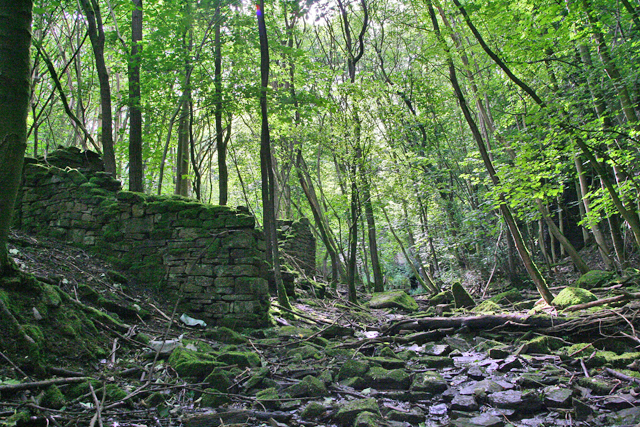
Rogerley Quarry today is not an active stone or marble quarry: it is a Site of Special Scientific Interest, valued for a Namurian sandstone river-channel exposure above the Great Limestone, and the site of an active underground fluorite-specimen mine, worked via an adit extending into the quarry face. Mindat describes it as the only mine currently operated commercially in the UK purely for mineral-specimen recovery, prized for green fluorite noted for its intense fluorescence. The Frosterley Marble outcrop itself is best seen today at nearby Harehope Quarry, now run as an environmental education centre.
Nearby mines
- Harehope Gill Mine — 0.2 miles (0.3 km) W
- Rogerley Mine — 0.7 miles (1.2 km) NW
- Cornish Hush Mine — 2.5 miles (4.0 km) SW
- Diana Maria Mine — 3.5 miles (5.6 km) W
- Stanhopeburn Mine — 3.7 miles (6.0 km) NW
Straight-line distance, within 9 miles (15 km). Show on the map.
Recorded claims
Individual factual claims, each attached to the source(s) that support it below. Where sources disagree, both are kept.
- A document from 1183 mentions 'Lambert the marble cutter' of Stanhope, almost certainly the earliest reference to the working of Frosterley Marble. 1
- Frosterley Marble has been used in Durham Cathedral since at least the 13th century, most famously in the Chapel of the Nine Altars, and later for fonts, floors and columns at York Minster, Beverley Minster, Auckland Castle, Tynemouth Priory, Newminster Abbey and Rievaulx Abbey. 1
- Frosterley Marble is not true metamorphic marble but an unmetamorphosed, fossil-rich limestone capable of taking a marble-like polish, in contrast to genuinely metamorphosed British stones such as Upper Teesdale's Sugar Limestone or Skye Marble. 1
- Rediscovered by mineral collectors Lindsay Greenbank and Mike Sutcliffe in the early 1970s, Rogerley Quarry has operated since under a succession of owners as, per Mindat, the only mine currently operated commercially in the UK purely for mineral-specimen recovery. 2
- Rogerley Quarry is designated a Site of Special Scientific Interest, valued for a Namurian sandstone exposure showing an ancient river channel above the Great Limestone. 3
Sources
- (primary) Frosterley Marble — North Pennines AONB Partnership
- (secondary) Rogerley Mine, Rogerley Quarry, Stanhope, County Durham — Mindat.org
- (secondary) Rogerley Quarry — Wikipedia
- (secondary) Frosterley, County Durham — Wikipedia
Record created: 26 August 2026 · Last researched: 26 August 2026