 MineArchive
Limestone
| Category | Commodities |
|---|---|
| Commodity page | Limestone → |
A sedimentary rock composed mainly of calcium carbonate, quarried and mined across Britain for building stone, lime burning, ironworking flux and, from the 19th century onward, cement — one of the few commodities on this site extracted almost as much by underground mining as by open quarrying.
Historical usage
Limestone building stone was cut in Britain from at least the Roman period, and Bath stone — the fine oolitic limestone of the Cotswolds — was worked underground at Box from Roman times right through to 1968. Lime burning is older still: kilns converting limestone to quicklime for mortar and agriculture operated in Britain for centuries before the Industrial Revolution, and the practice is sometimes described as one of the oldest continuous chemical industries on earth. Large-scale underground limestone mining is a comparatively narrow chapter within that much longer story: it flourished chiefly from the 18th century, when canal transport made bulk haulage practical, to the early 20th, when cheaper mechanised open quarrying took over almost everywhere it could.
How it worked
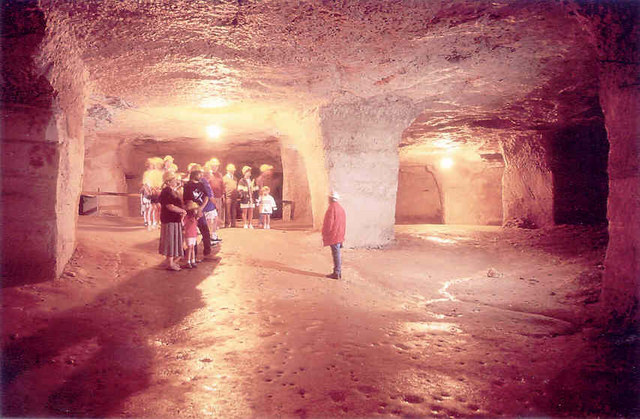
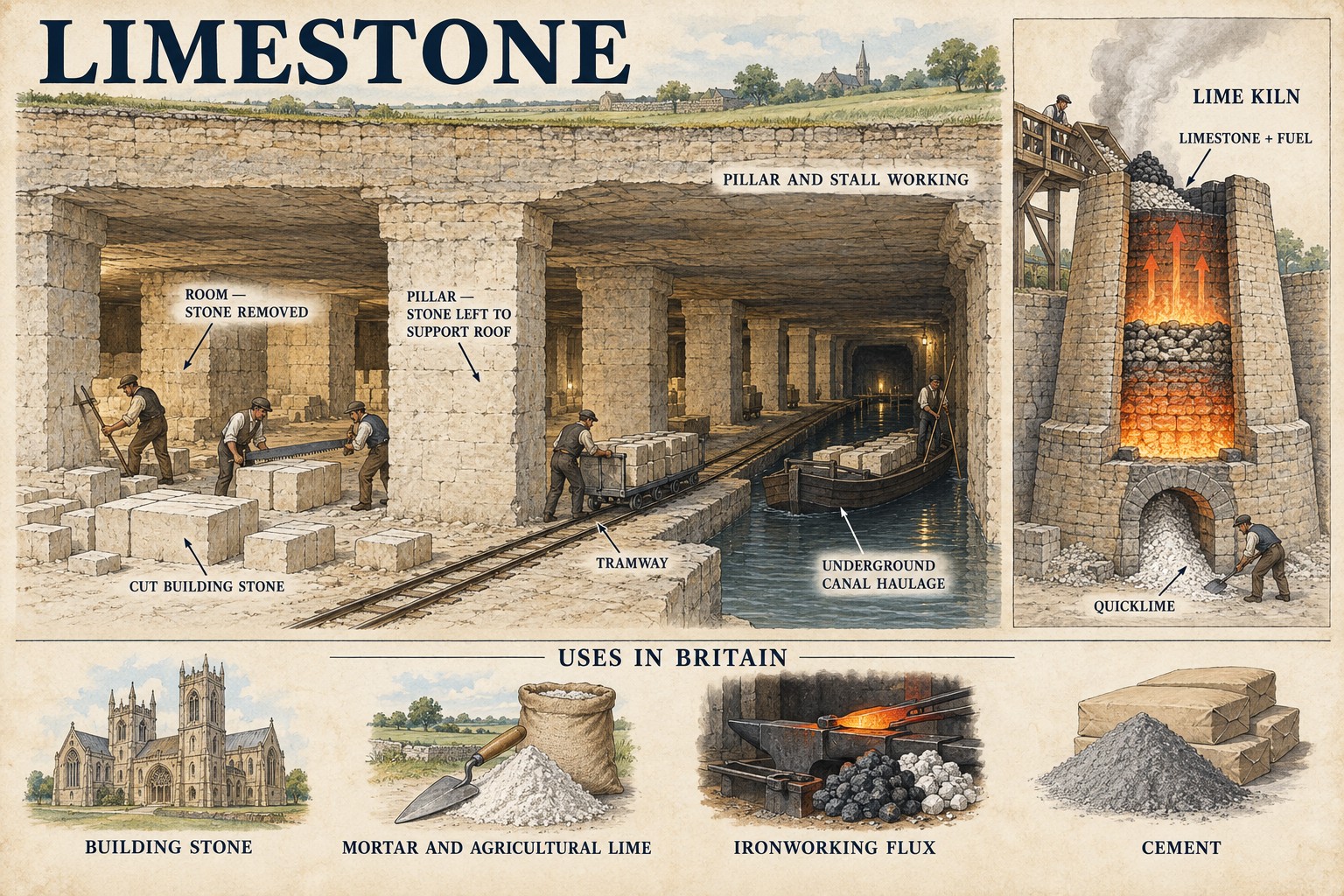
Where limestone was mined rather than quarried at the surface — usually because the best beds lay too deep to strip economically, or because a canal or river offered underground boat access — it was worked by the room-and-pillar (locally, 'pillar and stall') method: parallel chambers driven into the rock, leaving regularly spaced pillars of unmined stone to hold up the roof. At Bath's Combe Down mines this was done with hand saws and picks, the blocks hauled out by tramway; at Wren's Nest in Dudley (see that mine's own page) it was reached by nearly three kilometres of underground canal tunnel, with boats loaded directly at the working face. Quarried or mined rock destined for lime was then burned in a kiln with fuel — originally wood, later coal — at high enough temperature to drive off carbon dioxide and leave quicklime behind.
Why it was used
Cut limestone is a durable, workable building stone — Bath stone alone built much of Georgian Bath and later Buckingham Palace and the Houses of Parliament. Burned to quicklime, it made mortar and plaster, and spread on fields it neutralises acid soil, a use that made lime burning a fixture of British farming for centuries. Crushed limestone is also the standard flux in iron smelting, combining with silica and other impurities in the furnace to form a removable slag, and from the 19th century it became the primary raw material for Portland cement, the single largest modern use of the rock by volume.
Value over time
For most of its history limestone's value lay in two steady, low-margin markets: agricultural lime, spread on fields to correct soil acidity, and mortar/plaster lime for building — both served by thousands of small local kilns near canals or railways. Ironworking flux added a second major market through the Industrial Revolution, tying limestone demand directly to the fortunes of the iron and steel industry. The rock's modern importance dates from Joseph Aspdin's 1824 patent for Portland cement, refined into its modern form by his son William in the 1840s: cement manufacture, and later the aggregates industry supplying 20th-century concrete construction, turned limestone into a bulk industrial commodity on a scale the old lime-kiln trade never approached, even as cheap chemical fertiliser eroded its old agricultural market through the 20th century.
Hazards & challenges
Pure limestone dust (calcite) is far less dangerous to breathe than the crystalline silica found in most metal-bearing rock — it is generally treated as a low-toxicity 'nuisance dust' rather than a direct cause of silicosis, though limestone beds with silica-bearing impurities such as chert carry some of the same risk. The greater historical hazard was structural: room-and-pillar limestone mines depended entirely on leaving enough stone unmined to hold the roof up, and where pillars were 'robbed' for extra stone or driven too thin, collapse followed — at Combe Down, sustained pillar-robbing and shallow cover left the abandoned mines so unstable that a ten-year, council-run programme (1999-2009) had to backfill 25 hectares of workings with foamed concrete to stop them collapsing under the houses built above. Burning limestone into quicklime added a separate hazard downstream of extraction: quicklime is strongly caustic, causing severe skin and eye burns on contact, historically a routine occupational risk for lime burners.
Risks & limitations
Underground limestone mining was always the costlier option next to open quarrying, and it survived commercially only where geology or transport made it worthwhile — a deep clean bed, or direct underground canal access as at Dudley. Once steam and then diesel machinery made large-scale open-pit quarrying cheap through the 19th and 20th centuries, almost every underground limestone mine in Britain was undercut on cost and closed; modern demand, hugely increased by cement and the aggregates industry, is now met almost entirely by a small number of very large surface quarries rather than the many small mines of the canal era.
Regional variation
Bath and Box in Somerset/Wiltshire mined fine oolitic freestone underground for dressed building stone; Dudley and the Black Country mined thick Wenlock limestone beds underground to feed local ironworks and lime works, reached by the Dudley Canal Tunnel system. The Mendips, the Peak District and the Yorkshire Dales, by contrast, are dominated today by large open quarries — Buxton's Tunstead quarry supplies exceptionally pure limestone for the chemical industry — with underground working there mostly confined to small, scattered lime-kiln-feeding pits rather than mines proper.
Related terminology
Calcite, Flats, Freestone, Lime Kiln, Magnesian Limestone, Marble, Pipe Vein
Mines associated with this term
5 examples chosen from 101 linked records — the term page is not an index.
- Wren's Nest Limestone Mines — West Midlands (surviving physical example)
Underground limestone mine reached by canal tunnel, worked by room-and-pillar method; still explored today by boat. - Browns Folly Mine — Somerset (well documented example)
Named in this record’s geology: “…have developed on Lower Lias clays, fuller's earth and the oolitic limestone of Jurassic age that was the object of the quarrying. The…” - Charlestown Limeworks — Fife (well documented example)
Named 5 times in this record, first in the summary: “The limestone quarries and kilns built on the Forth shore by Charles Bruce, 5th…” - Greetwell Ironstone Mines — Lincolnshire (well documented example)
Named 7 times in this record, first in the summary: “…ironstone tramways had mechanised. The site later produced limestone, and Greetwell Hollow is now a Lincolnshire Wildlife Trust nature…” - Ham Hill Quarries — Somerset (well documented example)
Named twice in this record, first in the geology: “Hamstone comes from a rock unit formerly called the Ham Hill Limestone Member, now treated as part of the Bridport Sand Formation, laid…”
See every mine that worked limestone →
Sources
- (secondary) Bath stone — Wikipedia
- (secondary) Burning the Bones of the Earth: Lime Kilns — Low-Tech Magazine
- (secondary) Comparative cytotoxicity of respirable surface-treated/untreated calcium carbonate rock dust particles in vitro — PMC
- (secondary) Portland cement — Wikipedia
- (secondary) Room and pillar mining — Wikipedia
- (secondary) The Stabilisation of Combe Down Stone Mines — Museum of Bath Stone
Record created: 21 August 2026 · Last researched: 21 August 2026