 MineArchive
Pipe Vein
| Also known as | Pipe workings |
|---|---|
| Category | Mine Workings & Access |
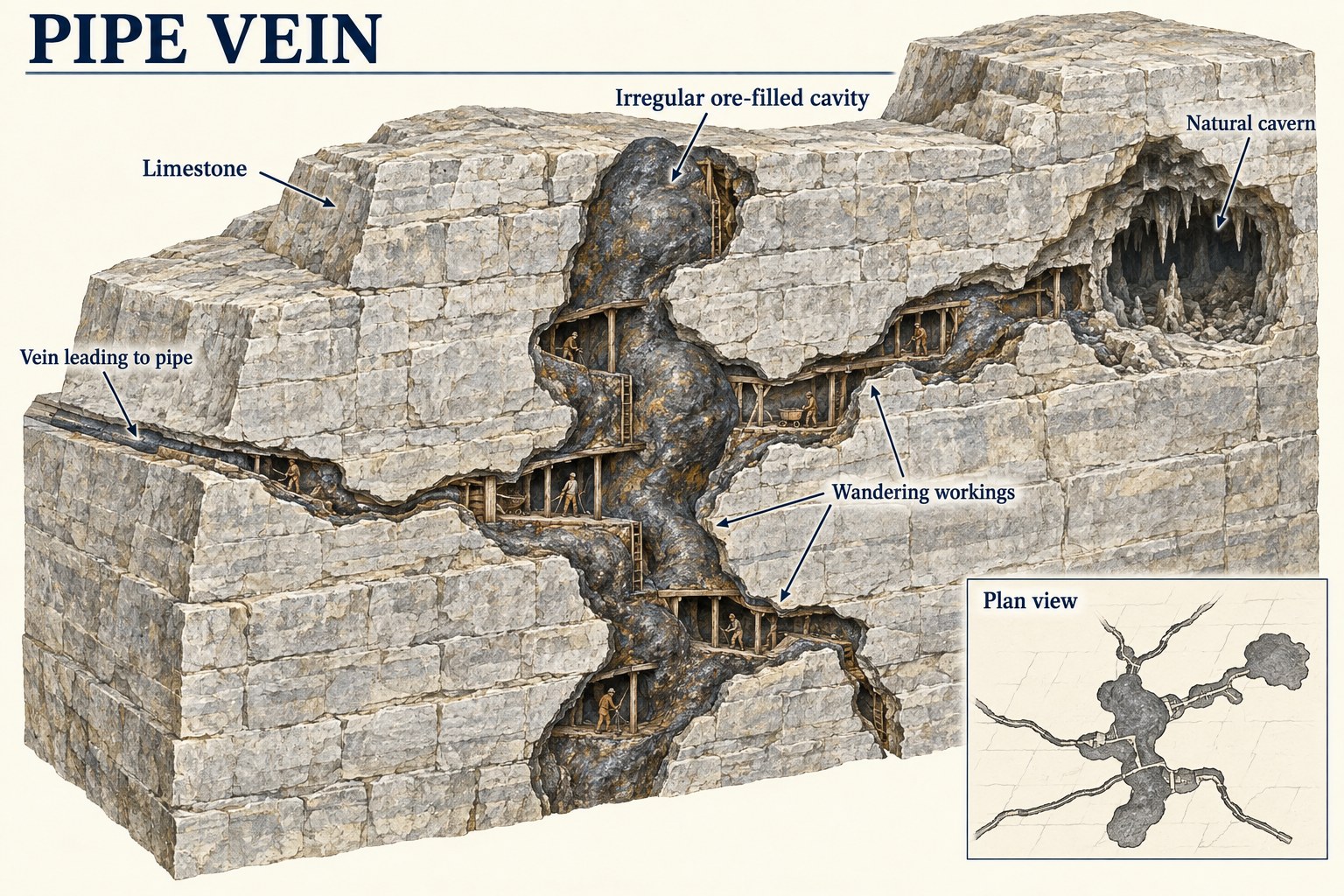
An irregular tube or pocket of ore filling a cavity that already existed in the limestone — not a sheet standing on edge like a vein, nor a bed lying flat like a flat, but a shape the rock had before the mineral arrived.
Historical usage
A Derbyshire word, and part of the standard set the Peak District lead miners used to describe what they were following: rakes for the great near-vertical fissure veins, scrins for the thin ones, flats for the bedded replacement bodies, and pipes for the cavity fills. Named pipes run through the record — the Calton Hill and Crimbo pipes among them — and pipe workings appear well beyond Derbyshire: Millclose opened new ground to work its pipe vein further north, and Tankerville in Shropshire worked a small pipe vein reached by a crosscut and a shaft. Pipe workings are among the oldest in the orefield. At the Nestus Pipes the workings are medieval or earlier, identified as such from the distinctive 'woodpecker' pickwork left on the walls.
How it worked
Pipes rarely reach the surface, so almost none were found by prospecting. Miners came on them sideways, working outward from a rake or scrin into the limestone, exactly as they found flats. Once found, a pipe was followed wherever it went — which is why pipe workings are irregular, wandering and hard to plan for, closer to caving than to the orderly stopes of a vein mine. Because the ore sits in a cavity the rock already had, pipe workings tend to wander, and they frequently run straight into open natural caverns that were never mined at all. Derbyshire miners had a word for those: a shack was any open cavern the old miners broke into. Golconda Mine at Brassington, reached by a single shaft 360 feet deep, has workings radiating in all directions as the ore was followed, several of them entering natural caverns of which the largest is the Great Shack.
Why it was used
Not a choice but a discovery. What made pipes worth the trouble is concentration: a cavity filled with ore could be far richer than the vein that led to it, and finding one could keep a mine going for years.
Risks & limitations
Unpredictable in every direction. A pipe can pinch out without warning, and because it occupies an old cavity system it can also open into water or into unstable ground. Nothing about a pipe tells you where the next one is.
Regional variation
Peak District vocabulary above all, where rake, scrin, pipe and flat together describe the orefield; the word travels to other limestone-hosted districts such as Shropshire, but a Cornish or Welsh hard-rock miner would not have used it. The line between a pipe and a flat is a matter of proportion rather than kind, and the literature applies it strictly: at Masson Hill near Matlock the mineralisation runs as a series of intermittent flats and pipes over some 1,500 m, and the largest body worked, at Masson Opencast Quarry, is counted a pipe rather than a flat only because its strike length of over 500 m exceeds its 240 m width down the dip.
Related terminology
Flats, Lead, Limestone, Rake, Scrin, Vein
Mines associated with this term
5 examples chosen from 15 linked records — the term page is not an index.
- Cambrian Colliery — Rhondda Cynon Taf (well documented example)
Named in this record’s workings: “…348,000 cubic feet of air a minute, with over 4,000 yards of water pipe run through the main roads and a spraying system used to wet coal on…” - Millclose Mine — Derbyshire (well documented example)
New ground was opened around 450 m to the north-east to work the pipe vein further north. - Carsington Pasture Lead Mines — Derbyshire (well documented example)
Named twice in this record, first in the history: “…capped shafts across the area giving access to underground vein and pipe workings. A 2006 walkover survey, carried out ahead of a proposed wind farm,…” - Coalisland Collieries — County Tyrone (well documented example)
Named in this record’s surface remains: “…and the industrial fabric of the town — the pottery, brick and pipe works that the coal was dug to fire.” - Llanharry Iron Mine — Rhondda Cynon Taf (well documented example)
Named in this record’s current condition: “…the shell of the former pumphouse down a steep embankment; a vent pipe on the remaining shaft lets you see down into the flooded workings.”
Disasters associated with this term
Included only where MineArchive's own research gives a reasonable evidential basis, with the nature of the relationship stated — not every disaster where this term might plausibly apply.
- Hamstead Colliery fire, 1908 (contextual relationship)
Named in this record’s cause: “…Redmayne noted it was 'greatly to be regretted' that the water pipe needed to fight it was not more easily reached, requiring a ladder…” - Wheal Mary Ann Footway Shaft Rescue (contextual relationship)
Named in this record’s cause: “…up to his chest while he and others were laying new drainage pipe as part of the shaft-clearance project.”
Sources
- (observational) Mining activities — Derbyshire — Derbyshire Caving Club
- (primary) Lead mine (monument type 69265) — Derbyshire Historic Environment Record — Derbyshire County Council
- (secondary) A Brief History of Derbyshire Lead Mining — Derbyshire Heritage
Record created: 25 August 2026 · Last researched: 9 September 2026