 MineArchive
Blue John Cavern
| Location | Treak Cliff, Castleton, Derbyshire — 53.3467, -1.6754 (approximate) |
|---|---|
| Commodity | Fluorspar |
| Type | Mineral |
| Worked | from At least 1766 |
Overview
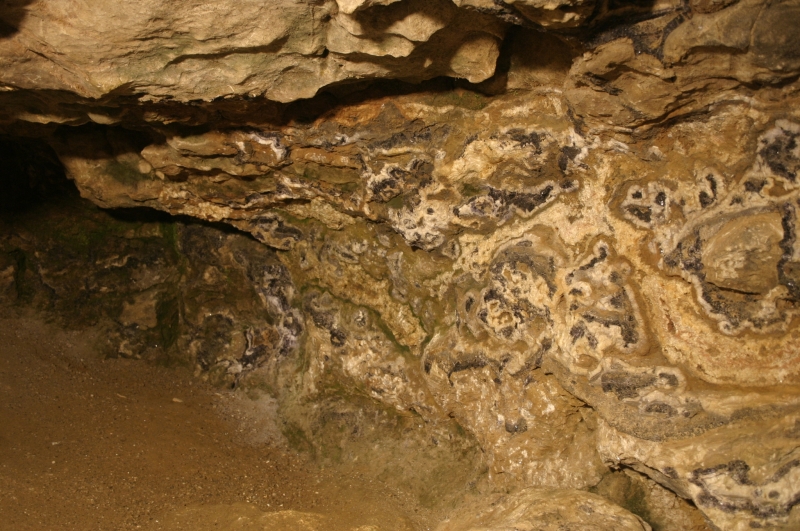
One of only two places on Earth where Blue John — a rare, ornamentally banded form of fluorspar — is found, worked at Castleton since at least the 18th century for jewellery, ornaments and grand houses including Chatsworth, and still mined today entirely by hand in tiny quantities to avoid damaging the stone's delicate banding.
History
Popular tradition credits Roman-era lead miners with first encountering Blue John by chance while working the district's genuine Roman lead veins, and points to similar banded fluorite vessels ('Roman murrhine') found elsewhere in the Roman world as circumstantial support — but no direct evidence confirms Roman-era discovery at Castleton specifically. The first solid documentary reference is a 1766 mining lease mentioning 'ye Blue John, Castleton'. The industrialist Matthew Boulton sought to acquire Blue John workings in 1768 to turn the mineral into ornamental ware, and the stone became fashionable for fireplace panels and inlays from around 1760, including work by the architect Robert Adam at Kedleston Hall; by the late 18th century it was in demand for vases and columns in some of Britain's grandest houses, Chatsworth among them. Blue John Cavern itself contains eight of the roughly fifteen known veins of the mineral in existence anywhere in the world; the only other source is the neighbouring Treak Cliff Cavern, opened for mining in 1745. A previously lost deposit was rediscovered in 2013, and the first entirely new vein found in 150 years followed in 2015.
Geology
Blue John is a rare, richly banded purple-blue-and-yellow variety of fluorspar (calcium fluoride), found in a handful of veins within a single hill at Castleton and nowhere else on Earth in workable quantity — ordinary fluorspar is common worldwide, but Blue John's distinctive banded colouring has never been found outside this one Derbyshire location.
Workings
Blue John is worked entirely by hand, without blasting, to avoid shattering the delicate banded structure that gives the stone its value; miners identify nodules by weight and carefully free them using hammer, chisel and crowbar rather than heavy machinery.
Closure
Unknown.
What remains
Blue John Cavern remains one of only two working sources of the mineral anywhere in the world, alongside the neighbouring Treak Cliff Cavern, and continues to operate as a show cave and small-scale working mine; permitted output has fallen from 20 tons a year under 18th-century leases to around 3 tons by 1892 and to roughly half a tonne today, reflecting both genuine scarcity and the deliberate, careful hand-working the stone demands.
Related mines
- Treak Cliff Cavern — The only two sources of Blue John fluorspar anywhere in the world, both still extracting the mineral today.
Nearby mines
- Silence Mine — 2.2 miles (3.6 km) W
- New Venture Lead Mine — 2.9 miles (4.7 km) W
- Bolehill Quarry — 3.0 miles (4.8 km) SE
- Moss Rake — 3.4 miles (5.4 km) W
- Merlin Mine — 3.5 miles (5.7 km) S
Straight-line distance, within 9 miles (15 km). Show on the map.
What's uncertain
Points where sources disagree or the record could not be settled; both accounts are kept. All open questions in the archive.
- The first documentary reference to Blue John is a 1766 mining lease mentioning 'ye Blue John, Castleton'; a popular tradition crediting Roman lead miners with its discovery is often repeated but is not supported by direct evidence. (disputed) 1,2
Recorded claims
Individual factual claims, each attached to the source(s) that support it below. Where sources disagree, both are kept.
- The first documentary reference to Blue John is a 1766 mining lease mentioning 'ye Blue John, Castleton'; a popular tradition crediting Roman lead miners with its discovery is often repeated but is not supported by direct evidence. (disputed) 1,2
- Blue John Cavern contains eight of the approximately fifteen known veins of the mineral anywhere in the world; the only other source is the neighbouring Treak Cliff Cavern, which opened for mining in 1745. 1,3
- Industrialist Matthew Boulton sought to acquire Blue John workings in 1768 to produce ornamental ware, and the architect Robert Adam used the stone in his 1760s work at Kedleston Hall. 1
- Permitted output fell from 20 tons a year under 18th-century leases to 3 tons by 1892 and to around half a tonne today, as the known veins have been progressively worked out. 1
- A previously lost deposit was rediscovered in 2013, and the first entirely new vein in 150 years was found in 2015. 1
Sources
- (secondary) Blue John (mineral) — Wikipedia
- (secondary) A History of Blue John and Treak Cliff Cavern — Treak Cliff Cavern
- (secondary) About Us — Blue John Cavern
- (primary) Blue John Caverns mine plan — BGS Mine Plans / Peak District Mines Historical Society
Record created: 22 August 2026 · Last researched: 22 August 2026