 MineArchive
Treak Cliff Cavern
| Also known as | Millers Mine |
|---|---|
| Location | Treak Cliff, Castleton, Derbyshire — 53.3451, -1.7972 (exact) |
| Commodities | Fluorspar, Lead |
| Type | Mineral |
| Worked | c.1745-50–1926 |
Overview
One of only two places on Earth where Blue John fluorspar is found, worked since the mid-18th century as Millers Mine and now, alongside the neighbouring Blue John Cavern, one of just two sites still extracting the stone — commercial mining ended here in 1926 after new cave passages were discovered, and the site opened to the public as a show cave in 1935.
History
What is now Treak Cliff Cavern began as Millers Mine, believed to be the world's first Blue John working, discovered around 1745-50 by miners who were originally prospecting for lead ore. Blue John extracted here shared the same 18th-century boom in demand as material from the neighbouring workings, being fashioned into vases, columns and ornamental panels for grand houses including Chatsworth and Buckingham Palace from the later 18th century onward.
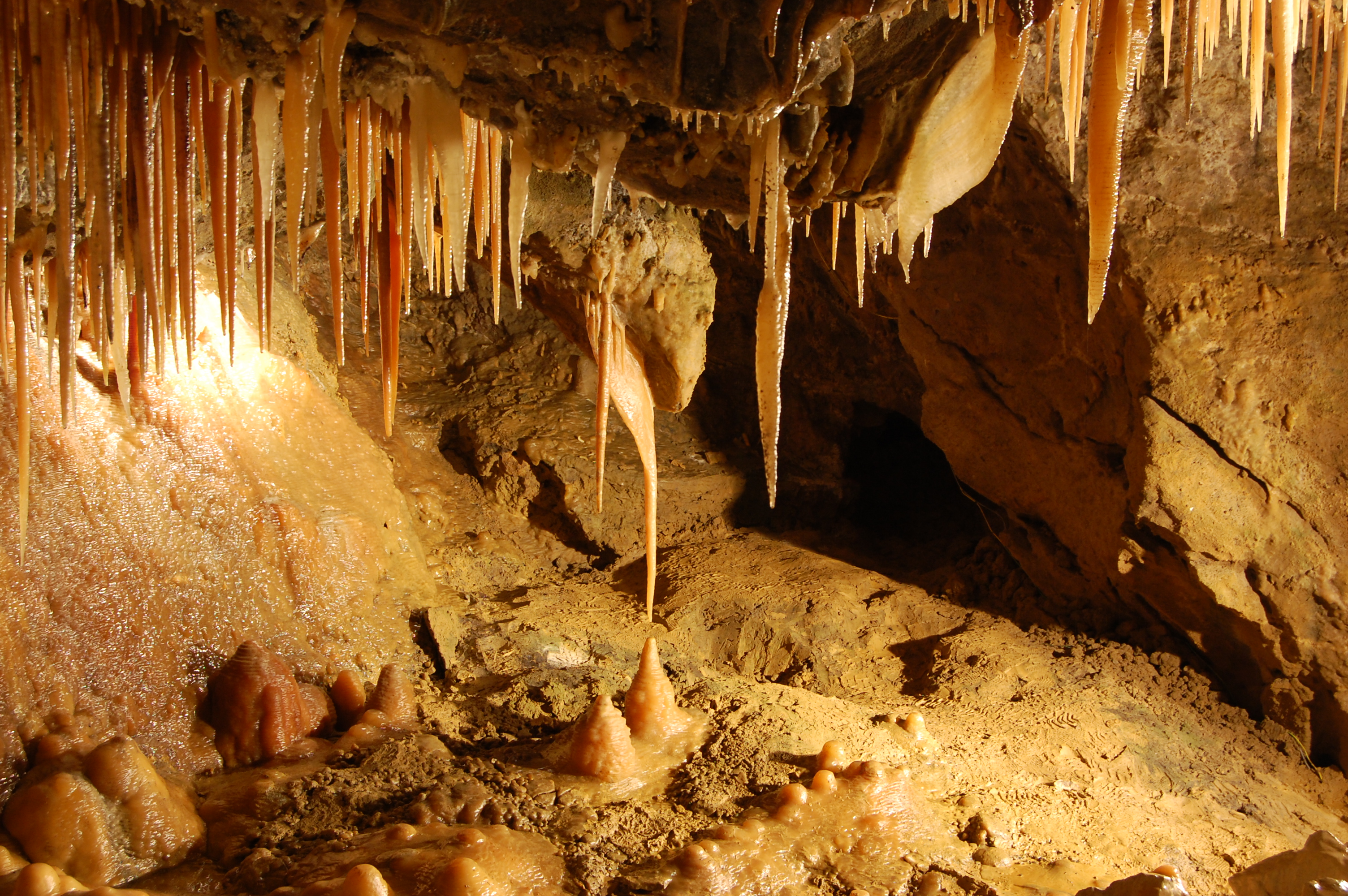
An 1878 account by William Hunt Painter describes visiting the 'variegated cavern' underground, noting chambers he estimated at 100-150 feet high and hung with stalactites — evidence that the workings were already a striking sight well before any thought of public admission.
The First World War brought a very different use for the mineral: fluorspar became essential as a flux in blast-furnace steelmaking, and wartime demand meant miners at Treak Cliff prioritised bulk extraction for industrial use over the careful working needed to preserve ornamental banding, destroying a good deal of decorative material in the process. In 1921, miners working the site discovered three Neolithic human skeletons together with flint implements in a nearby cave.
In 1926 the miner Bert Eyre and three companions, blasting for fluorspar, broke into a previously unknown, well-decorated section of cave now known as the New Series. The landowner, Colonel Broadbent, halted commercial mining to protect the new discovery rather than risk damaging it, and once an easier route into the New Series was found, the site was developed instead as a show cave, opening to the public at Easter 1935. Since 1945 the site has been run by the Harrison family. Very limited mining for jewellery-grade stone has continued alongside public visits, extracting around half a tonne of Blue John a year — a previously lost vein was rediscovered in 2013, and the Ridley Vein, the first entirely new vein found in 150 years, was discovered in 2015.
Geology
Blue John fluorspar, found in only two places on earth, both on Treak Cliff, with lead in the same ground.
Workings
Narrow veins of banded Blue John fluorspar within limestone, originally followed by hand alongside lead-ore working; extraction today is by hand only, in small quantities, to avoid damaging the stone's delicate colour banding.
Closure
Unknown.
What remains
Operates as a show cave open to the public, displaying natural formations alongside surviving Blue John veins; roughly half a tonne of the mineral is still extracted each year for jewellery and small ornamental pieces. Along with the neighbouring Blue John Cavern, it remains one of only two places in the world where the mineral is worked.
Related mines
- Blue John Cavern — The only two sources of Blue John fluorspar anywhere in the world, both still extracting the mineral today.
Nearby mines
- Odin Mine — 0.2 miles (0.4 km) NW
- Speedwell Cavern — 0.3 miles (0.5 km) SE
- Faucet Rake — 0.5 miles (0.8 km) S
- New Rake Lead Mines — 0.7 miles (1.1 km) S
- Slitherstone and Linacre Lead Mines — 1.1 miles (1.8 km) SW
Straight-line distance, within 9 miles (15 km). Show on the map.
Recorded claims
Individual factual claims, each attached to the source(s) that support it below. Where sources disagree, both are kept.
- Treak Cliff Cavern began as Millers Mine, believed to be the world's first Blue John working, discovered around 1745-50 by miners originally prospecting for lead. 1,2
- An 1878 account by William Hunt Painter described visiting the 'variegated cavern', with chambers estimated at 100-150 feet high hung with stalactites. 2
- During the First World War, fluorspar became essential as a blast-furnace flux, and wartime demand led miners to prioritise bulk extraction over preserving ornamental banding. 1,2
- In 1921, miners working the site discovered three Neolithic human skeletons together with flint implements in a nearby cave. 2
- In 1926 Bert Eyre and three companions, blasting for fluorspar, broke into a previously unknown, well-decorated section of cave now known as the New Series; landowner Colonel Broadbent halted commercial mining to protect the find. 1,2
- The cavern opened to the public at Easter 1935, once an easier route into the New Series had been found. 1,2
- Since 1945 the site has been run by the Harrison family, with Blue John extracted only in small quantities for jewellery and ornaments; a lost vein was rediscovered in 2013 and the Ridley Vein, the first entirely new vein found in 150 years, in 2015. 1,2
- Located at about 53.345 N, 1.797 W. 2
Sources
- (secondary) A History of Blue John and Treak Cliff Cavern — Treak Cliff Cavern
- (secondary) Treak Cliff Cavern — Wikipedia
Record created: 26 August 2026 · Last researched: 26 August 2026