 MineArchive
Faucet Rake
| Location | Castleton, Derbyshire — 53.3379, -1.7995 (exact) |
|---|---|
| Commodity | Lead |
| Type | Metal |
| Worked | At least 1680–Mid-19th century |
Overview
A scheduled lead-mining rake near Castleton in the Peak District, worked mainly between about 1780 and the mid-19th century, incorporating the show cave Oxlow Cavern among its workings.
History
Also known as Foreside Rake, Faucet Rake saw limited production before 1680 but was worked mainly from around 1780 to the mid-19th century, with peak activity between roughly 1750 and 1850. The rake runs for over a mile and a half as a distinctive line of spaced shaft mounds following the inclined ('hading') lead vein, part of a wider mining group that also included the Oxlow, Watts Grove, Slithertow and New Rakes mines. Two cave systems were modified by the miners in the course of working the rake: Oxlow Cavern, considered Britain's deepest cave at the time of its discovery, and Rouster Mine, which may connect underground to the Speedwell Cavern system.
Geology
A hading lead vein near Castleton, followed for over a mile and a half as a line of spaced shaft mounds, and intersecting the natural cavern system that includes Oxlow Cavern.
Geological setting: Veins and Lodes (surviving physical example)
Workings
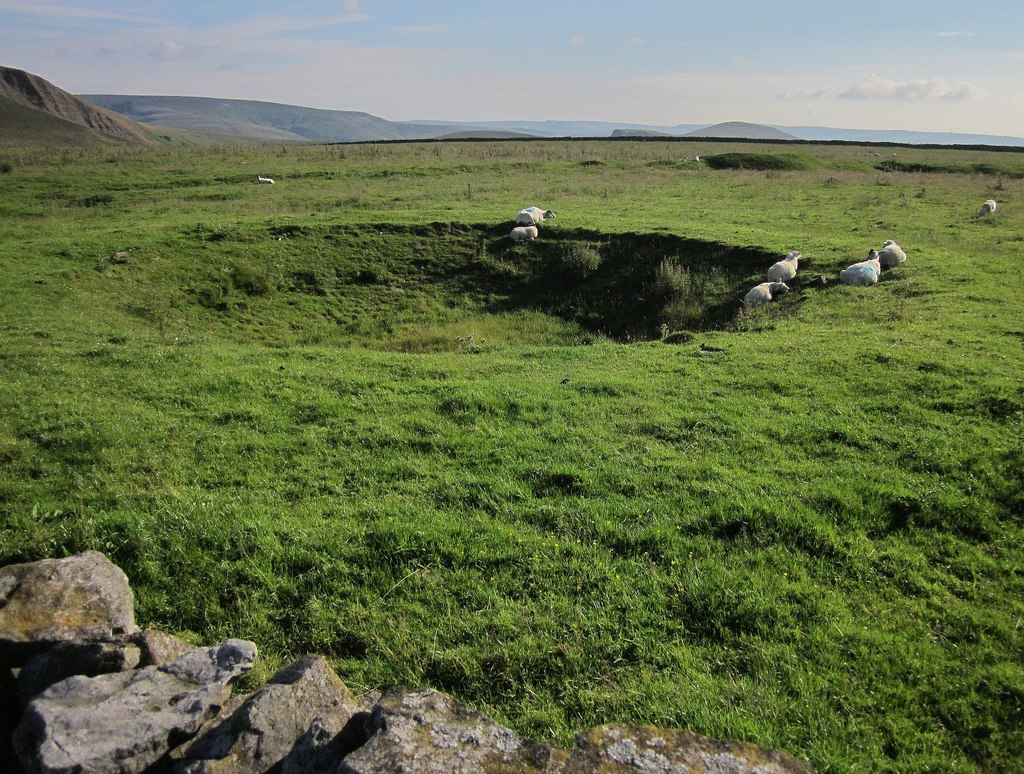
Surface and underground features surviving along the rake include multiple shafts and open cuts, an engine shaft, a gin circle, underground washing and dressing floors, ore storage bins, capped shafts and ruined coes (miners' shelters).
Closure
Unknown.
What remains
Designated a Scheduled Monument in 2000; the workings are traceable throughout their length by lines of hillocks and shaft remains.
Related mines
- Speedwell Cavern — Rouster Mine may connect underground to the Speedwell Cavern system.
Nearby mines
- New Rake Lead Mines — 0.3 miles (0.4 km) SE
- Speedwell Cavern — 0.4 miles (0.6 km) NE
- Treak Cliff Cavern — 0.5 miles (0.8 km) N
- Odin Mine — 0.7 miles (1.1 km) N
- Slitherstone and Linacre Lead Mines — 0.7 miles (1.1 km) SW
Straight-line distance, within 9 miles (15 km). Show on the map.
Recorded claims
Individual factual claims, each attached to the source(s) that support it below. Where sources disagree, both are kept.
- Faucet Rake (also Foreside Rake) saw limited production before 1680 but was worked mainly from around 1780 to the mid-19th century, with peak activity between about 1750 and 1850. 1
- The rake's workings incorporate two cave systems modified by miners: Oxlow Cavern, considered Britain's deepest cave at the time of its discovery, and Rouster Mine, which may connect underground to the Speedwell Cavern system. 1
- Faucet Rake was designated a Scheduled Monument in 2000, and is included in J. Barnatt's 2004 inventory of regionally and nationally important lead-mining sites in the Peak District. 2,1
- The remains of a shaft that formed part of the Faucet Rake complex can be seen from the track near Rowter Farm, a collapsed hollow in the pasture. 3
Photographs & further reading
Derbyshire Historic Environment Record's monument entry, with fuller feature-by-feature detail.
View sourceHistoric England's own scheduling description (its own page blocks automated retrieval; linked for readers who can browse it directly).
View sourceSources
- (primary) Faucet Rake (MDR2279) — Derbyshire Historic Environment Record
- (primary) An Inventory of Regionally & Nationally Important Lead Mining Sites in the Peak District (SDR19821) — Derbyshire Historic Environment Record / J. Barnatt (2004)
- (observational) Old lead mine shaft near Rowter Farm (Geograph, Derek Harper) — Geograph Britain and Ireland
Record created: 29 August 2026 · Last researched: 24 September 2026