 MineArchive
Veins and Lodes
| Category | Deposit Types |
|---|
A sheet-like body of mineral-bearing rock filling a crack or fracture in the surrounding country rock — the single most common shape taken by Britain's historic metal deposits, and the shape that dictated how the great majority of British hard-rock mines were built underground. "Vein" and "lode" describe the same thing; "lode" is simply the word Cornish and Devon miners used for it.
How it forms
A vein forms wherever a fracture in rock becomes filled with mineral material — most commonly, in Britain, by a hydrothermal fluid depositing dissolved metal as it cools or reacts with the surrounding rock, though veins can form from other fluid or magmatic processes too. The fracture itself came first: veins follow pre-existing structural weaknesses in the rock — faults, joints, fold-related fractures — rather than creating their own pathway from nothing.
Why minerals concentrate here
A vein is, by definition, wherever the fracture happened to be and wherever fluid moving through it deposited its dissolved load — so the mineral is concentrated along that one structural feature rather than spread evenly through the surrounding rock. This is precisely why veins were so attractive to work: a prospector who found a vein at the surface had found a genuine, bounded target, not a vague hope that ore might be somewhere nearby.
Typical shape of the deposit
A sheet or tabular body, typically steeply dipping, ranging from a few centimetres to several metres wide and extending for anything from a few metres to several kilometres along its length and down its dip. Real veins are rarely uniform: they swell into richer "bunches" or "shoots" of ore, pinch down to almost nothing, branch into multiple strands, and can die out abruptly and unpredictably — a fact that made prospecting and mine planning as much a matter of judgement and luck as science, even with a known vein to follow.
What this means for mining
Working a vein meant following its exact, often irregular course underground rather than extracting from a predictable grid. Miners drove levels along the vein's strike at successive depths, sank shafts and winzes to connect those levels, and drove crosscuts through barren rock specifically to intersect the vein where its course wasn't otherwise accessible — then stoped out the vein material itself, leaving the barren walls largely undisturbed. A narrow, steep vein could be worked to considerable depth on a comparatively small underground footprint, which is a major reason so many British metal mines — unlike coal mines — are deep, narrow and labyrinthine rather than broad and shallow.
Associated commodities
Antimony (Stibnite (antimony sulphide) is worked from veins, as at Glendinning Louisa Mine — an uncommon commodity in Britain but the same vein-hosted mechanism as the rest of this record.), Arsenic (Arsenopyrite is a common accessory sulphide in the same tin, copper and tungsten veins covered by this record — e.g. Botallack, East Pool, Devon Great Consols, Wheal Jane, Carrock Fell.), Calcite (A common hydrothermal vein gangue mineral, as at Odin Mine and Long Rake.), Cobalt (Cobalt ores occur as a vein accessory alongside copper and lead, as at Alderley Edge.), Copper (Commonly hosted in the same veins as tin.), Gold (Vein-hosted at several Welsh and Scottish sites.), Lead (The dominant vein commodity of the Pennines and Peak District.), Silver (Recovered from lead veins by cupellation.), Tin (The classic Cornish vein/lode commodity.), Uranium (Hydrothermal uranium minerals occur as a lode-hosted accessory or, at South Terras, as the principal ore of a hydrothermal vein.), Witherite (Witherite occurs as a Pennine-orefield vein mineral, in a single well-defined vein at Settlingstones, alongside the barite and fluorspar already covered by this record.), Zinc (Frequently accompanies lead in the same veins.)
Related geology
Dykes and Sills, Faults and Fractures, Hydrothermal Deposits, Placer Deposits
Related Mining Terms & Methods
Crosscut (Driven through barren rock specifically to intersect a vein.), Level (Driven along a vein's strike to work it.), Lode (The Cornish/Devon term for the same feature.), Rake (A Peak District term for a near-vertical vein.), Shaft (The primary means of reaching a vein at depth.), Stope (The working itself, extracting vein material.), Vein (The general term for this deposit shape.), Winze (Connects levels driven on the same vein.)
Diagrams
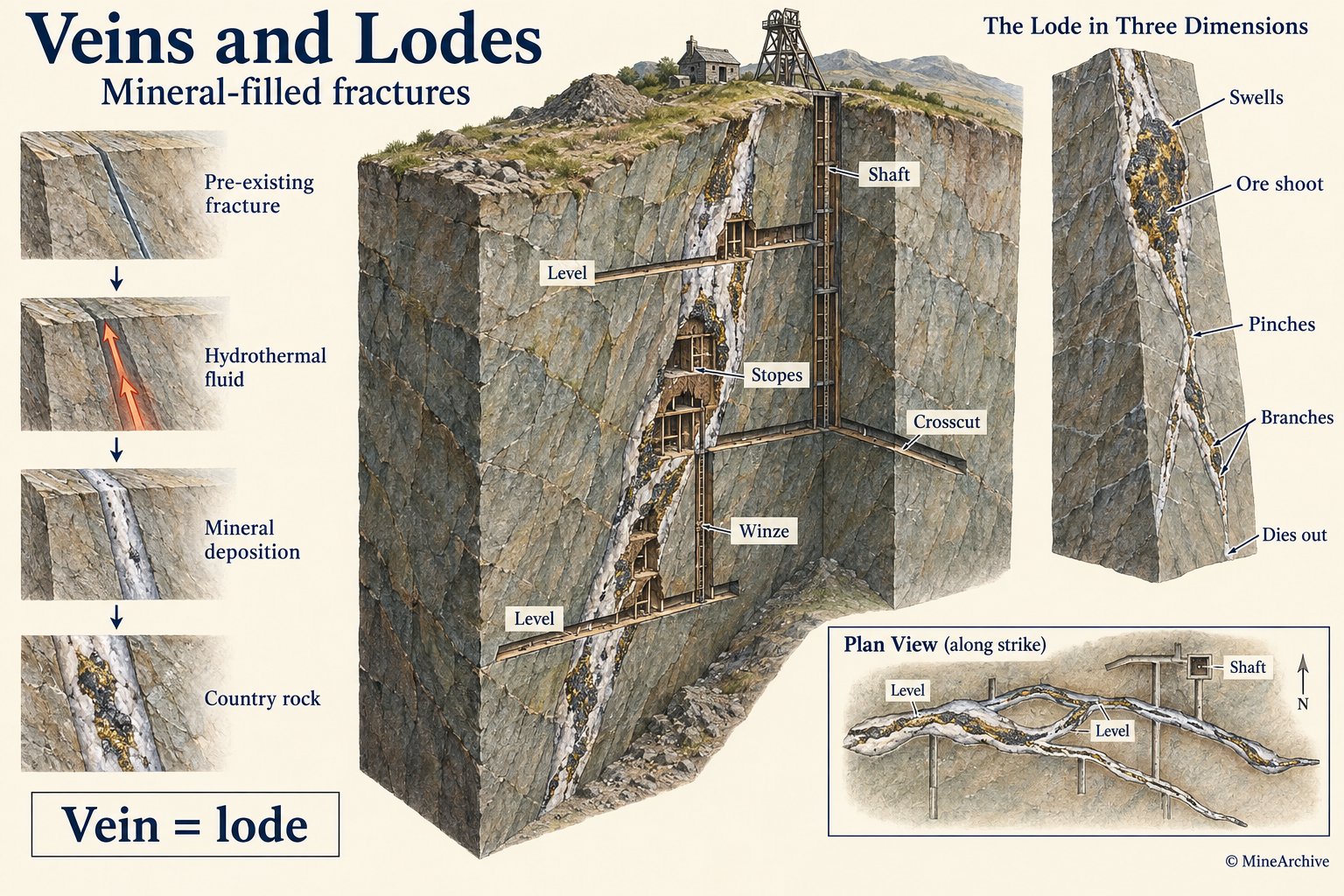
Images
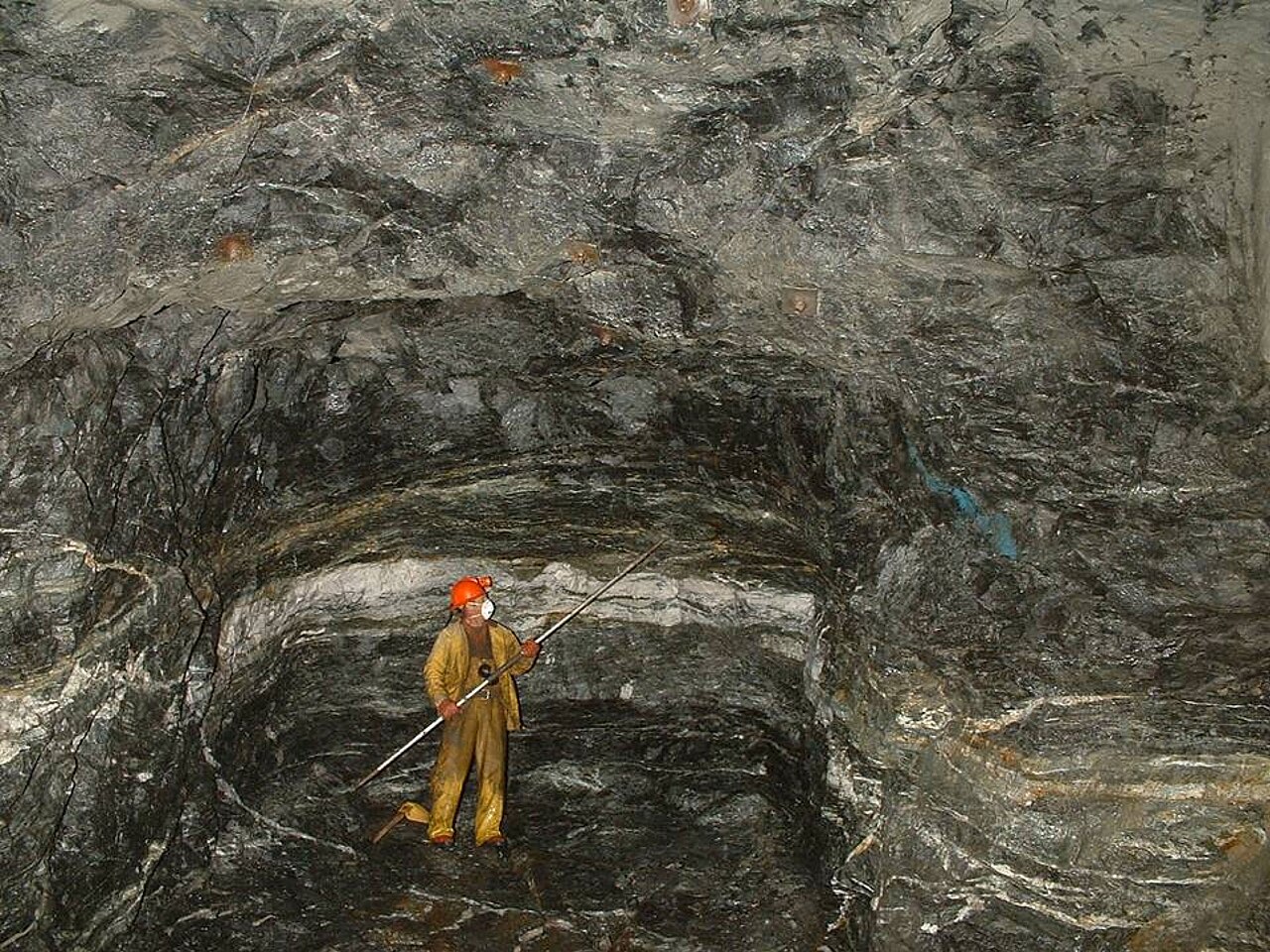
MineArchive examples
Included only where MineArchive's own research gives a reasonable evidential basis — not every mine where this geology might plausibly apply. Showing the 10 strongest examples of 243 linked mines.
- Carrs Mine — Cumbria (surviving physical example)
Worked the Smallcleugh Cross Vein and Carrs Cross Vein West with flats spreading from them into the limestone; the vein mineralisation is visible in the walls of the horse level. - Cothercott Mine — Shropshire (surviving physical example)
A barite vein is still exposed beside the old openings, which lead into an open stope on the vein. - Faucet Rake — Derbyshire (surviving physical example)
Faucet Rake is a textbook example of a rake vein worked from surface: a linear series of shafts and open cuts following the line of an inclined lead vein for over a mile and a half. - Botallack Mine — Cornwall (well documented example)
The mine's own recorded history describes working a specific lode by name. - Burrow Farm Mine — Somerset (well documented example)
The record describes ore worked from a lode in the Morte Slates, and the lode's unreliability — 'fickle' in the sources — is the stated reason the mine closed in 1868. - Carshield Mine — Northumberland (well documented example)
A North Pennine mine working near-vertical lead veins through a Carboniferous sequence, whose zinc — left in those same veins as waste by the lead miners — gave the ground a second working life, as this record's geology explains. - Consolidated Mines — Cornwall (well documented example)
The mine worked around eight main lodes through killas, crossed by intrusive elvan dykes, of which the Virgin Lode was the most productive and was stoped continuously for more than 1.3 miles. - Dolaucothi Gold Mines — Carmarthenshire (well documented example)
Dolaucothi's own geology text describes gold occurring in quartz veins along the Cothi Anticline, with the richest deposit the 'Roman Lode' saddle reef. - Rodderup Fell Mine — Cumbria (well documented example)
A North Pennine mine driven at three horizons to cut named near-vertical veins through the Carboniferous sequence, paying best where a vein crossed a competent limestone — the deposit type this record's geology sets out in detail. - Snaefell Mine — Isle of Man (well documented example)
The mine worked zinc-lead-silver veins on the slopes of Snaefell Mountain, part of the same Manx mineralised belt as Laxey and Foxdale.
See all 243 linked mines.
Sources
- (primary) Northern Pennine Orefield — BGS Earthwise
- (secondary) Hydrothermal Vein Deposits — earthsci.org
- (secondary) Mineral deposit - Hydrothermal, Solutions, Ore — Encyclopaedia Britannica
Record created: 22 August 2026 · Last researched: 22 August 2026