 MineArchive
Placer Deposits
| Category | Deposit Types |
|---|
A concentration of valuable mineral formed not underground but at the surface, where moving water sorts loose rock and sediment by weight, leaving dense minerals like gold behind while lighter material is carried away. Placer deposits are worked entirely differently from veins, lodes or seams — by washing and sorting loose sediment rather than breaking rock underground — and Britain's are modest by world standards, but genuine examples exist.
How it forms
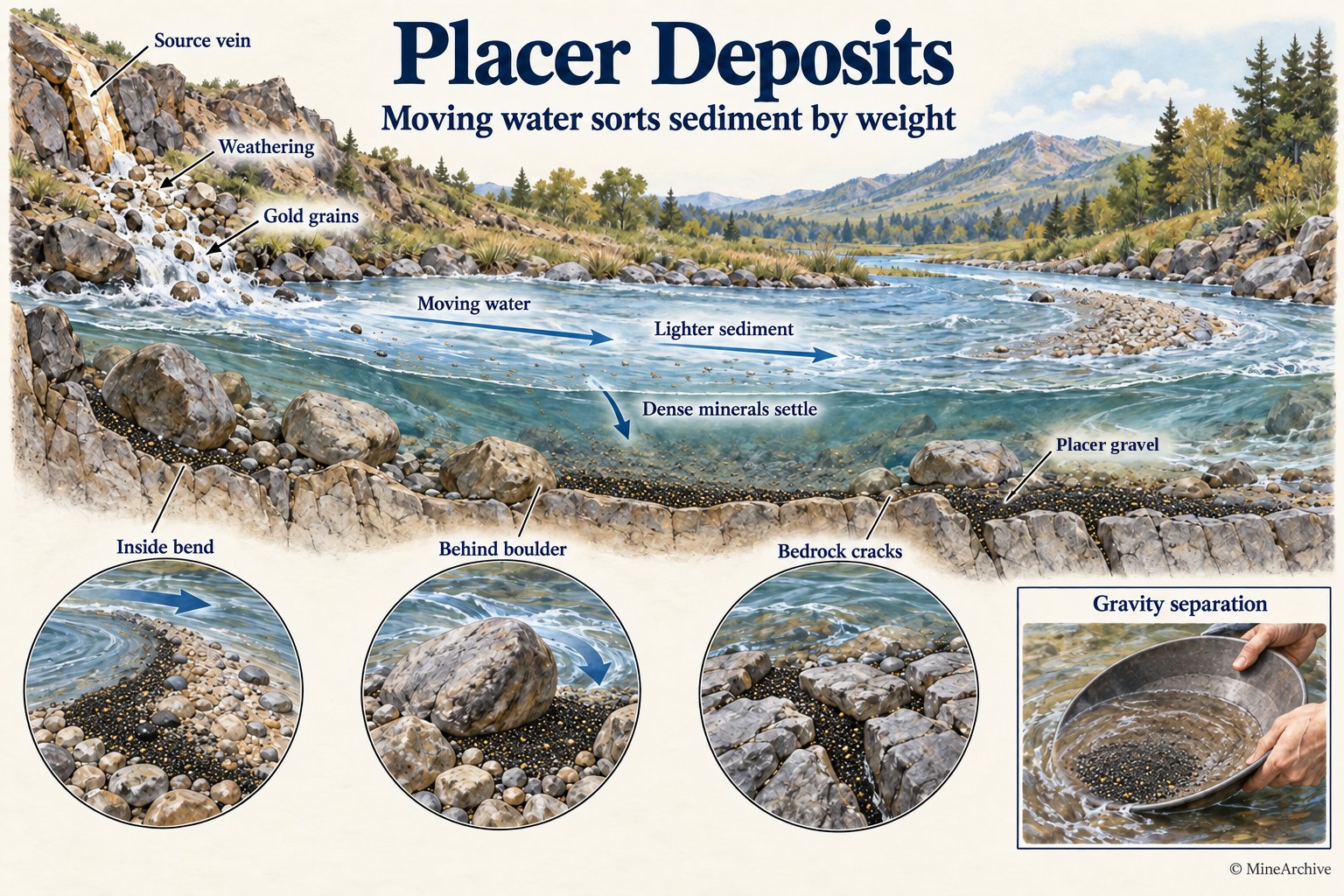
When a mineral vein or lode at the surface is broken down by weathering and erosion, its material — including any dense, durable minerals like gold — washes into nearby streams and rivers along with everything else. Moving water sorts this mixed sediment by density and durability rather than carrying it all downstream equally: dense particles like gold, roughly seven times denser than the quartz and rock fragments around it, settle out and accumulate wherever the water's flow slows, while lighter material continues on. Repeated over time, this natural sorting concentrates gold that was once thinly and invisibly scattered through a large volume of eroding rock into small, findable pockets in streambeds and gravel banks. The same density-and-durability sorting works in a marine setting too, and doesn't require the concentrated material to be a metal at all: at Felixstowe and Trimley in Suffolk, wave and current action reworking the sea floor stripped away lighter sediment and left phosphatic nodules — mostly phosphatised fragments of older fossil material rather than true fossilised dung, despite the name 'coprolites' given to them — concentrated into a thin, durable lag at the base of the Red Crag, in exactly the density-and-durability-driven way a river concentrates gold.
Why minerals concentrate here
Placer concentration is a purely mechanical, gravity-driven process rather than a chemical one — no fluid needs to dissolve and re-precipitate anything, as it does in a hydrothermal deposit. The same density difference that makes gold hard to lose once it's in a gravel bed also makes it comparatively easy to recover: it's exactly what let prospectors pan for gold using nothing more than a bowl of water and their own hands.
Typical shape of the deposit
Placer deposits are irregular and follow the shape of the stream, river or beach environment that concentrated them — a thin, patchy layer of enriched gravel along a present or ancient watercourse, rather than a well-defined vein, seam or body with any regular geometry. A rich placer deposit can be exhausted from a short stretch of stream in days, and finding the next productive stretch was as much a matter of reading the landscape as any deeper geological knowledge.
What this means for mining
Because the valuable material is already loose, in sediment rather than locked in solid rock, placer working never required blasting, shafts or underground development at all — only digging, washing and gravity-sorting the sediment itself, using techniques as simple as panning by hand or as industrial as hydraulic sluicing. This is the most fundamental way placer mining differs from every other deposit type on this site: it is a surface, sediment-processing operation, not an underground rock-breaking one, and the whole shape of a placer operation follows a stream's course rather than a vein's or a seam's.
Associated commodities
Coprolite (Concentrated by marine reworking as a lag deposit rather than a river placer, but the same density/durability sorting mechanism.), Gold (Britain's principal placer commodity.), Tin (Cornish 'stream tin' — cassiterite washed into river gravels and recovered by streaming and panning.)
Related geology
Related Mining Terms & Methods
Highbanking (Highbanking is the modern, mechanised extension of the same gravity-sorting concentration process described in this record, scaled up with a pump and sluice box.), Panning (Panning is the manual technique described above: swirling gravel and water to exploit gold's density.)
Diagrams
Images
MineArchive examples
Included only where MineArchive's own research gives a reasonable evidential basis — not every mine where this geology might plausibly apply.
- Cononish Mine — Stirling (well documented example)
Alluvial gold has been recorded in the streams around Tyndrum since at least the 1600s, predating the hydrothermal vein mine later worked underground here. - Felixstowe and Trimley Coprolite Diggings — Suffolk (well documented example)
The mine's own geology field explicitly describes the phosphatic nodules as 'concentrated at the base of the Crag by marine reworking — heavy, durable material left behind as lighter sediment was carried away' — the placer mechanism, upgraded here from historical_reference now that the connection is spelled out on both records. - Gaverigan Tin Streaming — Cornwall (well documented example)
An alluvial tin-streaming works recovering cassiterite from gravels beside the River Fal. - Glengonnar — South Lanarkshire (well documented example)
The mine's own recorded history explicitly describes 16th-century alluvial gold working, with surviving 'gowd scaur' spoil mounds. - Kildonan Gold Rush — Highland (well documented example)
Britain's clearest example of a genuine gold rush built on placer (alluvial) gold in the Strath of Kildonan. - Dolaucothi Gold Mines — Carmarthenshire (historical documentary reference)
Archaeological evidence suggests gold extraction here may have begun as Bronze Age washing of gold-bearing river gravels, predating the Roman vein-following operation. - Hyndford Quarry — South Lanarkshire (historical documentary reference)
The quarry works fluvial sand and gravel laid down by the River Clyde — water-sorted superficial deposits rather than solid rock. The link is to the depositional setting, not a claim that the workings are a mineral placer. - Marford Quarry — Wrexham (historical documentary reference)
The quarry worked sand and gravel deposited by glacial meltwater in a delta terrace — water-sorted superficial material rather than solid rock. The link is to the depositional setting, not a claim that the workings are a mineral placer. - Wanlockhead — Dumfries and Galloway (historical documentary reference)
Early working relied on manual digging and gold-panning in local streams, before deeper vein mining began. - Wheal Grey Mine — Cornwall (historical documentary reference)
An alluvial tin deposit found in the lower clay pit as the clay was cleared.
See all 10 linked mines.
Sources
- (primary) Gold in placer deposits — United States Geological Survey
- (secondary) Placer Gold Deposits: How Rivers Concentrate Gold — Metalorix
Record created: 22 August 2026 · Last researched: 22 August 2026