 MineArchive
Wheal Grey Mine
| Location | Tresowes, south-east of Germoe church, west side of Tregonning Hill, Cornwall — 50.1128, -5.3655 (approximate) |
|---|---|
| Commodities | Tin, China Clay |
| Type | Metal |
| Worked | By 1715–1873 (tin); sources differ |
| Maximum depth | 65 fathoms below adit |
Overview
A tin mine at Tresowes, south-east of Germoe church, on 'a large tin vein in pot granite', recorded in 1715 and employing 130 people with a 60-inch engine in 1836. Its sett was later worked for china clay, and its 1898 engine house, built to pump the clay pit with a second-hand stamps engine from Polgooth, still stands.
History
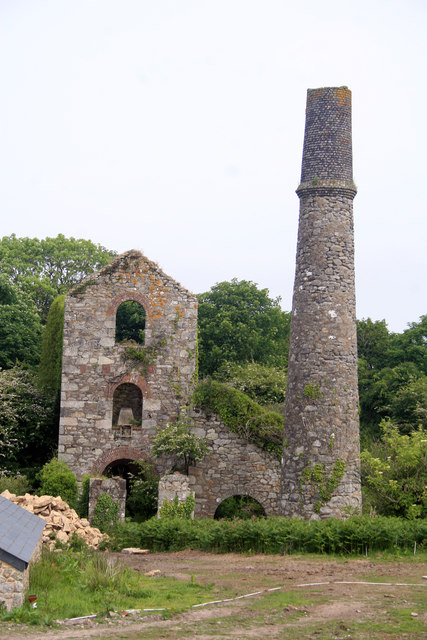
Wheal Grey worked a tin lode south-east of Germoe church, described by Joseph Collins as 'a large tin vein in pot granite', beside the clay pits on the western side of Tregonning Hill. Tin workings there are mentioned in the Callenick smelting-house books in 1715. The mine appears to have closed and was reopened in 1810; in 1836 it employed 130 people and had a 60-inch pumping engine, but work stopped in 1848, when its machinery, by then including 53-inch and 40-inch pumping engines, was put up for sale. Five lodes were worked for tin, to 65 fathoms below adit at the deepest, and an alluvial tin deposit was later found in the lower clay pit. The mine's abandonment plans, for tin ore and china clay, are dated 1846. Part of the mine was taken into Great Work Mine in 1868, and that section was abandoned in 1873, shortly before mining ceased there; Cornish Mine Images gives a different span, 1838 to 1910, with 116 tons of tin in all. From 1875 the sett was worked for china clay by William Argall of Breage, a story that belongs with the Tregonning Hill clay works. To drain the clay pit, an engine house was completed in 1898 for a 36-inch pumping engine; the engine had been built as a rotative stamps engine by the Charlestown Foundry for Polgooth Mine and used at two other sites before it came here in 1897-98, and it stayed in the house until it was scrapped in 1935. The engine house, its separate stack and the boiler house still stand among spoil heaps.
Geology
Tin lodes in granite, described as 'a large tin vein in pot granite'; five were worked. China clay from the altered granite was worked in two pits, and an alluvial tin deposit was found in the lower pit as the clay was cleared.
Geological setting: Placer Deposits (historical documentary reference), Veins and Lodes (well documented example)
Workings
Five tin lodes worked to a maximum of 65 fathoms below adit, drained in 1836 by a 60-inch pumping engine and by 1848 also by 53-inch and 40-inch engines. The engine house completed in 1898 held a 36-inch pumping engine that drained the clay pit, with a two-boiler boiler house beside it.
Closure
Sources differ: work stopped in 1848 and its machinery was sold; the abandonment plans are dated 1846; the part incorporated into Great Work Mine in 1868 was abandoned in 1873 (Cornwall Calling); Cornish Mine Images has the mine working from 1838 to 1910. The clay pit it later drained was pumped until the engine was scrapped in 1935.
What remains
The engine house of 1898, its separate stack and the boiler house stand in good repair among rubble and vegetation on private ground; the former processing shed has been converted into a holiday home and the clay pit is flooded.
The 1898 pumping engine house, its separate stack, the boiler house and spoil heaps.
Related mines
- Great Work Mine — Part of Wheal Grey was incorporated into Great Work Mine in 1868.
- Tregonning Hill China Clay Pits — Wheal Grey's sett was taken by William Argall in 1875 for china clay and worked with the Tregonning Hill clay pits; its 1898 engine house drained the Wheal Grey clay pit.
Nearby mines
- Tregonning Hill China Clay Pits — 1.1 km NE
- Wheal Vor — 1.3 km E
- Great Work Mine — 1.7 km N
- Wheal Prosper — 2.2 km S
- Wheal Trewavas — 2.5 km S
Straight-line distance, within 15 km. Show on the map.
People
- William Argall · lessee, from 1875 — Acquired Wheal Grey in 1875 to work its china clay.
- Joseph Collins · author — Described Wheal Grey as 'a large tin vein in pot granite'.
What's uncertain
Points where sources disagree or the record could not be settled; both accounts are kept. All open questions in the archive.
- In 1868 some of the mine was incorporated into Great Work Mine, but this section was abandoned in 1873, just before mining ceased there. (disputed) 1
- Wheal Grey was worked for tin and china clay from 1838 to 1910, producing 116 tons of tin in all. (disputed) 3
Recorded claims
Individual factual claims, each attached to the source(s) that support it below. Where sources disagree, both are kept.
- Workings for tin at Wheal Grey are mentioned in the Callenick smelting-house books in 1715; the mine appears to have closed and was reopened in 1810, and in 1836 it employed 130 people and had a 60-inch pumping engine. 1,2
- Work ceased in 1848 and the machinery, including 53-inch and 40-inch pumping engines, was put up for sale. 1,2
- Joseph Collins described Wheal Grey as 'a large tin vein in pot granite'; five lodes were exploited for tin to a maximum depth of 65 fathoms below adit. 1
- In 1868 some of the mine was incorporated into Great Work Mine, but this section was abandoned in 1873, just before mining ceased there. (disputed) 1
- Wheal Grey was worked for tin and china clay from 1838 to 1910, producing 116 tons of tin in all. (disputed) 3
- Abandonment plans of Wheal Grey, for tin ore and china clay, on three sheets, are dated 1846. 4
- The engine house was completed in 1898 for a 36-inch pumping engine to drain the china clay pit; the engine stayed in the house until it was scrapped in 1935. 3,5
- The engine was built as a rotative stamps engine by the Charlestown Foundry for Polgooth Mine and used at two further sites before being installed at Wheal Grey as a pumping engine in 1897-98. 2
Photographs & further reading
Photographs of the 1898 engine house and boiler house.
View sourceThe tin mine's history from 1715, its engines and lodes, and the clay pit beside it.
View sourceSources
- (secondary) Wheal Grey Mine, Cornwall — Cornwall Calling
- (observational) Wheal Grey - GooseyGoo — GooseyGoo
- (secondary) Wheal Grey — Cornish Mine Images
- (primary) Wheal Grey (Mining Remediation Authority abandonment plan OMR159A, via BGS catalogue item 21867182) — British Geological Survey / Mining Remediation Authority
- (observational) Wheal Grey - engine house (Geograph photo 4993942, Chris Allen, 2016) — Geograph Britain and Ireland
Record created: 18 September 2026 · Last researched: 18 September 2026