 MineArchive
Wheal Trewavas
| Location | Rinsey, Breage, Cornwall — 50.0908, -5.3583 (exact) |
|---|---|
| Commodity | Copper |
| Type | Metal |
| Worked | by 1834–1846 |
| Maximum depth | 600 feet (Diagonal Shaft) |
Overview
Wheal Trewavas, on the sea cliffs east of Trevavas Head near Rinsey, worked four copper lodes running out beneath the seabed of Mount's Bay — one of a handful of Cornish mines whose galleries genuinely passed under the sea rather than merely approaching the coast.
History
Wheal Trewavas was in operation from about 1834 to 1846, employing around 160 people at its peak. Its four copper lodes ran south-east, out under the sea, and were worked from two engine shafts on the clifftop: Old Engine Shaft, in operation by 1834 with an 18-inch Cornish engine, and New Engine Shaft, begun in 1836 with a larger 45-inch Cornish engine. A third working, Diagonal Shaft, was sunk on an incline to follow the lodes and reached some 600 feet below surface, extending workings well out under the seabed. Over its working life the mine raised about 17,500 long tons of copper ore, worth over £100,000. The mine was not without incident: sixteen-year-old Henry Richards fell to his death down one of the shafts, and a boiler exploded in December 1842. Working under the sea carried an obvious hazard, and closure came through flooding — tradition holds that two men laying tables in a sea-level tunnel for the annual tributers' dinner noticed water seeping from the tunnel roof and got out just before the sea broke in.
Geology
The mine worked four copper lodes running south-east under the seabed of Mount's Bay, part of the same Cornubian orefield of hydrothermal, granite-related mineral veins worked across west Cornwall.
Geological setting: Hydrothermal Deposits (well documented example), Veins and Lodes (well documented example)
Workings
Two engine shafts served the workings from the clifftop — Old Engine Shaft (1834, 18-inch engine) and New Engine Shaft (1836, 45-inch engine) — with a third, Diagonal Shaft, sunk on an incline to follow the lodes out to sea and reaching around 600 feet below surface.
Closure
The mine closed in 1846 after the sea broke into the sub-seabed workings; no attempt was made to reopen it.
What remains
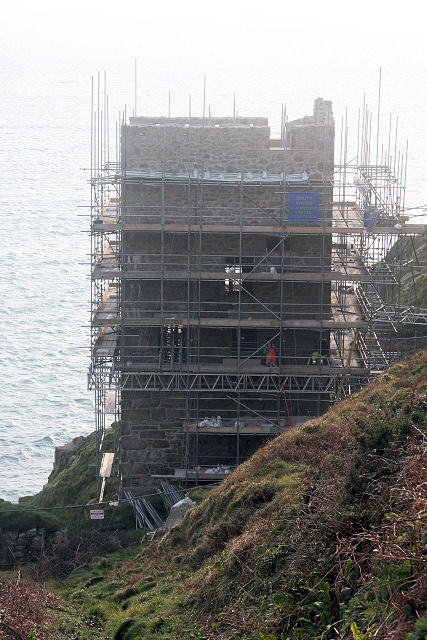
The engine house at Old Engine Shaft and the engine house at New Engine Shaft both survive on the clifftop east of Trevavas Head, along with their detached chimneys and the capstan platform at Old Engine Shaft; all are Grade II listed and the site is a Scheduled Monument.
Related mines
- Wheal Prosper — The earlier and larger neighbour along the cliffs at Rinsey.
Nearby mines
- Wheal Prosper — 0.4 miles (0.7 km) NW
- Wheal Grey Mine — 1.6 miles (2.5 km) N
- Tregonning Hill China Clay Pits — 2.1 miles (3.4 km) N
- Wheal Fortune — 2.3 miles (3.8 km) NE
- Wheal Vor — 2.3 miles (3.8 km) NE
Straight-line distance, within 9 miles (15 km). Show on the map.
Recorded claims
Individual factual claims, each attached to the source(s) that support it below. Where sources disagree, both are kept.
- The mine employed around 160 people at its peak and raised about 17,500 long tons of copper ore, worth over £100,000, between 1834 and 1846. 1
- Local tradition holds that closure came when two men preparing a sea-level tunnel for the annual tributers' dinner noticed water leaking from the roof and left just before the sea broke in. 1,2
- Diagonal Shaft was sunk on an incline to follow the lodes and reached around 600 feet below surface, extending the workings out under the seabed. 2
Photographs & further reading
A short August 2019 report on the cliff-top engine houses between Praa Sands and Porthleven, posted by a walker who came on them while looking for wartime coastal pillboxes and did not know what they were; other members identify the site in the replies. Photographs of the buildings in their setting above the sea, with Porthleven in the distance.
View sourceSources
- (secondary) Wheal Trewavas — Wikipedia
- (secondary) Wheal Trewavas Mine — Cornwall Guide
- (primary) Detached chimney at SW 598263, Trewavas Mine, Breage — Historic England (Listed Building record)
Record created: 22 August 2026 · Last researched: 22 August 2026