 MineArchive
Hydrothermal Deposits
| Category | Formation Processes |
|---|
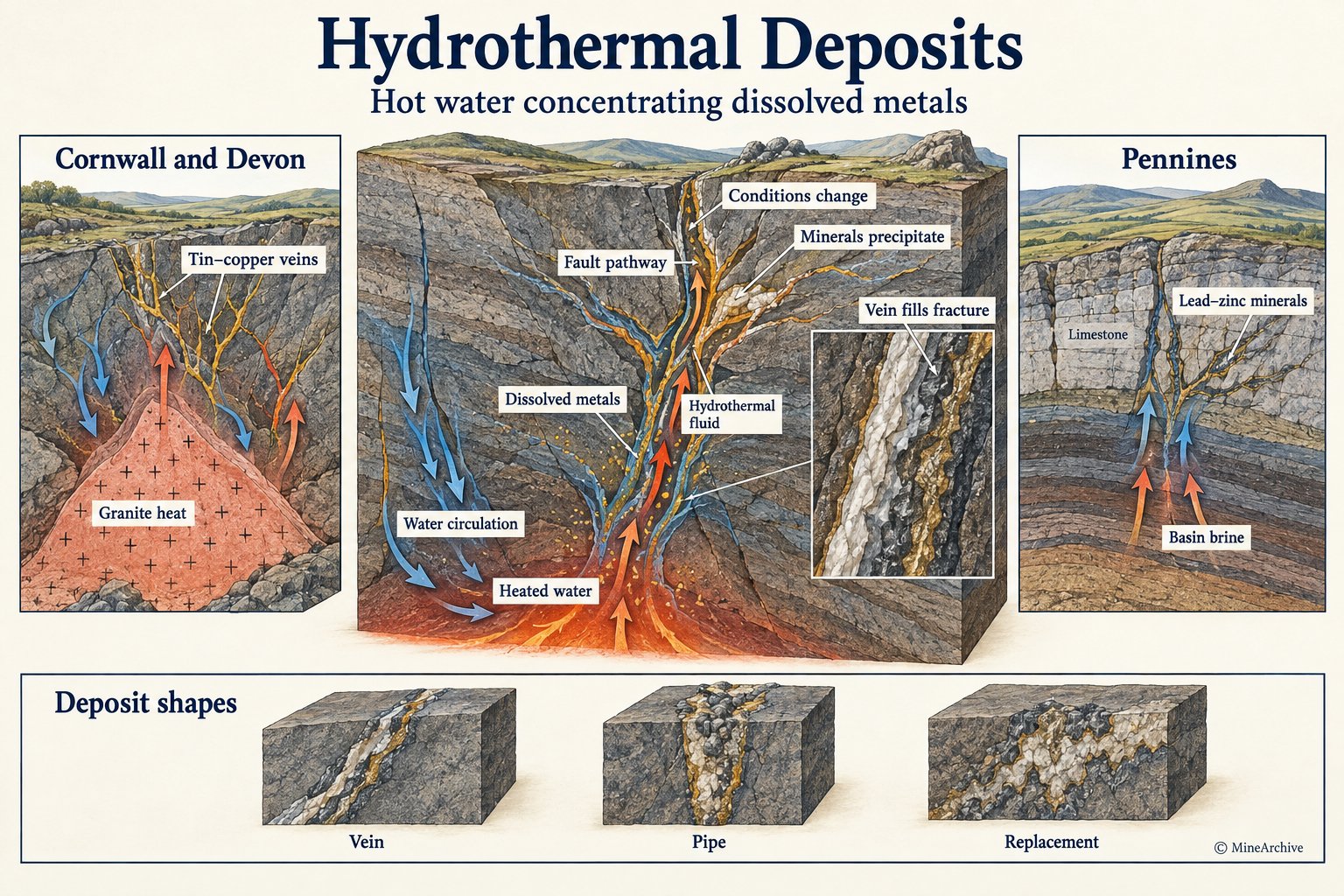
Mineral deposits formed when hot, chemically active water — carrying dissolved metals picked up from the surrounding rock — flows through fractures and cracks, then deposits that dissolved material as solid minerals when conditions change. Most of Britain's historically important metal deposits, and the veins and lodes miners followed underground, formed this way.
How it forms
Water moving through the Earth's crust dissolves small amounts of metal from the rocks it passes through, particularly where it's heated — either by nearby molten rock (magma) or simply by the natural increase in temperature with depth. This hot, mineral-laden water finds its way along the crust's weakest points: faults, fractures and other openings. As the fluid moves — cooling, losing pressure, mixing with other groundwater, or reacting chemically with the rock it passes through — its capacity to hold dissolved metal falls, and the metal precipitates out as solid mineral crystals lining or filling the fracture. Britain's hydrothermal deposits actually formed in at least two quite different ways: Cornwall and Devon's tin and copper mineralisation is directly linked to the Cornubian granite batholith, a huge mass of granite that intruded around 280-295 million years ago, whose heat drove convecting fluids through the surrounding rock. The Peak District and Pennine orefields, by contrast, have no comparable local source of igneous heat at all — their lead, zinc, fluorspar and barite mineralisation is now understood to have come from deep sedimentary basins to the east, where burial and compaction squeezed out hot, metal-bearing brines that migrated sideways and upward through the limestone.
Why minerals concentrate here
A hydrothermal fluid can only hold so much dissolved metal at any given temperature, pressure and chemistry — change any of those conditions and the fluid's capacity drops, forcing the metal to come out of solution as solid mineral. Because this happens repeatedly, in the same structurally weak zones, over long periods, dissolved metal that was once scattered thinly through a huge volume of rock and water becomes concentrated into a comparatively small, workable deposit — exactly what mining depends on.
Typical shape of the deposit
Overwhelmingly veins and lodes — a mineral-filled sheet occupying a fracture, often just centimetres to a few metres wide but continuous for a great distance along and down the fracture. Less commonly, hydrothermal fluids form pipe-like bodies where they've exploited a particularly permeable zone, or replace the surrounding rock outright rather than simply filling an open crack. Real veins pinch, swell, branch and die out unpredictably along their length — they are never the neat, uniform sheets a cross-section diagram makes them look like.
What this means for mining
Because a hydrothermal vein is a narrow, roughly planar body rather than a broad layer, mines built to work one had to follow its exact course underground, however awkward that path turned out to be — driving levels and crosscuts along and across the vein, sinking winzes to connect levels, and stoping out the vein material while leaving the surrounding barren rock largely untouched. This is a large part of why British metal mines look so different underground from a coal mine: a coal seam invites broad, systematic extraction across its whole area, while a vein forces mining to snake along a narrow, often unpredictable line, chasing the ore wherever it actually goes rather than working to a predetermined grid.
Associated commodities
Antimony (Stibnite (antimony sulphide) is worked from veins, as at Glendinning Louisa Mine — an uncommon commodity in Britain but the same vein-hosted mechanism as the rest of this record.), Arsenic (Arsenopyrite is a common accessory sulphide in the same tin, copper and tungsten veins covered by this record — e.g. Botallack, East Pool, Devon Great Consols, Wheal Jane, Carrock Fell.), Barite (A common Pennine orefield hydrothermal gangue/ore mineral.), Calcite (A common hydrothermal vein gangue mineral, as at Odin Mine and Long Rake.), Cobalt (Cobalt ores occur as a vein accessory alongside copper and lead, as at Alderley Edge.), Copper (Cornubian granite-related and, separately, basinal-brine hydrothermal mineralisation.), Fluorspar (A common Pennine orefield hydrothermal gangue/ore mineral.), Gold (Hydrothermal vein-hosted gold occurs at several Welsh and Scottish sites.), Lead (Pennine/Peak District basinal-brine hydrothermal mineralisation.), Silver (Commonly recovered from hydrothermal lead (galena) veins.), Tin (Cornubian granite-related hydrothermal mineralisation.), Uranium (Hydrothermal uranium minerals occur as a lode-hosted accessory or, at South Terras, as the principal ore of a hydrothermal vein.), Witherite (Witherite occurs as a Pennine-orefield vein mineral, in a single well-defined vein at Settlingstones, alongside the barite and fluorspar already covered by this record.), Zinc (Frequently accompanies lead in Pennine/Peak District hydrothermal veins.)
Related geology
Faults and Fractures, Greisen and Pegmatite Deposits, Kaolinization and China Clay Deposits, Veins and Lodes
Related Mining Terms & Methods
Gossan (The oxidised surface expression of a hydrothermal vein, used to prospect for it.), Lode (Cornish/Devon term for the same feature.), Quartz (The near-universal gangue mineral filling hydrothermal veins alongside the ore.), Vein (The typical resulting shape of a hydrothermal deposit.)
Diagrams
Images
MineArchive examples
Included only where MineArchive's own research gives a reasonable evidential basis — not every mine where this geology might plausibly apply. Showing the 10 strongest examples of 112 linked mines.
- Botallack Mine — Cornwall (well documented example)
Botallack's tin, copper and arsenic lodes are hydrothermal, formed from fluids driven by the cooling Land's End granite. - Britannia Copper Mine — Gwynedd (well documented example)
Copper worked from mineralised veins in the volcanic rocks of the Snowdon massif. - Ecton Copper Mines — Staffordshire (well documented example)
Exploits near-vertical, pipe-like hydrothermal copper-lead-zinc mineralisation, a less common deposit shape than a simple vein. - Geevor Tin Mine — Cornwall (well documented example)
Geevor's cassiterite-bearing veins are hydrothermal, formed in and around granite intruded into Devonian killas. - Alport Mines — Derbyshire (well documented example)
The mine's own recorded geology explicitly describes lead-bearing veins within the Peak District orefield's Carboniferous limestone. - Alva Silver Mine (Silver Glen) — Clackmannanshire (well documented example)
The mine's own recorded geology explicitly describes a hydrothermal vein system yielding native silver. - Arkendale Mine — North Yorkshire (well documented example)
The Arkengarthdale lead was deposited from mineralising fluids rising along faults and joints through the Carboniferous sequence of the dales. - Ballacorkish Mine — Isle of Man (well documented example)
The mine's own recorded geology explicitly describes lead- and zinc-bearing veins of the Manx mineralised belt. - Barrow Mine — Cumbria (well documented example)
Argentiferous galena with blende, cerussite, pyromorphite and pyrite, in a vein believed to be part of the same structure as the Yewthwaite and Thornthwaite lodes. - Bedford United Mine — Devon (well documented example)
The mine's own recorded geology explicitly describes copper-bearing lodes of the Tamar Valley orefield.
See all 112 linked mines.
Sources
- (primary) Direct evidence of fluid mixing in the formation of stratabound Pb-Zn-Ba-F mineralisation in the Alston Block, North Pennine Orefield (England) — Mineralium Deposita / ResearchGate
- (primary) Northern Pennine Orefield — BGS Earthwise
- (primary) Porphyry and epithermal mineral deposits — United States Geological Survey
- (secondary) Hydrothermal Vein Deposits — earthsci.org
Record created: 22 August 2026 · Last researched: 22 August 2026