 MineArchive
Quartz
| Category | Mine Workings & Access |
|---|
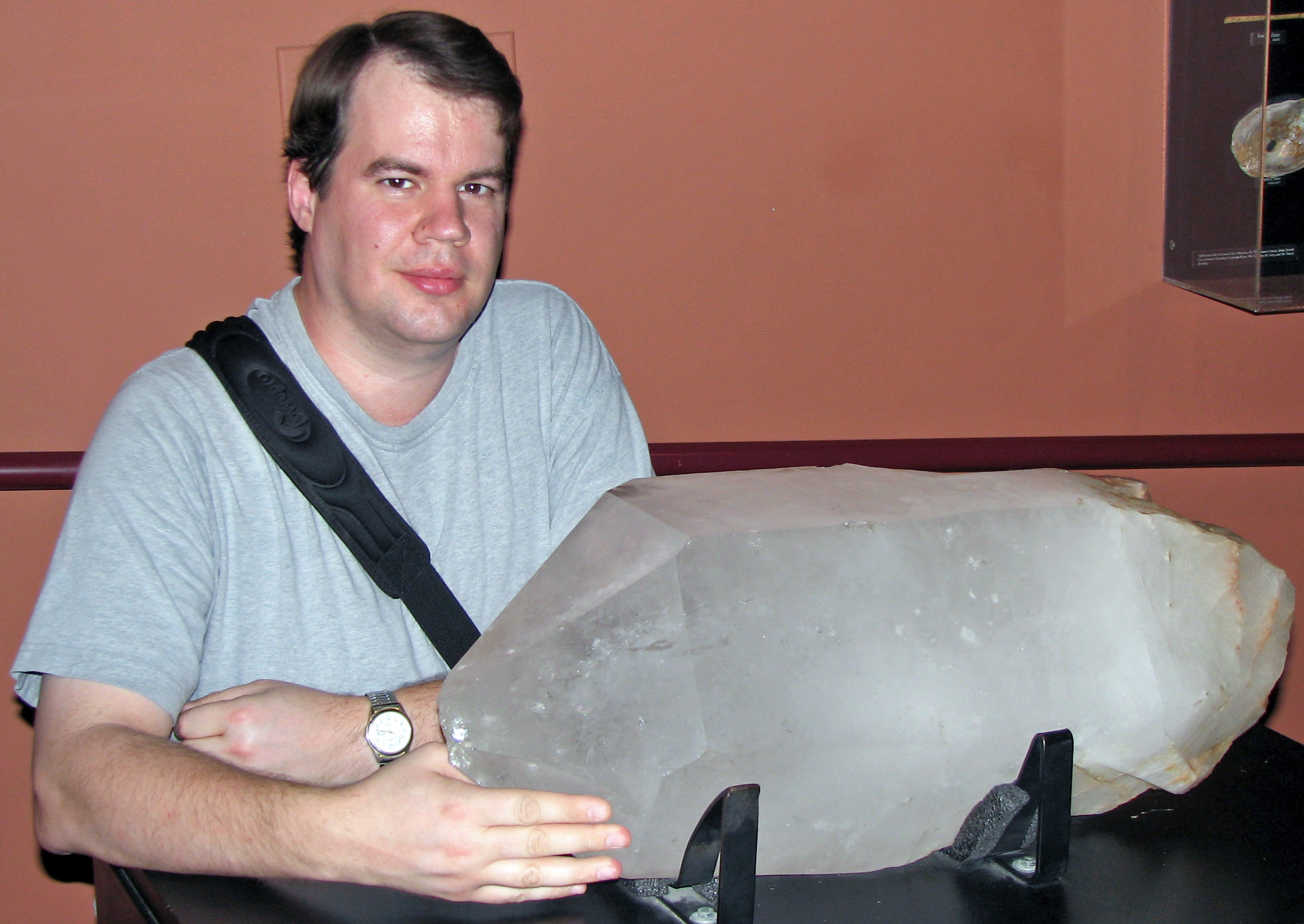
The most common vein-filling mineral in British metalliferous mining — a hard, glassy silica (SiO₂) mineral that formed the visible "reef" prospectors followed underground, and which occasionally itself became the object of extraction rather than merely its host.
Historical usage
Quartz is overwhelmingly the dominant gangue mineral in British hydrothermal ore veins, hosting everything from Welsh gold — as at Gwynfynydd and Clogau, where "gold-bearing quartz" was the literal target ore — to Cornish tin and copper and the barite and fluorspar veins of the Pennines. Its hardness and resistance to weathering mean quartz veins often stand out clearly as pale, upstanding "reefs" in eroded ground, making them one of the most reliable visual guides early prospectors had for locating a mineral vein at all, long before any assay confirmed what it actually contained. A small number of British sites went further and mined quartz-rich sandstone in its own right for its silica content: most notably Lochaline on Scotland's Morvern peninsula, opened in 1940 after wartime cuts to imported optical glass sand created urgent demand, still the only underground silica sand mine in Europe.
How it worked
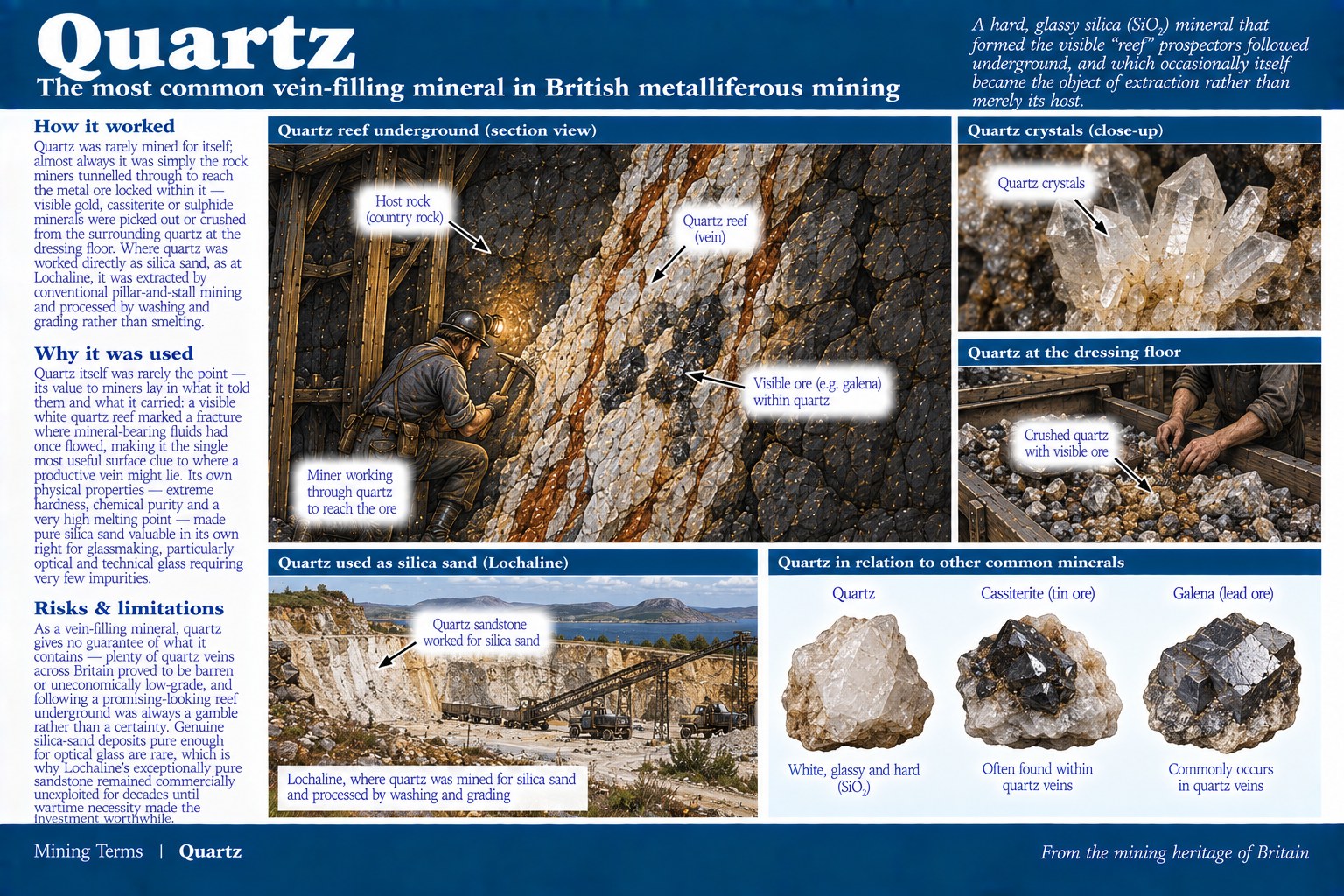
Quartz was rarely mined for itself; almost always it was simply the rock miners tunnelled through to reach the metal ore locked within it — visible gold, cassiterite or sulphide minerals were picked out or crushed from the surrounding quartz at the dressing floor. Where quartz was worked directly as silica sand, as at Lochaline, it was extracted by conventional pillar-and-stall mining and processed by washing and grading rather than smelting.
Why it was used
Quartz itself was rarely the point — its value to miners lay in what it told them and what it carried: a visible white quartz reef marked a fracture where mineral-bearing fluids had once flowed, making it the single most useful surface clue to where a productive vein might lie. Its own physical properties — extreme hardness, chemical purity and a very high melting point — made pure silica sand valuable in its own right for glassmaking, particularly optical and technical glass requiring very few impurities.
Risks & limitations
As a vein-filling mineral, quartz gives no guarantee of what it contains — plenty of quartz veins across Britain proved to be barren or uneconomically low-grade, and following a promising-looking reef underground was always a gamble rather than a certainty. Genuine silica-sand deposits pure enough for optical glass are rare, which is why Lochaline's exceptionally pure sandstone remained commercially unexploited for decades until wartime necessity made the investment worthwhile.
Regional variation
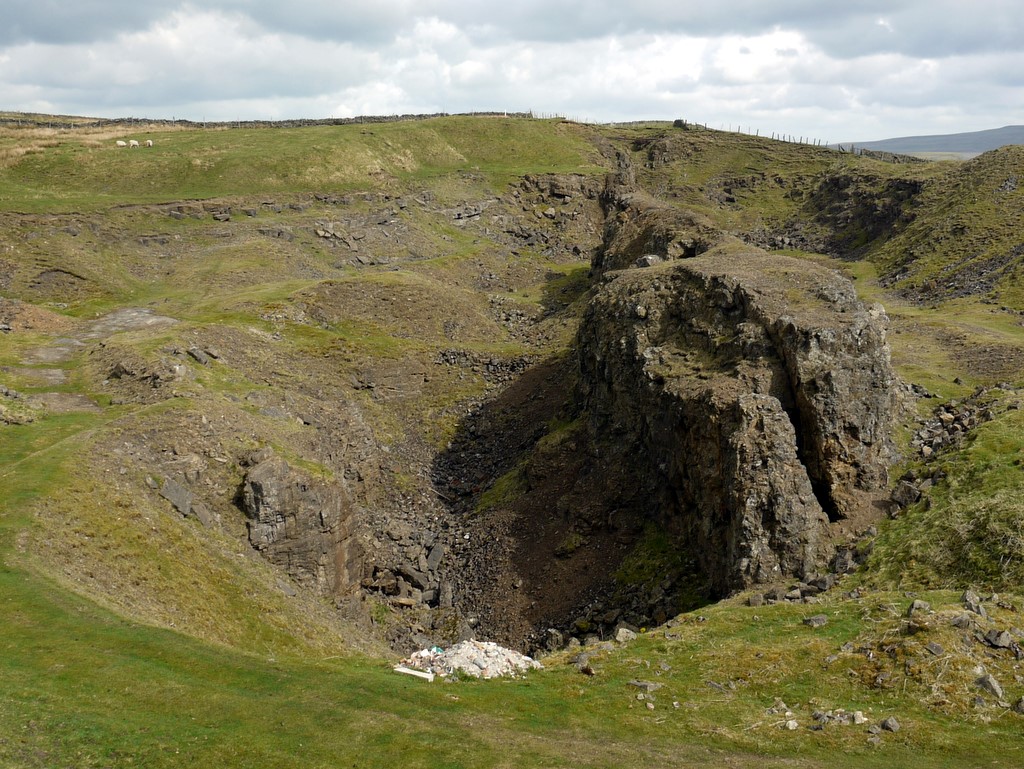
Vein quartz occurs virtually everywhere Britain's metal mining took place — Cornwall, Wales, the Pennines, the Lake District and Scotland alike; dedicated silica-sand mining, by contrast, is essentially unique to Lochaline on Scotland's west coast. The Slitt Vein at West Rigg Opencut in Weardale is the clearest place in Britain to see what that means on the ground: an ironstone working cut across the vein and left its structure standing in section, and the vein is largely quartz with the ore minerals distributed through it.
Related terminology
Mines associated with this term
5 examples chosen from 45 linked records — the term page is not an index.
- Fremington Edge Quarry — North Yorkshire (well documented example)
Named in this record’s geology: “Chert is a hard, dense form of silica — cryptocrystalline quartz — which occurs in the Carboniferous limestones of the northern…” - Penlee Quarry — Cornwall (well documented example)
Named in this record’s geology: “…arsenopyrite, löllingite, molybdenite, pyrite, pyrrhotite, quartz and chalcedony — of which molybdenite and löllingite are both rare…” - Trefor Granite Quarry — Gwynedd (well documented example)
Named in this record’s geology: “…in local accounts as a granite-like stone of porphyrite and quartz rather than a true granite. Its hardness is what made it valuable:…” - Ullcoats Mine — Cumbria (well documented example)
Named in this record’s geology: “…Baryte, fluorite, calcite, aragonite, dolomite, pyrolusite and quartz all occur alongside the haematite.” - Dolaucothi Gold Mines — Carmarthenshire (well documented example)
Linked on an exact-phrase match in this record's own text.
Sources
- (observational) West Rigg Opencut, showing the structure of the Slitt Vein — Wikimedia Commons
- (secondary) Lochaline Mine — Wikipedia
- (secondary) Lochaline Silica Sand Mine — Subterranea Britannica
- (secondary) Twenty-Five Gold Indicators You Should Know — ICMJ's Prospecting and Mining Journal
- (secondary) Vein (geology) — Wikipedia

Record created: 22 August 2026 · Last researched: 9 September 2026