 MineArchive
Trefor Granite Quarry
| Location | Trefor, Llanaelhaearn, Llyn peninsula, Gwynedd — 52.9851, -4.4397 (exact) |
|---|---|
| Commodity | Granite |
| Type | Quarry |
| Worked | 1850–1963 |
| Maximum depth | Not applicable: an open hillside quarry worked in galleries cut into the seaward flank of Yr Eifl. |
| Operators | Welsh Granite Company (1850–1911), Penmaenmawr & Welsh Granite Co. (1911–?), The Darbishire Company (1911–?) |
Overview
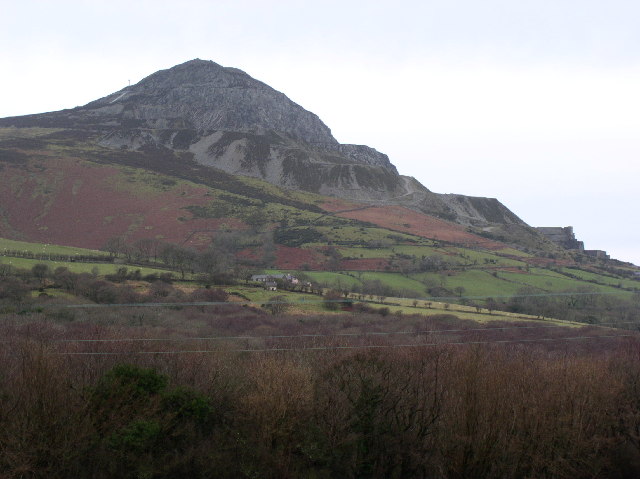
The great granite quarry on the seaward flank of Yr Eifl on the Llyn peninsula, opened in 1850 and worked for paving setts on a scale that made it one of the largest granite quarries in the world, over a million tons of setts by 1931. It built its own village, named after the works manager Trefor Jones, and shipped its stone from its own pier by way of an incline of one in one and three-quarters, said to be the steepest in any British granite quarry. The stone is still taken occasionally for curling stones.
History
Stone was being taken commercially from the northern side of Yr Eifl by the 1840s and loaded into small ships off the beach; the earliest known lease on the site was granted in March 1844 to John Heyden of Liverpool. The quarry proper opened in 1850 under new owners who formed the Welsh Granite Company, and from 1854 they began building houses for a workforce that was fast becoming the district's largest employer. The settlement they built took the name Trefor after the works manager, Trefor Jones, who is also given as the quarry's first foreman and whose name the quarry itself came to carry; locally it was simply Y Gwaith Mawr, the large works. A second quarry was opened on the hillside and narrow-gauge track laid, the loaded wagons on the new incline hauling the empties back up by their own weight. From the foot of the incline, at the village edge, wagons went by horse and later by locomotive across the fields to the shore; a short spur brought coal and other goods into the village and to a limekiln.
Demand for hard-wearing setts to pave the streets of the industrial towns carried the quarry through the second half of the century. After a change of ownership in 1864 a third quarry was opened and the harbour enlarged for bigger ships. An application to build a jetty in 1855 had come to nothing; renewed in 1867, it produced the pier by 1870 and the railway that served it, worked by horses from about 1865 and by steam locomotives from 1873 along the half-mile from the foot of the incline to the pier. In 1902 the manager, Augustus Wheeler, fired a 'gigantic blast' electrically from explosives packed in tunnels. Wages were reported to be high, but the sett trade was already turning: three hundred men lost their jobs at Y Gwaith Mawr in the last four months of 1907. The Darbishire family, quarry owners at Penmaenmawr and Nantlle, took over in 1911 and looked for new markets, putting up a building of saws and polishing machines for ornamental work; the Penmaenmawr and Llanfairfechan quarries were joined with the Eifl ones the same year to form the Penmaenmawr and Welsh Granite Company. In 1913 grassland north of the quarry slid into the sea over several days under the weight of quarry waste tipped on the hillside. The managing director, Colonel Charles Darbishire, hosted a Welsh Army Corps recruiting drive at Trefor in January 1915; seven months later he learned that his quarry manager, by then Major Augustus Wheeler, had been killed at Gallipoli, leaving a wife and four children. A brutalist concrete loading building went up in 1923, and by 1931 the quarry had produced 1,157,000 tons of setts. Road transport replaced the railway from 1951, the main incline was abandoned in 1959 and the line closed in 1962.
Geology
The quarry works the igneous rock of Yr Eifl, described in local accounts as a granite-like stone of porphyrite and quartz rather than a true granite. Its hardness is what made it valuable: it took the wear of street paving, and its particular properties make it one of only two sources in Britain of stone suitable for curling stones, the other being Ailsa Craig off the Ayrshire coast.
Workings
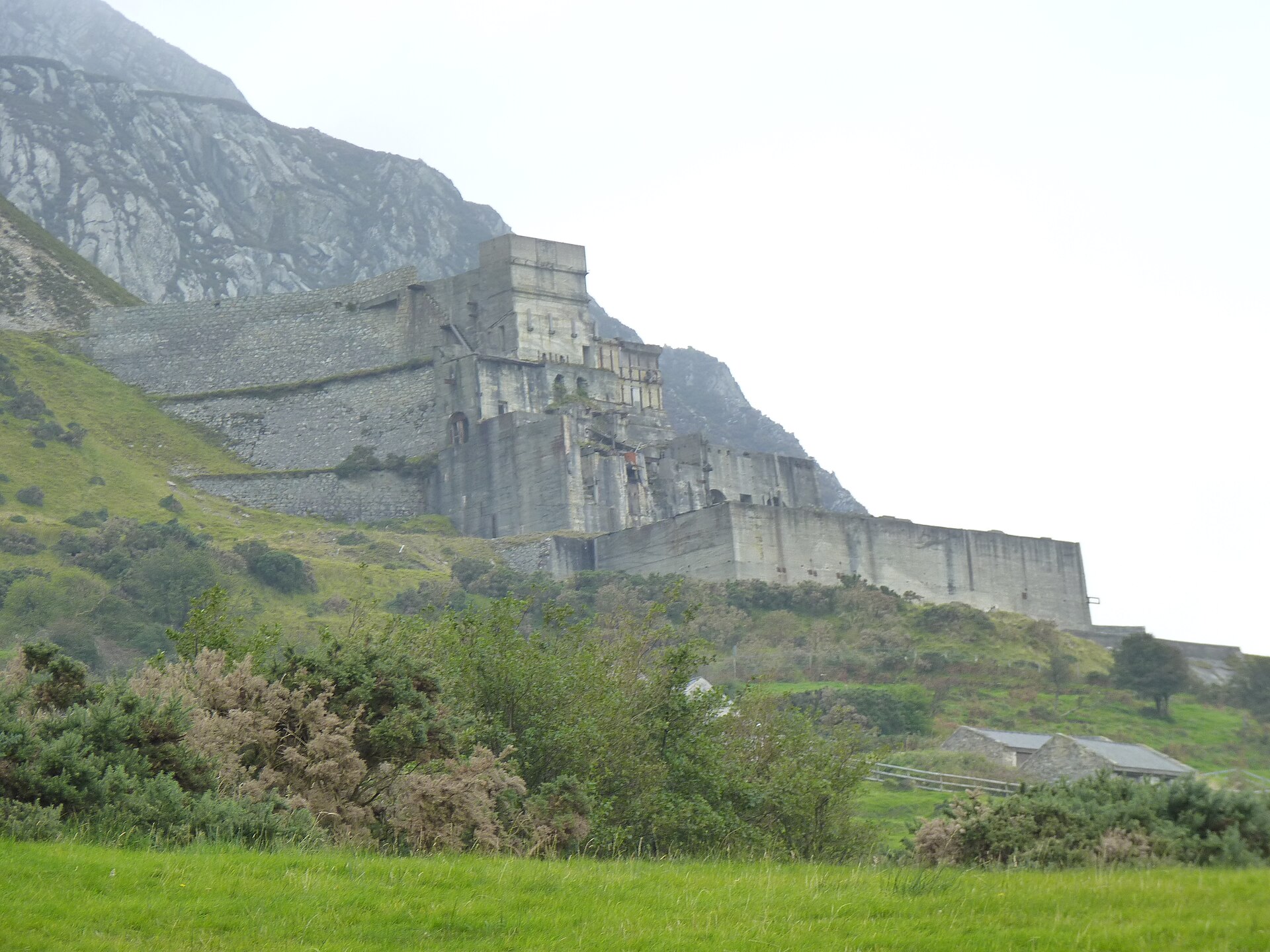
An open quarry of about a quarter of a square kilometre, worked in rail-served galleries with workshops, a magazine, loading bins and a crusher house. A tramway incline 920 m long and of 597 mm gauge, at a gradient of one in one and three-quarters said to be the steepest in any granite quarry in Britain, dropped the stone to the village; from the foot of the incline the line continued on the level past further workshops and offices, with a siding into Trefor, to the pier. Loaded wagons on the incline pulled the empties back up. Horse haulage was in use inside the quarry by 1865 and steam locomotives from 1873; the locomotives included two vertical-boilered De Wintons of 1873 and 1875, the Bagnall saddle tank Isabel of 1900 and the Hunslet Betty of 1912. A concrete loading building of 1923 became the main transfer point onto the narrow gauge.
Closure
Sources disagree on the year. Coflein and the People's Collection Wales record for the site both give 1963, and an urban-exploration history follows them; another account has large-scale industry ending with closure in 1960; History Points, working from Gwynedd Archaeological Trust material, gives 1971. All agree the railway went first, the main incline being abandoned in 1959 and the line closing in 1962, and that the stone has been taken on a small scale since, notably for curling stones.
What remains
Derelict but substantially intact and much visited. The galleries, inclines, loading bays, crusher house and the 1923 concrete building all stand, reached on foot up the mountain from the base of the incline; a report of April 2023 describes a straightforward walk-up with the concrete structures and sweeping views over the bay, and little left inside the buildings. Much of the rail was lifted and reused around the village as fence and gate posts, where it can still be seen. Small-scale extraction for curling stones continues.
Extensive: rail-served galleries, workshops, magazine, bins, crusher house, the 920 m incline and the 1923 concrete loading building, with the pier at Trefor below.
Redevelopment
None; the site remains a quarry, worked occasionally, and the village and pier survive.
Related mines
- Penmaenmawr Granite Quarry — Amalgamated in 1911, when the Penmaenmawr and Llanfairfechan quarries were joined with the Yr Eifl workings to form the Penmaenmawr and Welsh Granite Co. Ltd under the Darbishire family, who owned both.
Nearby mines
- Nant Gwrtheyrn Quarries — 1.3 miles (2.1 km) SW
- Dorothea Quarry — 7.1 miles (11.4 km) NE
- Vron Quarry — 7.9 miles (12.7 km) NE
- Hafodlas Quarry — 8.4 miles (13.5 km) NE
- Tymawr East Quarry — 8.4 miles (13.6 km) NE
Straight-line distance, within 9 miles (15 km). Show on the map.
What's uncertain
Points where sources disagree or the record could not be settled; both accounts are kept. All open questions in the archive.
- Coflein and the People's Collection Wales record give the quarry's closure as 1963. (disputed) 1,2
- History Points gives the closure as 1971, and Wikipedia's article on the village says large-scale industry ended with closure in 1960. (disputed) 3,6
Recorded claims
Individual factual claims, each attached to the source(s) that support it below. Where sources disagree, both are kept.
- The quarry opened in 1850 and is named after its first foreman, Trevor Jones; it covers about a quarter of a square kilometre. 1,2
- Stone was taken commercially from the northern side of Yr Eifl from the 1840s, the earliest known lease being granted to John Heyden of Liverpool in March 1844, and quarrying expanded in the 1850s under the new Welsh Granite Company, which developed the village of Trefor, named after works manager Trefor Jones. 3
- The main product was granite setts, shipped to Liverpool and other cities for paving; by 1931 the quarry had produced 1,157,000 tons of them. 1,4
- A 920 m tramway incline of 597 mm gauge at a gradient of one in one and three-quarters, said to be the steepest in any British granite quarry, ran down to the level section and Trevor Pier. 1,5
- An application to build a jetty in 1855 lapsed; renewed in 1867, it produced the pier by 1870 and the railway to it. Horse-worked tramways were in use inside the quarry by 1865 and steam locomotives from 1873. 5
- Three hundred men lost their jobs at the quarry in the last four months of 1907 as demand for setts fell. 3
- The Darbishire family, owners of quarries at Penmaenmawr and Nantlle, took over in 1911; the Penmaenmawr and Llanfairfechan quarries were joined with the Eifl ones the same year to form the Penmaenmawr and Welsh Granite Co. Ltd. 3,4
- In 1913 grassland north of the quarry slid into the sea over several days, pushed by the enormous weight of quarry waste tipped on the hillside. 3
- The main incline was abandoned in 1959 and the railway closed in 1962. 5,4
- Coflein and the People's Collection Wales record give the quarry's closure as 1963. (disputed) 1,2
- History Points gives the closure as 1971, and Wikipedia's article on the village says large-scale industry ended with closure in 1960. (disputed) 3,6
- The properties of the stone make Trefor one of only two places where granite suitable for curling stones is found, the other being Ailsa Craig; it is still occasionally quarried for them. 6,4
- The site retains its rail-served galleries, workshops, magazine, bins and crusher house, and a 1923 concrete building that was the main loading point onto the narrow gauge. 1,4
Photographs & further reading
A recent walk-up of the incline with photographs of the loading bays, concrete buildings and galleries as they stand today.
View sourceA concise illustrated history compiled with Gwynedd Archaeological Trust, with John Thomas's photographs of the quarrymen about 1875 and the incline about 1885.
View sourceSources
- (primary) Coflein NPRN 40573: Yr Eifl Quarry; Trevor Quarry — Royal Commission on the Ancient and Historical Monuments of Wales
- (secondary) Yr Eifl Quarry; Trevor Quarry (People's Collection Wales, RCAHMW) — People's Collection Wales
- (secondary) Trefor quarry (History Points, with Gwynedd Archaeological Trust) — History Points
- (observational) Trefor granite quarry, North Wales, April 2023 (28DaysLater) — 28DaysLater
- (secondary) Trefor Quarry railway (Wikipedia) — Wikipedia
- (secondary) Trefor, Gwynedd (Wikipedia) — Wikipedia
Record created: 9 September 2026 · Last researched: 9 September 2026