 MineArchive
Vron Quarry
| Also known as | Fron Quarry, Chwarel Fron |
|---|---|
| Location | Fron, Nantlle Valley, Gwynedd — 53.0680, -4.3080 (approximate) |
| Commodity | Slate |
| Type | Slate |
| Worked | By 1815–1950 |
| Maximum depth | Unknown. |
| Operators | Vron & Old Braich Slate Quarries Ltd (1896–1901) |
Overview
A Nantlle Valley slate quarry, also known as Fron Quarry, worked with interruptions from 1815 to 1950 and employing up to 100 men at its peak, remembered for its own named steam locomotive and a change of rail connection in 1881 that switched it from the original Nantlle Railway to the newer narrow-gauge line to Drumhead.
History
Vron Quarry, also recorded as Fron Quarry, was operating by 1815 under John Evans, passing to Sir John Kennaway (Bart) and other partners from 1837. Production is recorded across several distinct periods -- by 1830, 1858-1880, 1882-1891 (excepting 1883), 1915, and then spasmodically through to 1950 -- with the quarry finally passing to Vron & Old Braich Slate Quarries Ltd in 1896, a company that entered liquidation by 1901. Output reached 680 tons in 1864, and the workforce varied considerably over the quarry's life: just 8 men were employed in 1858, rising to 96 by 1886 and peaking at around 100 by 1915. Slate was initially sent out via a toll arrangement with the Nantlle Railway, at 10 pence a ton, but in 1881 this connection was abandoned once the North Wales Narrow Gauge Railways' own Bryngwyn line reached nearby Drumhead, and a new 2-foot gauge tramway was built to connect the quarry to that line instead. The quarry ran its own locomotives: a De Winton 0-4-0 vertical-boilered engine, delivered around 1878 and named Vron after the quarry itself, and later a 1904 Hunslet, works number 848, acquired secondhand from the neighbouring Moel Tryfan Quarry. Much of the quarry's day-to-day slate haulage, however, still relied on gravity, hand-pushing or horses rather than locomotive power.
Geology
Slate of the Nantlle valley; the vein is not named on the record.
Workings
Slate worked and transported initially via a tramway connected by toll to the Nantlle Railway, then, from 1881, via a new 2-foot gauge tramway to Drumhead on the North Wales Narrow Gauge Railways' Bryngwyn line; haulage used a combination of the quarry's own locomotives (De Winton 'Vron', 1878; Hunslet No. 848, acquired from Moel Tryfan Quarry) alongside gravity, hand-pushing and horses.
Closure
Worked, with several interruptions, until 1950, its last operating company, Vron & Old Braich Slate Quarries Ltd, having already gone into liquidation by 1901.
What remains
Now known locally as Chwarel Fron; former tips are worked by Hogan Brothers for road-building material.
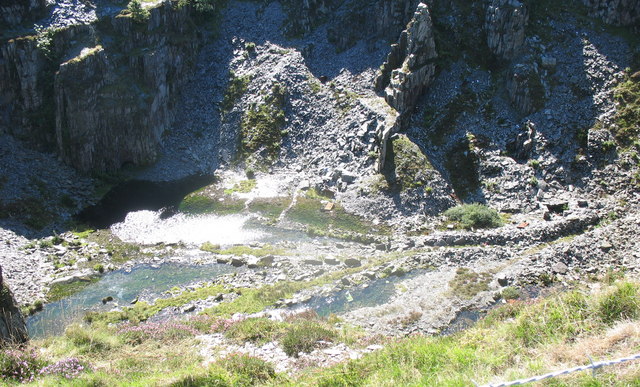
The former quarry pit and its spoil tips, part still worked commercially for roadstone.
Related mines
- Moel Tryfan Quarry — Vron acquired a locomotive (Hunslet No. 848) secondhand from the neighbouring Moel Tryfan Quarry.
Nearby mines
- Blaenycae Quarry — 0.4 miles (0.7 km) E
- Hafodlas Quarry — 0.5 miles (0.8 km) E
- Tymawr East Quarry — 0.6 miles (0.9 km) N
- Llwydgoed Quarry — 0.6 miles (1.0 km) NE
- Coedmadoc Quarry — 1.0 miles (1.6 km) NE
Straight-line distance, within 9 miles (15 km). Show on the map.
Recorded claims
Individual factual claims, each attached to the source(s) that support it below. Where sources disagree, both are kept.
- The quarry was operating by 1815 under John Evans, passing to Sir John Kennaway and other partners from 1837; production is recorded across several distinct periods through to 1950, with the operating company Vron & Old Braich Slate Quarries Ltd, formed in 1896, entering liquidation by 1901. 1
- Output reached 680 tons in 1864; the workforce grew from just 8 men in 1858 to 96 by 1886 and peaked at around 100 by 1915. 1
- The quarry's original toll connection to the Nantlle Railway was abandoned in 1881 once the North Wales Narrow Gauge Railways' Bryngwyn line reached Drumhead, replaced by a new 2-foot gauge tramway; the quarry ran its own De Winton locomotive, Vron (delivered c.1878), and later a secondhand 1904 Hunslet acquired from Moel Tryfan Quarry. 1
- Unlike the large enterprises at Bethesda, Llanberis and Blaenau Ffestiniog, the Nantlle Valley's slate quarries -- Vron among them -- were run independently and on a much smaller scale, though the valley as a whole, with at least 37 operating quarries at one time, was still a world-leading slate producer in the 19th century. 2
Photographs & further reading
The full ownership, production and locomotive history of the quarry under its alternative name.
View sourceSources
- (secondary) Fron Quarry — Festipedia
- (primary) Dyffryn Nantlle — Slate Landscape of Northwest Wales — Llechi Cymru / Wales Slate (Welsh Government)
Record created: 30 August 2026 · Last researched: 31 August 2026