 MineArchive
Moel Tryfan Quarry
| Location | Rhosgadfan, near Y Fron, Gwynedd — 53.0790, -4.2195 (exact) |
|---|---|
| Commodity | Slate |
| Type | Slate |
| Worked | 1745 (lease)–1972 |
| Operators | Moel Tryfan Slate & Slab Co. Ltd (1879–1918), Amalgamated Slate Association (1918–1931), Caernarvonshire Crown Slate Quarries Ltd (1932–?) |
Overview
A Nantlle Valley slate quarry, worked from 1824 into the 1970s, best known for a catastrophic 1909 rockfall of 421,000 tons that completely filled the pit and permanently reduced the site's output.
History
The site was first leased in 1745, though significant quarrying only began in 1824. Employment and output grew steadily through the 19th century: from 50 workers producing 775 tons in 1864 to 81 workers and 1,880 tons by 1882, reaching a peak value of £22,413 in 1903 and a workforce of 250 by 1914. Ownership changed repeatedly -- early operators including a Hayward, then an unnamed company by 1875, the Moel Tryfan Slate & Slab Co. Ltd from 1879, the Amalgamated Slate Association from 1918, and Caernarvonshire Crown Slate Quarries Ltd from 1932. In November 1909 a catastrophic rockfall of 421,000 tons slipped from the quarry's north face and completely filled the pit; production never again reached its earlier levels, though various lessees kept the quarry working intermittently. From 1918 the quarry was worked jointly with the neighbouring Alexandra quarry, connected by an internal tunnel and served by narrow-gauge locomotives including two built by Hunslet in 1902 and 1904, named Tryfan and Cadfan. The quarry operated in further phases -- 1918-1929, 1933-1939, and from the 1940s to 1958 -- before continuing from 1959 until the Safety Inspectorate condemned the working face in 1972, ending quarrying; some tip reclamation and aggregate extraction has continued since.
Geology
Slate of the Nantlle valley, in ground unstable enough to give way in 1909 in a rockfall of 421,000 tons.
Workings
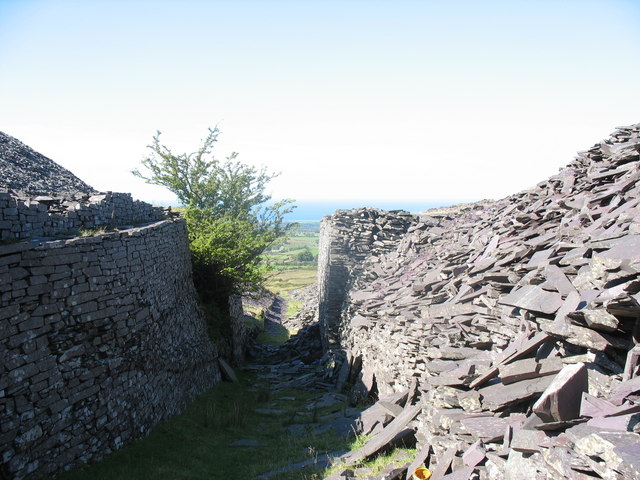
A large open pit scooped into the southern and eastern flanks of Moel Tryfan mountain, rising in five tip levels, connected by an internal tunnel to the neighbouring Alexandra quarry and served by narrow-gauge locomotives running to the North Wales Narrow Gauge Railways.
Closure
Closed in 1972 after the Safety Inspectorate condemned the remaining working face; tip reclamation and aggregate extraction have continued intermittently since.
What remains
A 2014 exploration of the quarry's adits found tunnels roughly 100 metres long with a 10-metre side passage, railway sleepers still in place, and a lack of footprints suggesting little recent visitation; the main passage ends in dumped rubbish rather than a collapse, and standing water at the entrance requires waterproof boots to explore.
Related mines
- Alexandra Quarry — Both passed into the Amalgamated Slate Association in the 1918 amalgamation that combined Alexandra with Moel Tryfan and other Nantlle Valley quarries.
- Vron Quarry — Vron acquired a locomotive (Hunslet No. 848) secondhand from the neighbouring Moel Tryfan Quarry.
Nearby mines
- Alexandra Quarry — 0.3 miles (0.5 km) NE
- Pen-yr-Orsedd Quarry — 1.3 miles (2.1 km) S
- Cilgwyn Quarry — 1.4 miles (2.3 km) SW
- Pen-y-Bryn Quarry — 1.4 miles (2.3 km) S
- Tal-y-sarn Quarry — 1.9 miles (3.1 km) SW
Straight-line distance, within 9 miles (15 km). Show on the map.
Recorded claims
Individual factual claims, each attached to the source(s) that support it below. Where sources disagree, both are kept.
- Employment and output grew from 50 workers producing 775 tons in 1864 to 81 workers and 1,880 tons by 1882, reaching a peak value of £22,413 in 1903 and a workforce of 250 by 1914. 1
- In November 1909 a rockfall of 421,000 tons slipped from the quarry's north face and completely filled the pit; production never again reached its earlier levels. 1,2
- The quarry passed through several operators: the Moel Tryfan Slate & Slab Co. Ltd (1879-1918), the Amalgamated Slate Association (1918-1931), and Caernarvonshire Crown Slate Quarries Ltd (1932 onward). 1
- The quarry operated in phases through the 20th century before the Safety Inspectorate condemned the remaining working face in 1972, ending quarrying; some tip reclamation and aggregate extraction continued afterward. 1
Sources
- (secondary) Moel Tryfan Quarry — Festipedia
- (observational) Moel Tryfan Quarry Adits - Fron, October 2014 — 28DaysLater
Record created: 29 August 2026 · Last researched: 29 August 2026