 MineArchive
Pen-yr-Orsedd Quarry
| Also known as | Penyrorsedd Quarry, Chwarel Pen-yr-Orsedd |
|---|---|
| Location | Nantlle, Dyffryn Nantlle, Gwynedd — 53.0602, -4.2241 (exact) |
| Commodity | Slate |
| Type | Slate |
| Worked | 1816–1979 |
| Operators | William Turner (1816–1854), John Lloyd Jones (1854–1862), The Darbishire Company (1862–1979) |
Overview
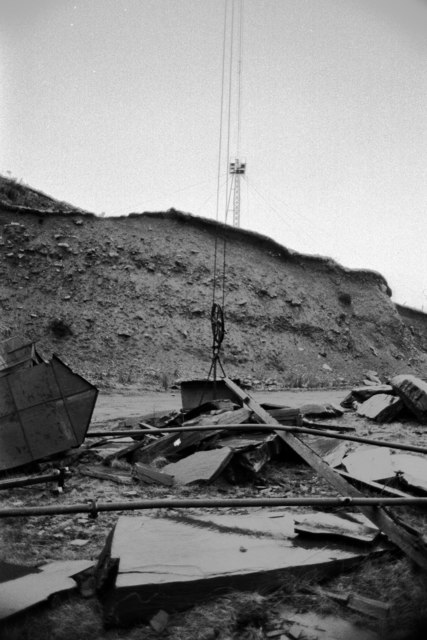
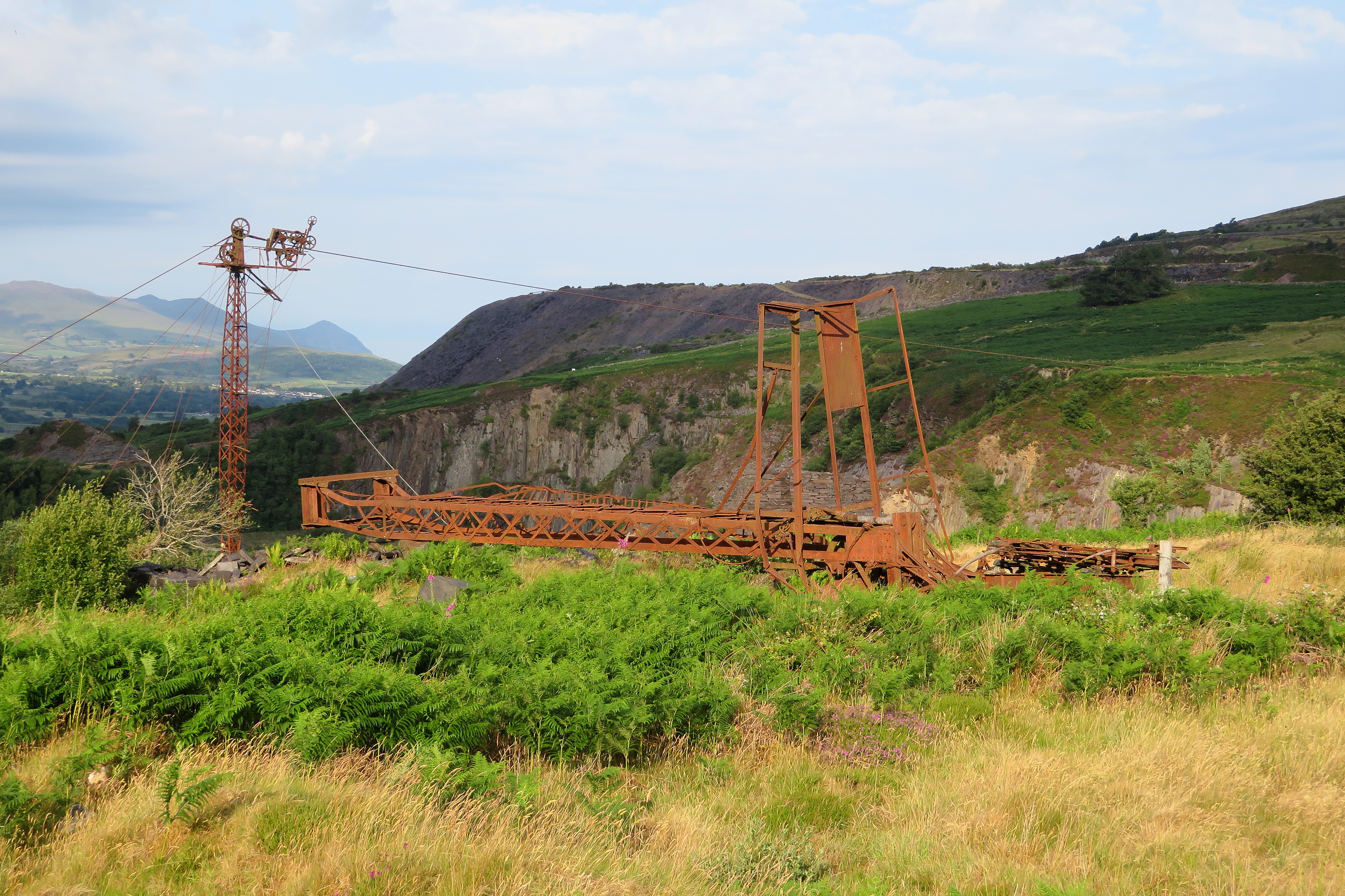
The last quarry in the Nantlle valley to sell slate commercially, and the place where the Blondin made its final stand: four aerial ropeways installed here in 1906 were still lifting slate out of the pits in 1979, the last working examples anywhere in Britain.
History
Pen-yr-Orsedd opened in 1816 as an open working under William Turner, who also held Dorothea down the valley and Diphwys Casson at Blaenau Ffestiniog. It passed to John Lloyd Jones in 1854 and in 1862 to the Darbishire company, already owners of the Penmaenmawr granite quarries. The Darbishires spent heavily and at first got little back — the quarry was raising only about 500 tons a year by 1871 — but under William Darbishire's direct management output climbed to nearly 8,000 tons by 1882. Mills were built on three successive levels, and the quarry connected to the 3 ft 6 in Nantlle Railway in 1862, eventually reaching all but its highest levels. It outlasted every other quarry in the valley, closing in 1979.
Geology
Pen-yr-Orsedd works the same Cambrian slate belt as its neighbours, and shares their defining problem: the cleavage stands close to vertical, so the slate had to be taken downwards in pits rather than driven into a hillside as chambers. Nantlle's quarries are consequently a series of deep holes rather than the great underground caverns of Blaenau Ffestiniog, and every one of them had to solve the question of how to lift finished slate out of a hole that kept getting deeper.
Geological setting: Slate and Regional Metamorphism (well documented example)
Workings
A series of pits with mills on three levels, worked with mixed 3 ft 6 in and 2 ft gauge trackwork — the wider gauge for the Nantlle Railway connection, the narrower for internal haulage. Pen-yr-Orsedd's answer to the deep-pit problem was the Blondin: four of them were installed in 1906 with Bruce Peebles electrical equipment, each an aerial ropeway spanning the pit on towers, able to pick a load off the floor and set it down anywhere under the span. That removed the need to rebuild haulage every time the pit went deeper. The external Nantlle Railway connection lasted until 1963; the internal 2 ft gauge lines ran until quarrying stopped.
Closure
Commercial slate production ended in 1979, making Pen-yr-Orsedd the last working quarry in the Nantlle valley — and taking Britain's last operational Blondins out of service with it.
What remains
Abandoned and unsecured, and a well-visited site for mine and quarry explorers, with exploration reports posted repeatedly between 2014 and 2023. The pits are deep and partly flooded and the standing structures are decaying.
Exceptional, and internationally significant: the Blondin towers survive, several now toppled, along with the last Blondin still in place on its cable — the only one of its kind left standing in Britain. The mills, pit edges, tramway formations and quarry buildings all remain.
Redevelopment
None. The quarry forms part of Component Part 3, the Nantlle Valley Slate Quarry Landscape, of the Slate Landscape of Northwest Wales World Heritage Site.
Related mines
- Pen-y-Bryn Quarry — Both begun by William Turner: Cloddfa'r Lôn in 1808 and Pen-yr-Orsedd about 1816.
Nearby mines
- Pen-y-Bryn Quarry — 0.3 miles (0.5 km) W
- Cilgwyn Quarry — 0.6 miles (1.0 km) W
- Tal-y-sarn Quarry — 1.0 miles (1.6 km) W
- Cloddfacoed Quarry — 1.1 miles (1.8 km) W
- Tymawr West Quarry — 1.2 miles (1.9 km) SW
Straight-line distance, within 9 miles (15 km). Show on the map.
Recorded claims
Individual factual claims, each attached to the source(s) that support it below. Where sources disagree, both are kept.
- The quarry opened in 1816 as an open working under William Turner, who also owned Dorothea and Diphwys Casson. 1
- John Lloyd Jones acquired it in 1854 and sold it to the Darbishire company, owners of the Penmaenmawr granite quarries, in 1862. 1
- Output was about 500 tons a year by 1871, rising to nearly 8,000 tons by 1882 under William Darbishire's direct management. 1
- The quarry connected to the 3 ft 6 in Nantlle Railway in 1862; most levels carried both 3 ft 6 in and 2 ft gauge track, the external connection lasting until 1963. 1
- Four Blondin aerial ropeways with Bruce Peebles electrical equipment were installed in 1906, and were the last working examples in Britain when the quarry closed. 2,1
- Pen-yr-Orsedd closed in 1979, the last quarry in the Nantlle valley to produce slate commercially. 1,3
- The quarry forms part of the Nantlle Valley component of the Slate Landscape of Northwest Wales World Heritage Site, inscribed in 2021. 4
Photographs & further reading
One of the more recent of many exploration reports on the site, showing the Blondin towers and mills as they now stand.
View sourceSources
- (secondary) Pen-yr-Orsedd quarry — Wikipedia
- (primary) Pen-yr-Orsedd Slate Quarry — Coflein (Royal Commission on the Ancient and Historical Monuments of Wales)
- (observational) Pen-yr-Orsedd Slate Quarry, Nantlle, April 2019 — 28DaysLater
- (primary) Dyffryn Nantlle — Slate Landscape of Northwest Wales — Llechi Cymru / Wales Slate (Welsh Government)
Record created: 24 August 2026 · Last researched: 24 August 2026