 MineArchive
Aerial Ropeway
| Also known as | Aerial flight (Lake District and the Pennines), Ropeway (Short form), Aerial tramway (North American), Aerial cableway (Occasional engineering usage) |
|---|---|
| Category | Structures & Machinery |
An overhead cable carrying buckets or tubs of ore, coal or stone from a mine or quarry to a mill, railway or wharf, usually across ground no road or tramway could sensibly cross. Distinct from a blondin, which lifts loads within a single quarry rather than carrying them from one place to another.
Historical usage
Aerial ropeways came into British mining in the second half of the nineteenth century and became the standard answer to a familiar problem: an upland mine with its mill, its railway or its wharf a mile or two away and several hundred feet below, across ground where building a road would cost more than the mine was worth. They are strongly associated with the Lake District, the Welsh slate and metal districts and the Pennine orefields. One survey of North Wales alone lists thirty-nine ropeway sites, serving lead, copper, gold, manganese, iron and pyrites mines, slate, granite, shale and roadstone quarries, an explosives works and a mill.
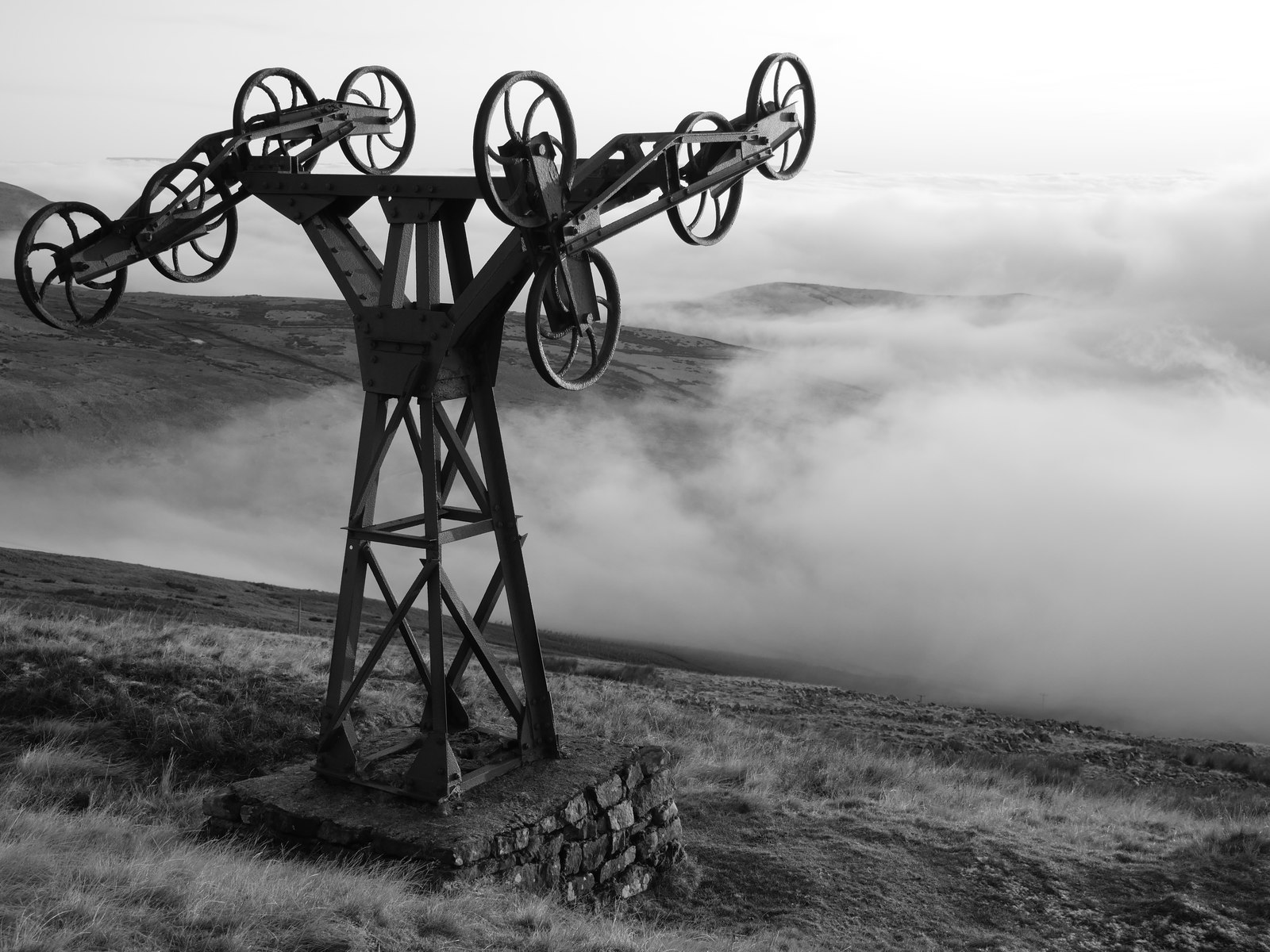
In Cumbria, ore from Coniston Copper Mines was carried by an aerial tramway — a rope suspended from stone pylons between the Paddy End Middle Shaft and the dressing floors at the Bonsor Mills — which the Lake District National Park Authority describes as having been the longest continuous winding rope in the country.
How it worked
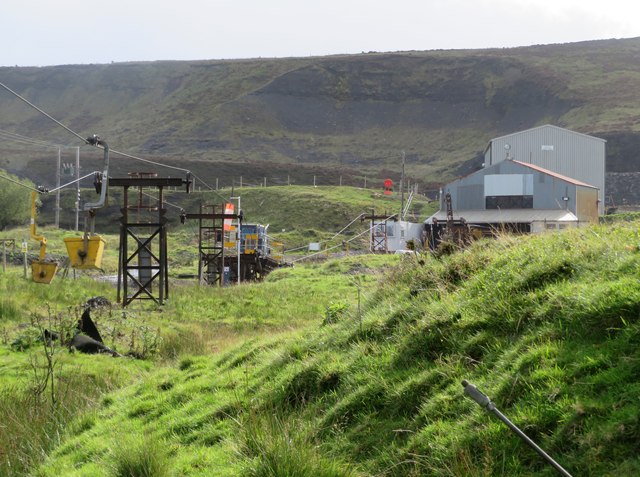
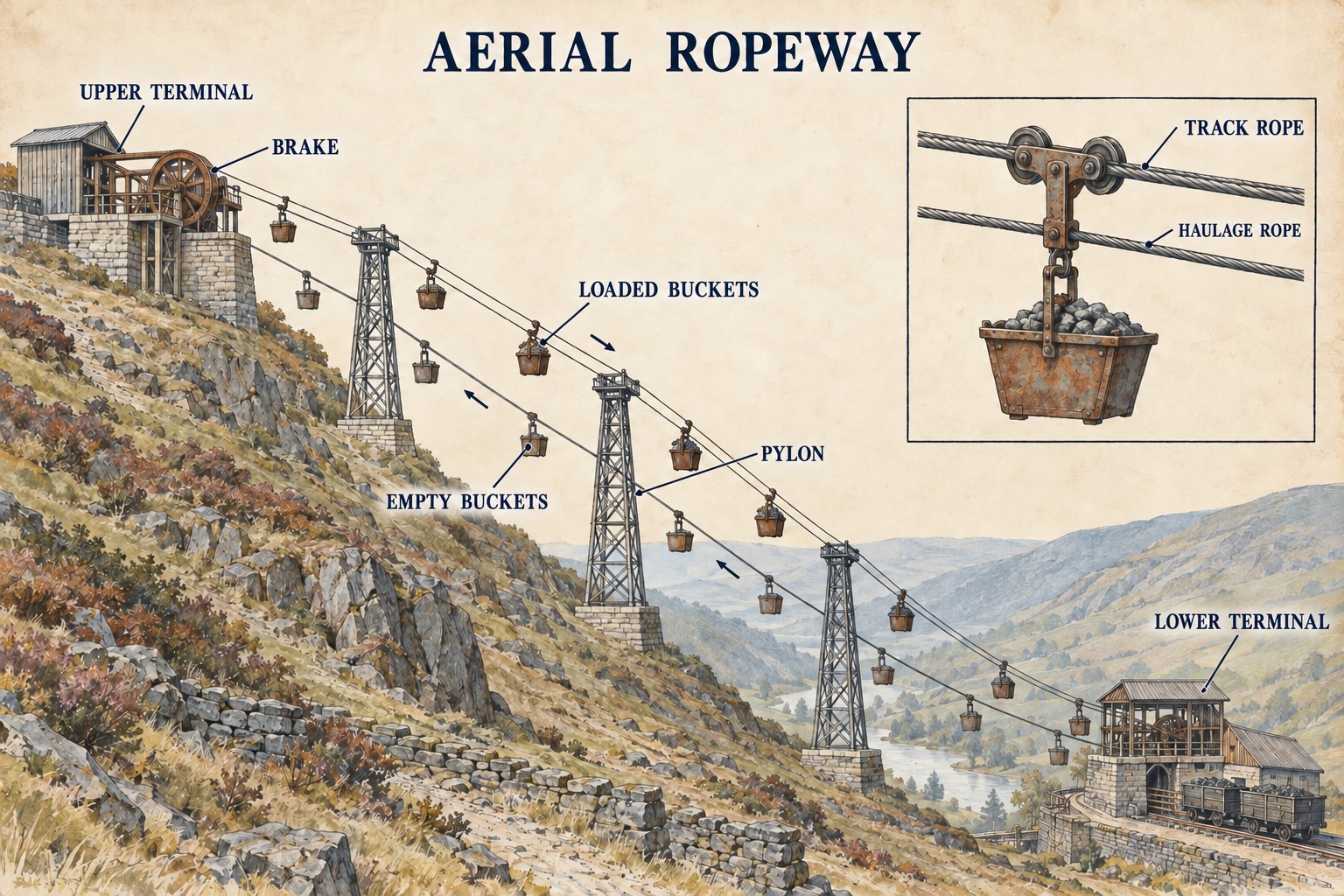
A monocable system runs a single continuous rope in a loop; the buckets clip on, ride round and are unclipped at the terminals. A bicable system runs the buckets on fixed track ropes with a separate moving haulage rope, which carries heavier loads over longer spans. Where the mine is above its destination the whole thing can be worked by gravity, the descending loaded buckets hauling the empties back up, with a brake at the top station governing the speed. The last such installation still working in Britain, built at Claughton in Lancashire in 1924, carries shale a mile and a quarter and 750 feet down to a brickworks: forty-odd buckets in circulation, about thirty-two minutes for a round trip, some 250 tonnes a day, and no power supply of any kind. Its bucket hangers grip the rope by gravity and friction alone, and are lifted off it at the terminals by a rising rail.
Why it was used
Cost and terrain. A ropeway crosses a valley, a bog, a river or a hillside in a straight line, needs only towers and a rope, and where the load runs downhill needs no fuel at all. Against the alternative of a road, an incline and a horse-drawn tramway, it was very often the only economic way to get a remote upland mine's output to market.
Risks & limitations
Ropeways were vulnerable to weather, and particularly to ice, which could form on a rope or in a bucket's mechanism and stop a system running or bring a bucket down. Ropes wear and need regular inspection, buckets spill, and a ropeway running above a public path is a permanent hazard. They were also inflexible — a ropeway serves exactly two points, and a change in where the ore had to go meant rebuilding it.
Regional variation
Aerial flight is common in the Lake District and Pennines. Ropeway or aerial ropeway is the general term; aerial tramway is the usual North American name for the same thing and turns up in engineering literature. A blondin is not a ropeway in this sense, and the distinction matters when reading site accounts: a blondin spans a quarry and lifts, a ropeway travels.
Related terminology
Mines associated with this term
5 examples chosen from 53 linked records — the term page is not an index.
- Alexandra Quarry — Gwynedd (well documented example)
Named twice in this record, first in the history: “…in 1888, a water-balanced shaft was working by 1893, and two Blondin aerial cableways were installed in 1901 with more added in 1909. In 1913 Alexandra…” - Britannia Copper Mine — Gwynedd (well documented example)
Named in this record’s workings: “…a Pelton wheel, with ore delivered to it from the workings above by aerial cableway. Getting the copper off the mountain shaped the landscape as much as…” - Pandora Mine — Conwy (well documented example)
Named in this record’s history: “…Stuart petrol locomotive and, over its final drop to the mill, by an aerial ropeway. Completed in 1900 and equipped with stone-breakers, Cornish rolls,…” - Alveley Colliery — Shropshire (well documented example)
Named twice in this record, first in the summary: “…by a rope-worked tramway on a purpose-built bridge, replaced by an aerial ropeway in 1961. It reached 300,000 tons a year and employed over 1,250 in…” - Ardenrigg Colliery — North Lanarkshire (well documented example)
Named 3 times in this record, first in the summary: “…1908 through a run of numbered pits to No. 6. Its coal went down an aerial ropeway to Stepends, where the dross made bricks, and it closed in June 1963.”
Disasters associated with this term
Included only where MineArchive's own research gives a reasonable evidential basis, with the nature of the relationship stated — not every disaster where this term might plausibly apply.
- Montagu View Pit disaster, 1925 (contextual relationship)
Named twice in this record, first in the narrative: “…them and two drivers to the main road. The water crossed the Irish ropeway and the travelling road into the lower workings. Lads on the ropeway…”
Sources
- (secondary) Aerial Ropeways of North Wales — hendrecoed.org.uk
- (secondary) Blondin (quarry equipment) — Wikipedia
- (secondary) Claughton Aerial Ropeway — Grace's Guide
- (secondary) Mining and processing the ore (History of Coniston Copper) — Lake District National Park Authority
Record created: 24 August 2026 · Last researched: 27 August 2026