 MineArchive
Manganese
| Category | Commodities |
|---|---|
| Commodity page | Manganese → |
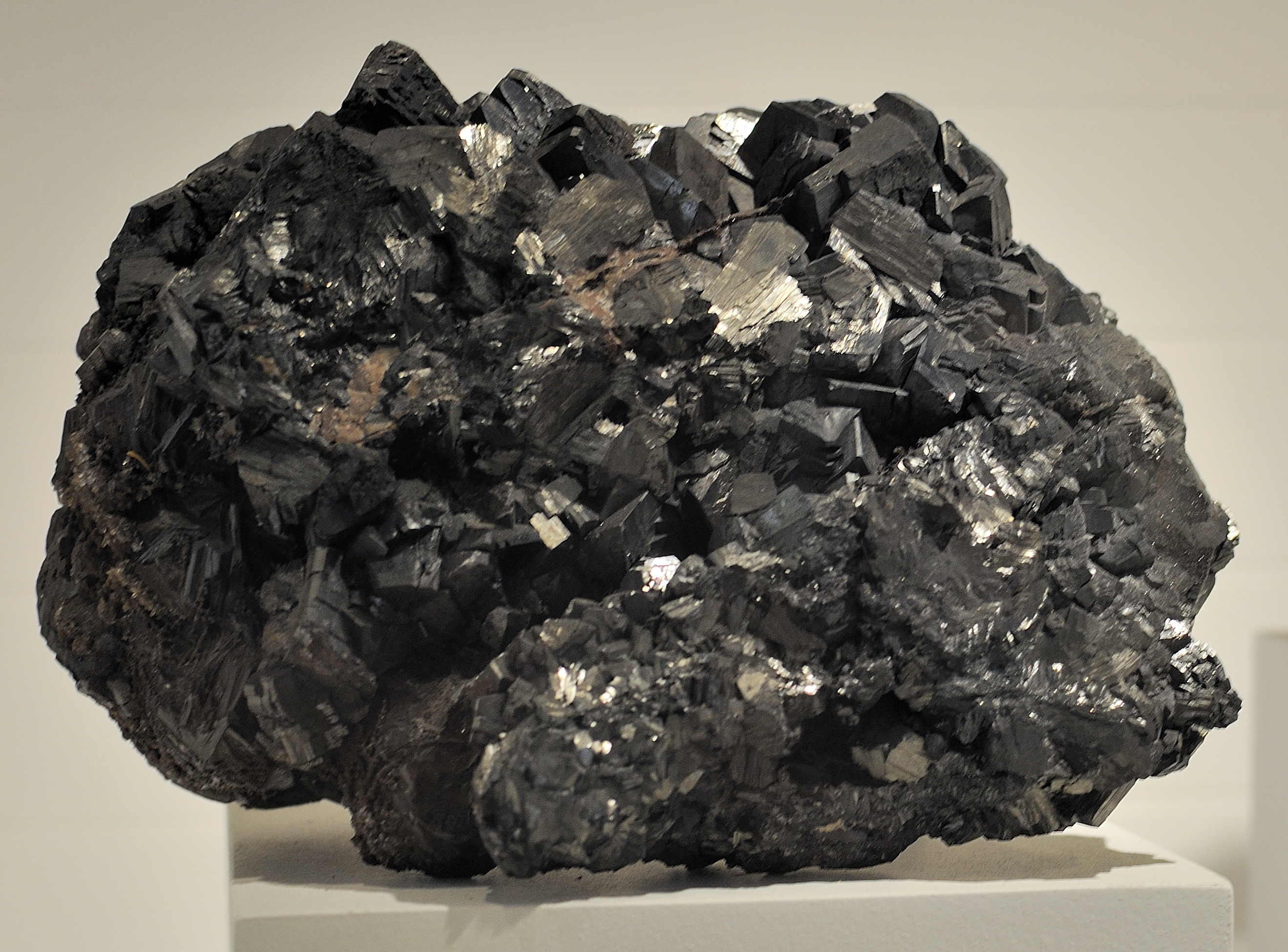
A hard, brittle metal (Mn) essential to modern steelmaking, added as ferromanganese or spiegeleisen to strip impurities from molten steel and strengthen the finished metal — a comparatively minor British industry whose entire commercial life was dictated by the rise and fall of demand from a single revolutionary technology, the Bessemer converter.
Historical usage
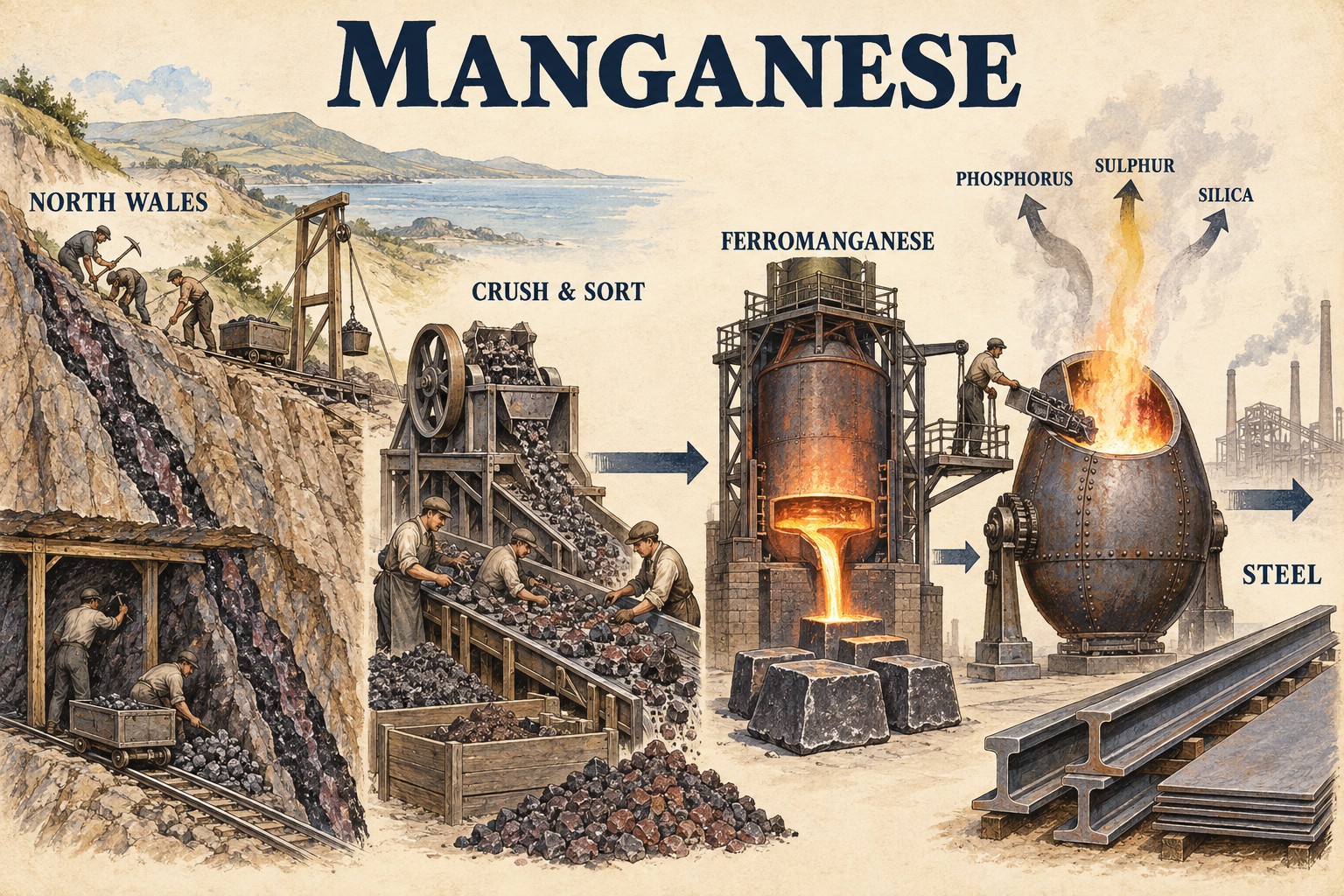
The earliest recorded British use of manganese ore was as a bleaching agent: from 1835, Welsh manganese was worked on a small scale for Glasgow's bleaching-powder trade, converting cotton-bleaching from a months-long process into one taking hours. That same Glasgow bleaching-powder industry gave the world its first documented case of manganese poisoning, when the physician James Couper identified severe neurological symptoms among manganese-handling employees of Charles Tennant and Co. in 1837 — decades before anyone connected the disease to occupational exposure more broadly. Real commercial demand for manganese only arrived with the Bessemer and open-hearth steelmaking processes developed from around 1870, which required manganese, as ferromanganese or spiegeleisen, to remove phosphorus, sulphur and silica from molten steel, at a rate of roughly 14 pounds for every ton produced. This transformed manganese from a curiosity into a strategic mineral: a dozen mines opened along a single manganese outcrop in Merioneth, north Wales, in 1886 alone, output from mines in Devon, Cornwall and Somerset also revived, and by the First World War manganese miners were being sought exemptions from military conscription because the mineral was considered essential to the war effort.
How it worked
Manganese ore was worked by whatever method suited its particular deposit — open opencast cutting where the ore lay near the surface, underground stoping where it ran deep or steeply, as at Hafotty in Merioneth — then crushed, hand-sorted and shipped to steelworks for smelting into ferromanganese or spiegeleisen alloy.
Why it was used
Manganese's chemical affinity for phosphorus, sulphur and silica let it strip these impurities out of molten steel during the Bessemer and open-hearth processes, without which the mass-produced steel that built the railways, ships and structures of the industrial age could not have been made to a reliable, predictable quality.
Value over time
Manganese had almost no commercial value in Britain before 1870: a brief flurry of interest in the 1830s, tied entirely to the Glasgow bleaching-powder trade, petered out within a few years once cheaper alternatives emerged. The Bessemer and open-hearth revolution in steelmaking changed that overnight from around 1870 onward, turning manganese into a genuinely strategic mineral almost by accident of chemistry — but British deposits were never rich or extensive enough to compete once the world's major manganese-producing regions were properly opened up, and by the 1890s the brief Welsh manganese boom was already over. Wartime strategic anxiety briefly revived interest twice more, in the First World War and again in planning documents drawn up during the Second, but neither led to sustained large-scale British production again.
Hazards & challenges
Chronic exposure to manganese dust and fume causes manganism, a severe and often irreversible neurological condition resembling Parkinson's disease, first identified as an occupational illness in 1837 among Glasgow bleaching-powder workers handling manganese ore — making manganese one of the very few British minerals whose principal industrial health hazard was documented before the mineral had found its major industrial use.
Risks & limitations
British manganese deposits were almost always thin, steeply dipping and difficult to work compared with the huge, shallow overseas deposits later developed in Russia, India, Brazil and South Africa, meaning the domestic industry could only ever compete during the brief window before cheap imported ore reached the market in volume — by the 1890s, most British mines, including Hafotty, had already closed.
Regional variation
Small manganese mining districts developed in Merioneth and Caernarfonshire in north Wales, the largest concentration in Britain, alongside more minor 18th- and 19th-century workings in Devon, Cornwall and Somerset; none ever approached the scale of the deposits later developed overseas.
Related terminology
Mines associated with this term
5 examples chosen from 8 linked records — the term page is not an index.
- Bampfylde Mine — Devon (well documented example)
Named 4 times in this record, first in the summary: “A copper (later also iron and manganese) mine on the River Mole near North Molton, worked intermittently…” - Benallt Mine — Gwynedd (well documented example)
Britain's most productive manganese ground, worked in fits and starts from 1886 and requisitioned in 1941 when the Atlantic convoys stopped bringing ore in. - Clive Mine — Shropshire (well documented example)
Named in this record’s workings: “…sections that still show candle-soot marks. Copper, cobalt, manganese and iron minerals stain the vein walls in distinctive coloured…” - Dry Gill Mine — Cumbria (well documented example)
Named 3 times in this record, first in the history: “…and the site was the first British locality for the lead manganese oxide coronadite. The finest material was taken in the nineteenth…” - Hafotty Manganese Mine — Gwynedd (well documented example)
The largest of Merioneth's manganese mines, opened in 1885 to meet Bessemer-era steelmaking demand.
See every mine that worked manganese →
Sources
- (primary) Diagnosis of manganism and manganese neurotoxicity: A workshop report — PMC / NIH
- (secondary) Manganism — Wikipedia
- (secondary) Merioneth Manganese: History — Hendrecoed North Wales Mining History
- (secondary) Uses of manganese — Hendrecoed North Wales Mining History
Record created: 22 August 2026 · Last researched: 22 August 2026