 MineArchive
Alveley Colliery
| Also known as | Highley Colliery (Alveley shaft) |
|---|---|
| Location | Alveley, east of the River Severn, near Highley, Shropshire — 52.4510, -2.3730 (approximate) |
| Commodity | Coal |
| Type | Coal |
| Worked | 1935 (production 1938)–31 January 1969 |
| Maximum depth | 360 yards |
| Operators | Highley Mining Company (1935–1947), National Coal Board (1947–1969) |
Overview
The second half of one colliery. The Highley Mining Company had followed its coal east under the River Severn, so in 1935 it sank a new 360-yard shaft on the Alveley bank to meet those workings; they joined in 1937 and production began in 1938. Everything then came up here, and went back across the river by a rope-worked tramway on a purpose-built bridge, replaced by an aerial ropeway in 1961. It reached 300,000 tons a year and employed over 1,250 in the mid-1950s. Declining coal quality in a market already oversupplied closed it on 31 January 1969; its site is now Severn Valley Country Park.
History
The shaft at Alveley was sunk in 1935 to a depth of 360 yards by the Highley Mining Company, to connect with workings driven from its Highley shaft which had by then passed under the river. Initial work was completed in 1937 and production began in 1938. The new shaft replaced the old one, which closed in 1939, with all production brought to the surface at Alveley — although the Highley shaft was kept for ventilation and as an emergency evacuation route. Because the two were one enterprise, the Alveley pit was generally known as Highley Colliery. The workings were very modern for their date, making full use of electrical power, including completely mechanical working of the coal face. Output was consistent: full production of 275,000 tons was reached in 1944, with a record of 5,547 tons in a single week that year, and a peak of 300,000 tons a year in the late 1950s. The colliery passed to the National Coal Board at nationalisation in 1947, when it employed 741; that rose to over 1,250 by the mid-1950s and fell back to about 700 by the end. Large reserves found to the east prompted a major expansion completed in 1962, said at the time to be enough for another fifty to a hundred years. It was not to be: a drop in coal quality, coming at a time of national over-supply, closed the colliery in 1969. The last coal was lifted on 31 January.
Geology
The Wyre Forest Coalfield, on the east bank of the Severn where the seams the Highley shaft had followed continue. Reserves found east of the workings in the late 1950s were large enough to justify a major expansion, completed in 1962; what defeated the colliery was not the quantity of the coal but its quality.
Workings
A single 360-yard shaft, sunk 1935 and connected to the older Highley workings under the river by 1937. The faces were fully mechanised and electrically powered from the start, unusual for a British pit of the late 1930s. Coal was taken back across the Severn by a rope-worked tramway on a bridge built to serve the mine, replaced in 1961 by an aerial ropeway, to reach the washeries and the sidings on the Highley bank — the sidings site now being the Severn Valley Railway’s Country Park Halt.
Closure
A major expansion had been completed only seven years earlier, on the strength of eastern reserves reckoned to hold fifty to a hundred years of coal. A drop in the quality of that coal, combined with a national over-supply, closed the pit instead. The last coal was lifted on 31 January 1969, leaving high unemployment and a ravaged landscape.
What remains
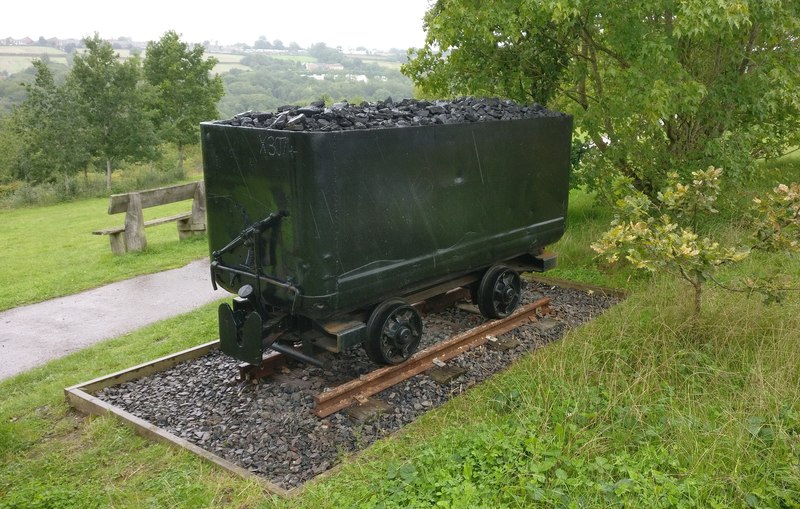
The colliery site lay derelict until an industrial estate was built and, from 1986, a landscape reclamation scheme turned the pit ground and spoil tips into Severn Valley Country Park, which opened in 1992. A preserved colliery wagon stands in the park. The 1930s bridge across the Severn was replaced in 2006 by a new footbridge linking Alveley to the Country Park Halt on the far bank. In 2017 the Alveley Mining Heritage Group was formed to preserve and present the village’s mining memory.
A preserved colliery wagon in the country park; the alignment of the tramway and the crossing of the Severn, now carried by a 2006 footbridge; and the former washery and sidings ground on the Highley bank, now Country Park Halt.
Related mines
- Highley Colliery — One mine in two halves. Highley’s workings ran east under the River Severn; the Alveley shaft was sunk in 1935 to meet them, the two joined underground in 1937, and men and equipment were transferred across. Highley’s shaft then served only for ventilation and escape.
Nearby mines
- Highley Colliery — 0.5 miles (0.8 km) SW
- Kinlet Colliery — 1.7 miles (2.8 km) S
- Billingsley Colliery — 2.1 miles (3.4 km) W
- Bayton Colliery — 7.5 miles (12.1 km) SW, Worcestershire
- Mamble Colliery — 8.6 miles (13.9 km) SW, Worcestershire
Straight-line distance, within 9 miles (15 km). Show on the map.
Recorded claims
Individual factual claims, each attached to the source(s) that support it below. Where sources disagree, both are kept.
- The shaft at Alveley was sunk in 1935 to a depth of 360 yards by the Highley Mining Company, and was connected with their workings from the Highley shaft, which had proceeded under the river by this point. Initial work was completed in 1937 and production started in 1938. 1
- The workings were very modern, with full use being made of electrical power, including completely mechanical working of the coal face. 1
- Coal was brought across the river by a rope-worked tramway on a bridge built to serve the mine, which was replaced with an aerial ropeway in 1961; this served the washeries and sidings, the latter now the location of the Country Park Halt. 1
- Full output was reached in 1944 with 275,000 tons raised, that year’s record week being 5,547 tons, and a peak of 300,000 tons a year was reached in the late 1950s. Employment was 741 at nationalisation in 1947, rose to over 1,250 in the mid-1950s and fell to around 700 by closure. 1
- A major expansion completed in 1962 followed the discovery of large reserves to the east, purported to be enough to last between 50 and 100 years; but a drop in the quality of the coal combined with a reduction in demand due to national over-supply forced closure in 1969, the last coal being lifted on 31 January. 1,2
- An industrial estate was built after the mine closed, and from 1986 a landscape reclamation scheme turned the disused colliery and spoil tips into Severn Valley Country Park, which opened in 1992. In 2006 a new footbridge linking Alveley and Highley replaced the unsafe 1930s bridge, and in 2017 the community-led Alveley Mining Heritage Group was formed. 2
Photographs & further reading
The village article’s "Coal mining and country park" section: the 1935 shaft, the transfer of coal across the river, the closure and its effect on the village, and the reclamation that produced the country park.
View sourceSources
- (secondary) Collieries served by the Severn Valley Railway — SVR Wiki, Severn Valley Railway
- (secondary) Alveley — Wikipedia
- (primary) BGS mine plans catalogue: Highley — British Geological Survey
- (secondary) Highley — Wikipedia
Record created: 7 September 2026 · Last researched: 7 September 2026