 MineArchive
Billingsley Colliery
| Location | Billingsley, near Bridgnorth, Shropshire — 52.4560, -2.4230 (approximate) |
|---|---|
| Commodities | Coal, Ironstone |
| Type | Coal |
| Worked | 1794–September 1921 |
| Maximum depth | Unknown. Coal in the Wyre Forest coalfield has been mined from outcrop to about 900 ft. |
| Operators | Severn Valley Colliery Company (1870–1890), Billingsley Colliery Company (1910–1915), Highley Mining Company (1915–1921) |
Overview
A colliery in the Wyre Forest coalfield two miles west of Highley, worked in fits and starts from the late eighteenth century and never successfully. Coal and ironstone were being mined at Billingsley in the eighteenth century, and in the mid-1790s the estate passed to Sir William Pulteney, MP for Shrewsbury, who was interested in its minerals; the venture struggled, one of his associates fled the country in 1802 for fear of his creditors, and the bankruptcy of George Stokes in 1811 ended the phase. Mining restarted in 1870 and the 1880 list of collieries at work returns the pit under the Severn Valley Colliery Company. A new Billingsley Colliery Company bought it in 1910 and built a railway to reach the Severn Valley line; the colliery was sold to the Highley Mining Company in 1915, employed about 250 by 1921, and closed during the miners’ strike of that year.
History
Billingsley was an agricultural parish with ironworking in it: the woods were being used for charcoal in the seventeenth century, and coal and ironstone were mined in the eighteenth. The first substantial venture came when the estate changed hands in the mid-1790s to Sir William Pulteney, MP for Shrewsbury, who held estates across the country and was particularly interested in exploiting the minerals here. The owners bought land at New England, down in the Borle Brook valley towards Highley, when the mines first started working in 1794, and about 1807 built a settlement of some sixteen cottages there for the workforce — a twenty-minute uphill walk to the pit each day. Coal mines and a blast furnace were at work in the fields near the Cape of Good Hope, and a horse-worked tramway carried their products down the Borle Brook to the Severn at Highley. The industry quadrupled the parish’s population.
It did not last. The colliery struggled; in 1802 MacNab, one of Pulteney’s associates, fled the country for fear of his creditors; and in 1811 the bankruptcy of George Stokes ended the industrial period. The mines closed in 1812 and most of the New England cottages stood empty. A brickworks opened in the parish in the late 1860s and ran until the First World War, and in 1870 mining started again at Billingsley — nine families were living at New England the following year. The official list of collieries at work in 1880 returns the pit as "Billingsley, Bridgenorth, Severn Valley Colliery Co."
The last attempt was the most serious. A number of companies had successively failed to make a go of the venture when, in 1910, the Billingsley Colliery Company was formed to buy the colliery; the Wellington Journal reported that the new company was about to lay down a railway to connect its mineral property with the Severn Valley line at Eardington. In the event the line joined the existing Kinlet Railway and reached the Severn Valley Railway through the same sidings as Kinlet Colliery, opening in 1913. Some housing was built for miners here, though most were housed at Highley. In 1915 the colliery was sold to the Highley Mining Company. Government control during the First World War improved wages, hours and safety; Lloyd George’s decision to return the mines to their owners in 1921, with the likely reversal of those gains, brought on the national strike, and Billingsley closed during it in September that year with about 250 on the books. The railway ran on until 1937, serving a coal wharf at Priors Moor.
Geology
The Wyre Forest coalfield runs about eighteen miles north to south and is up to six miles wide, from Harpswood south-west of Bridgnorth down to Abberley south-west of Kidderminster. Coal has been mined in it from surface outcrops down to about 900 feet — shallow by the standards of the great coalfields, and part of why the field’s collieries were small and its ventures fragile. Ironstone occurs with the coal at Billingsley, which is why a blast furnace stood here in the same fields.
Geological setting: Sedimentary Beds and Seams (well documented example)
Workings
What is best recorded is the transport rather than the pit. The early workings sent coal and iron down a horse-worked tramway along the Borle Brook to the Severn at Highley. The 1910 company’s railway was intended to run to the Severn Valley line at Eardington but was built instead to join the existing Kinlet Railway, sharing Kinlet Colliery’s sidings on the Severn Valley Railway; it opened in 1913, sixteen years before the colliery it was built for closed, and outlived it by another sixteen, running until 1937 to serve a coal wharf at Priors Moor.
Closure
Billingsley closed during the national miners’ strike of 1921, which followed Lloyd George’s decision to return the mines to their original owners and with it the likely loss of the wages, hours and safety improvements made under wartime government control. About 250 people were employed there at the time. It was the last of at least four attempts to work coal at Billingsley profitably, none of which succeeded.
What remains
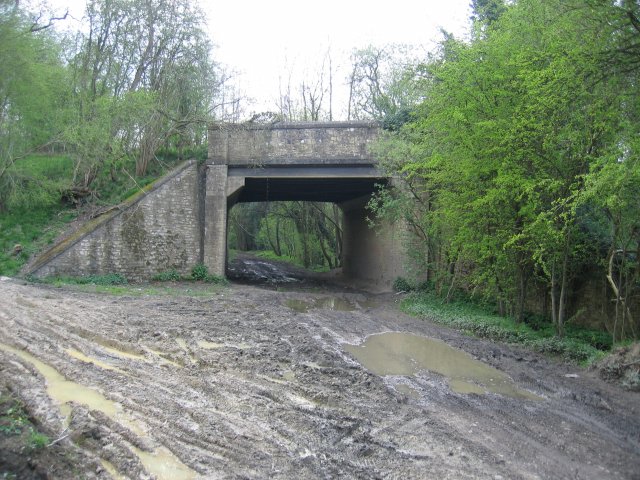
Farmland and woodland. New England, the miners’ settlement in the Borle Brook valley, is a quiet isolated spot where the foundations of a row of eleven stone cottages can be made out in the undergrowth beside the road — almost all that is left of it. The trackbed of the colliery railway survives as an earthwork, crossed at Kinlet by the bridge carrying the Highley road.
The foundations of the New England cottages in the undergrowth by the roadside, and the trackbed of the abandoned colliery railway with its road bridge at Kinlet.
Related mines
- Kinlet Colliery — The Billingsley Colliery Company’s railway, laid after 1910, joined the existing Kinlet Railway and reached the Severn Valley line through the same sidings; in 1915 Billingsley was sold to the Highley Mining Company, which already owned Kinlet.
Nearby mines
- Highley Colliery — 1.8 miles (3.0 km) E
- Alveley Colliery — 2.1 miles (3.4 km) E
- Kinlet Colliery — 2.6 miles (4.3 km) SE
- Catherton Colliery — 7.1 miles (11.4 km) SW
- Bayton Colliery — 7.2 miles (11.6 km) S, Worcestershire
Straight-line distance, within 9 miles (15 km). Show on the map.
Recorded claims
Individual factual claims, each attached to the source(s) that support it below. Where sources disagree, both are kept.
- The official list of collieries at work in 1880 returns the pit as "Billingsley, Bridgenorth, Severn Valley Colliery Co." 1
- The estate passed in the mid-1790s to Sir William Pulteney, MP for Shrewsbury, who was particularly interested in exploiting its mineral reserves; the colliery struggled, MacNab — one of Pulteney’s associates — fled the country in 1802 for fear of his creditors, and the bankruptcy of George Stokes in 1811 ended Billingsley’s industrial period. 2
- The colliery owners bought land at New England when the mines first started working in 1794 and probably built about sixteen cottages there in 1807; when the mines closed in 1812 most stood empty, and by 1851 the census enumerator recorded only five dwellings occupied and five empty. 3
- The Billingsley Colliery Company was formed in 1910 to buy the colliery, and the Wellington Journal reported that it was about to lay a railway to connect its mineral property with the Severn Valley line at Eardington; in the event the route joined the existing Kinlet Railway and reached the Severn Valley Railway through Kinlet Colliery’s sidings. 4
- The colliery was sold to the Highley Mining Company in 1915, employed around 250 people by 1921, and closed during the miners’ strike of that year; the railway remained in use until 1937, serving a coal wharf at Priors Moor. 4
- Mining started again at Billingsley in 1870, and nine families were living in the New England cottages the following year. 3
Photographs & further reading
An account of the four Wyre Forest collieries the railway served — Highley, Alveley, Kinlet and Billingsley — with the formation of the 1910 Billingsley company, the railway it built and where that line actually went.
View sourceThe story of the miners’ settlement in the Borle Brook valley that the Billingsley owners built about 1807, traced through the censuses from sixteen cottages to five occupied dwellings and back again, and what can still be found of it in the undergrowth.
View sourceSources
- (secondary) List of coal mines UK 1880 — Coalmining History Resource Centre
- (secondary) Billingsley, Shropshire — Wikipedia
- (secondary) New England — Highley — Highley Local History Group
- (secondary) Collieries served by the Severn Valley Railway — SVR Wiki, Severn Valley Railway
Record created: 6 September 2026 · Last researched: 6 September 2026